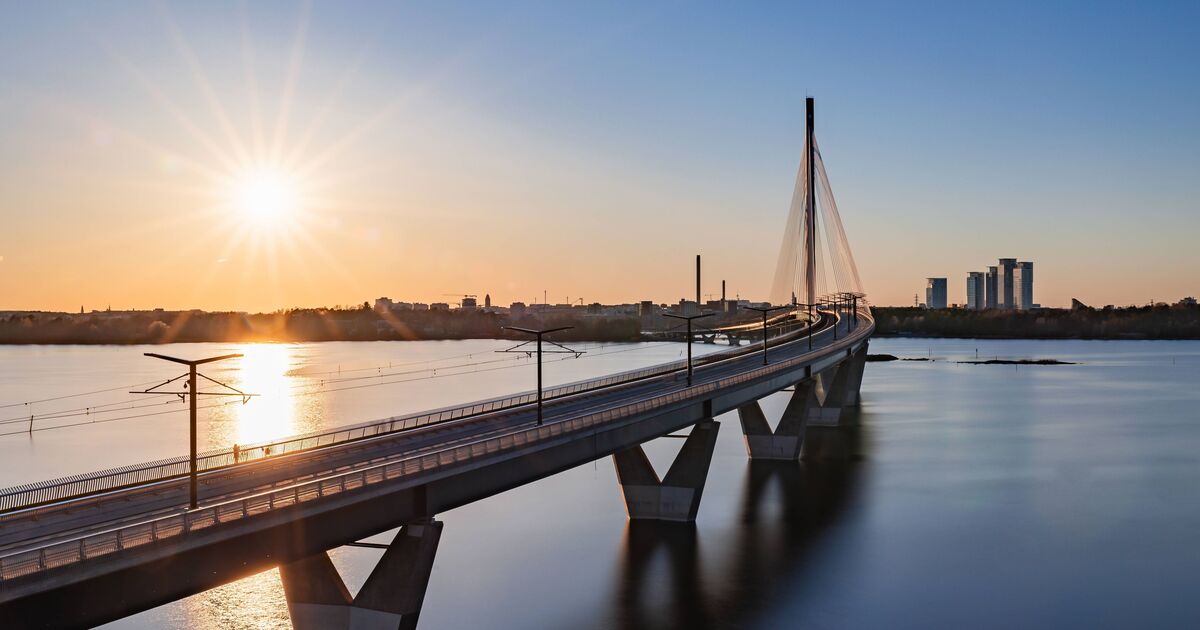
A gigantic pedestrian bridge has opened in a European capital (Image: ArtBBNV/Shutterstock)
A colossal bridge linking two islands has finally opened its doors – and not a single car is in sight. The mammoth 1,200-metre (4,000ft) structure is widely believed to be the longest pedestrian bridge on the planet.
Located near the Finnish capital of Helsinki – just a three-hour flight from London – the bridge connects the islands of Laajasalo and Korkeasaari, while also holding the title of Finland’s longest and tallest bridge.
As part of a commitment to sustainability, the enormous structure is the “world’s longest bridge dedicated exclusively to trams, pedestrians and cyclists,” according to a spokesperson for designers Knight Architects.
“Unusually for a structure of this scale, Kruunuvuori Bridge prioritises sustainable movement having been conceived exclusively for trams, pedestrians and cyclists,” the firm said. “This fundamental decision redefines the role of the bridge from a piece of transport infrastructure to a civic space in its own right.”
The €150m (£126m) Kruunuvuori bridge is one of six being constructed as part of a £505m project that will extend the tram network approximately six miles from the city centre to Laajasalo, where a significant new housing development is currently being built.

The Kruunuvuorensilta bridge takes around 15 minutes to cross by foot (Image: ArtBBNV/Shutterstock)
The average person would take roughly 15 minutes to cross the bridge on foot. “As the longest and tallest bridge in Finland, its central diamond is a major new addition to Helsinki’s skyline,” architect Tom Osborne told Newsweek. “The bridge is a vital link to a new community and a catalyst for sustainable growth.” The bridge’s width ranges from 49 feet to 62 feet – with the broadest sections located around the pylon – boasting a 65-foot maximum clearance.
The bridge is not only enormous, but its anticipated lifespan far exceeds that of comparable structures. “120 years would be a typical design life for bridges of this scale,” Tom said, assuring that the Kruunuvuori Bridge should last for approximately 200 years.
“It is a big bridge and therefore a big investment. But taking a 200-year position on the returns of that investment – in both financial and climate terms – shows that big projects need to be paired with a long-term view.”

Kruunuvuori bridge will link the islands to the Finnish capital (Image: HELSINKI MAP SERVICE)
Osborne told New Civil Engineer that there was sound reasoning behind constructing such a towering structure in what is generally quite a low-lying city: “Building something that is quite tall and distinctive was perhaps not the obvious thing but there was a good reason. Having a central tower allowed the skyline at deck level to be much less cluttered than having many smaller towers.”
He added: “The water gets quite deep on either side of the tower, and so having smaller spans would have been more expensive.”
The architects have been required to factor in the harsh Finnish winters when designing the extensive chain of bridges. In a press release, Knight Architects explained that the bridge’s stay cables are “designed to remain in constant slight motion” whenever the wind blows – helping prevent ice buildup. The cables are encased in a textured plastic coating that cause ice to break into fine particles rather than forming into large icicles.

Kruunuvuori bridge under construction in 2023 (Image: Shutterstock / TRIPMOOD365)
The bridge will additionally feature an advanced wind warning system, whereby electronic signs at either end will display alerts whenever powerful gusts are detected.
Osborne added that he hopes the bridge will be the first of a new generation of structures that are built with an eye to the future: “Over the next 200 years, I hope this diamond becomes not only a symbol of its place, but a symbol of a shift towards more sustainable ways of living,” he said.