Abuja Original Inhabitants (AOIs) and stakeholders have renewed calls for the Federal Capital Territory (FCT) to operate a full state governance structure, arguing that the current arrangement denies indigenous residents adequate political representation and identity.
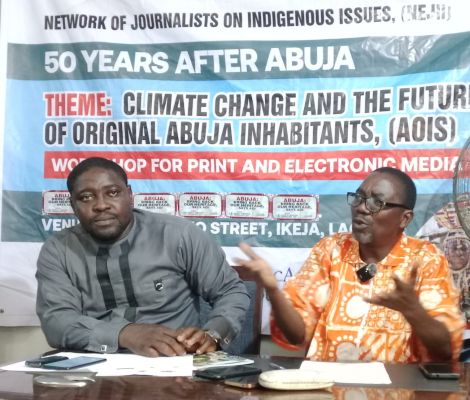
The demand was made during a media parley on the social, economic and environmental rights of Abuja Original Inhabitants held in Lagos on Wednesday.
The media parley was organised by the Network of Journalists on Indigenous Issues (NEJII) to engage media stakeholders on the rights of Abuja Original Inhabitants as political activities ahead of the 2027 elections begin to gather momentum.
It was organised in collaboration with the Resource Centre for Human Rights and Civic Education (CHRICED), with support from the MacArthur Foundation.
Speaking at the workshop, NEJII Coordinator, Adewale Adeoye, emphasized that the political representation of Abuja Original Inhabitants in the context of the wider need of a democratic sub-national, which will allow them cater for their social and economic interests remain a fundamental question.
According to him, it remains an anomaly that while other Nigerians have the right to vote and elect Governors and members of the State Houses of Assembly, Abuja Original Inhabitants are denied this same right.
“Added to this is the imbalance in the number of legislative seats provided for the indigenous peoples in the FCT.
“As it stands, FCT remains in the incongruous and unacceptable situation of having only one Senate seat and two House of Reps seats, while other States, even those with less population than the FCT have three Senate seats and scores of House of Representatives seats.
“Subsequently, the Abuja Original Inhabitants need sincere and far-reaching constitutional and legal reforms,” Adeoye said.
Participants at the event said the indigenous communities of Abuja have continued to face challenges decades after the creation of the Federal Capital Territory in 1976, when ancestral lands were acquired for the development of the nation’s capital.
The AOIs comprise communities including the Gbayi, Bassa, Gwandara, Koro, Dibo, Gade, Ebira, Angwama and Nupe peoples.
Speakers noted that many families were displaced from their ancestral settlements following the creation of the FCT.
A key focus of the discussion was the need for a governance structure similar to those enjoyed by Nigeria’s 36 states.
Speaking at the event, Fabian Anawo argued that the solution was not merely the creation of a state in name but the establishment of a complete governance framework.
He said: “It’s not just to advocate for a state, it’s a state with a full structure. It will have the full complements of governance. Because that will begin to restore to them who they are.”
According to him, indigenous residents currently lack the level of representation available to citizens in other states.
Anawo said: “If they become a state today, they’ll have three senators. They’ll have like seven members of House of Representatives. They’ll have their own state assembly to make laws that will govern them appropriately as they wish. That identity has been taken away from them.”
Participants also highlighted concerns over cultural preservation, language loss, political identity and economic opportunities available to indigenous communities.
During group discussions, speakers stressed the importance of documenting the history, culture and challenges of Abuja’s original inhabitants through sustained media coverage.
They argued that greater public awareness could influence policy decisions, attract support for cultural preservation and promote social justice for affected communities.
Anawo also urged journalists covering indigenous issues to prioritise informed consent, avoid stereotypes and ensure indigenous voices remain at the centre of reporting.
He said coverage should help audiences understand indigenous communities as “contemporary communities with agency, expertise, and diverse perspectives, rather than only as subjects of historical or crisis-focused coverage.”