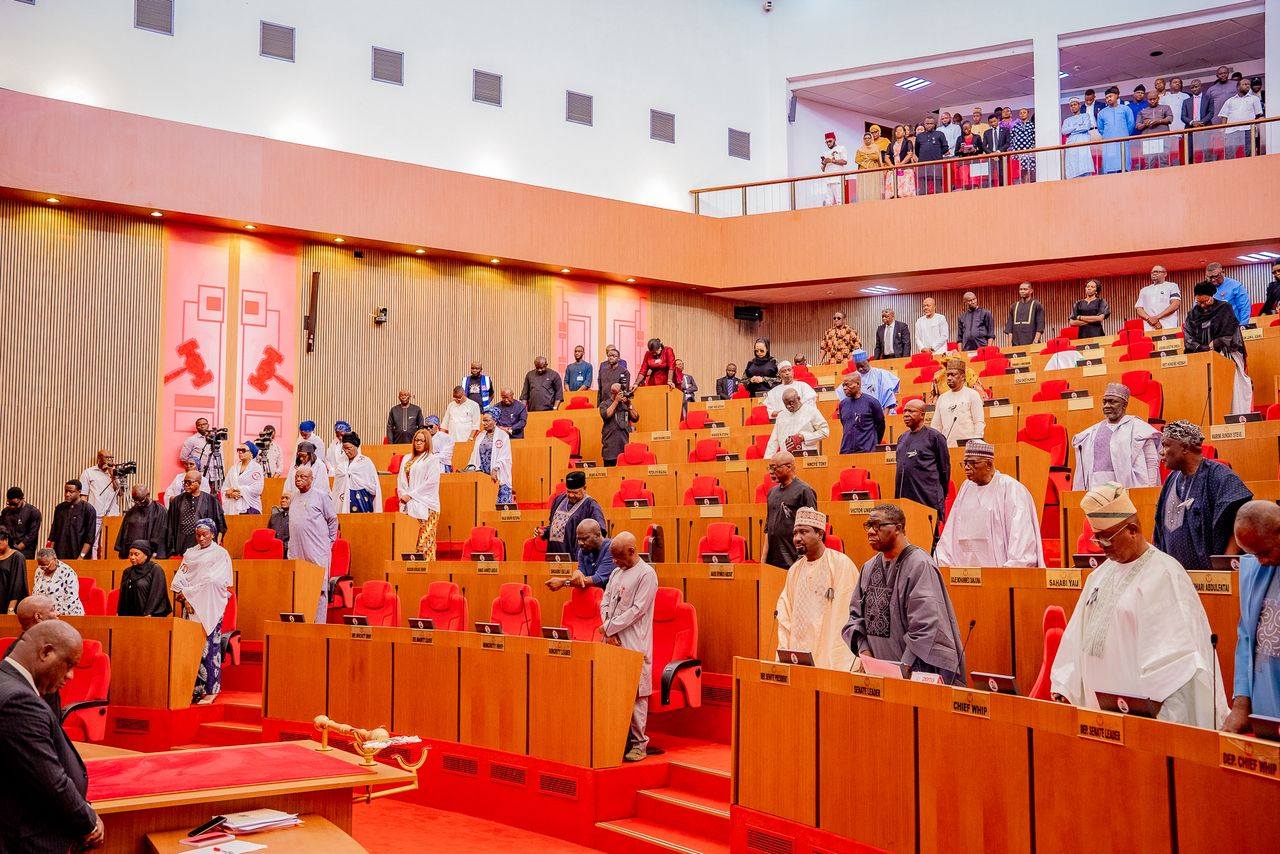
The Nigerian Senate, a chamber intended to be the sanctuary of democratic deliberation and the ultimate safeguard against executive overreach, has been reduced to a mere shadow of its constitutional purpose.
Over the past year, the institution has been unceremoniously railroaded into infamy. Under the questionable stewardship of Senate President Godswill Akpabio, the red chamber has ceased to be a place of debate, becoming instead a rubber-stamp appendage of the executive branch.
In this climate of forced compliance, Senator Adams Oshiomhole has emerged not just as a critic, but as the last firewall of legislative conscience. While the rest of the chamber falls into line, silenced by either complicity or fear, Oshiomhole’s insistence on procedural integrity has exposed the rot at the core of the 10th Senate’s leadership.
The Death of Deliberation: A Rubber-Stamp Factory
The most damning indictment of the current Senate is the near-total abandonment of its oversight function. Traditionally, the Senate is the arena where national policy, particularly fiscal policy, is interrogated. Yet, under Akpabio, the legislative process has been reduced to a performative pantomime.
We are witnessing an era where national budgets are approved with haste, and President Tinubu’s relentless appetite for loans—often presented with little more than a request for immediate approval—is met with a disturbing, robotic “Aye have it.” There is no questioning of the debt ceiling; no analysis of the potential for long-term economic strangulation; no debate on the viability of the projects those loans are meant to fund.
The Senate President has facilitated a culture where questioning is treated as an act of treason against the leadership. When the legislative body abdicates its responsibility to scrutinize the purse, it abdicates its responsibility to the people. This is not governance; it is complicity.
The Vulgarity of the Rube
Perhaps more damaging than the institutional failure is the sheer lack of dignity brought to the office of the Senate President. Akpabio’s tenure has been punctuated by outbursts and statements that are, frankly, beneath the office he occupies.
Who can forget the infamous “holiday allowance” debacle? As Nigerians grappled with a cost-of-living crisis of historic proportions, Akpabio casually announced that “tokens” had been sent to senators’ accounts to ensure they “enjoyed” their vacation.
When the resulting national outrage became too loud to ignore, his attempt to backtrack—claiming he had sent “prayers” to their emails instead—was not just pathetic; it was an insulting display of cynical humor at the expense of a suffering citizenry.
This is the hallmark of a leader who views the public as gullible and the Senate as his private fiefdom. His dismissive attitude toward the economic plight of Nigerians—clashing violently with his performative, empty exhortations of “Let the poor breathe”—has cemented his status as the embodiment of the disconnect between the ruling class and the governed.
The Judiciary, Nepotism, and the Sanitization of Fraud
The questions surrounding Akpabio’s legitimacy begin at the very start of his journey to the Senate Presidency. His failure to secure a mandate in the APC primary was an open secret, yet he was propelled to his position through a series of legal maneuvers and judicial rulings that many observers labeled as a sanitization of electoral reality.
This history of judicial intervention seems to have colored his leadership style: it is authoritative, intolerant of dissent, and deeply transactional. Consider the allegations of nepotism that have begun to surface, most notably the reports regarding the employment of his daughter at the NNPC.
In a system where public office should be a trust, the perception—or reality—that the Senate President is using his leverage to secure private professional gains for his kin is toxic. It suggests a chamber run on personal favors rather than public merit.
The Oshiomhole Crucible: Why the Senate President Fears Dissent
The ongoing friction between Godswill Akpabio and Senator Adams Oshiomhole is the most telling narrative of this legislative session. Akpabio’s visible, and at times visceral, discomfort with Oshiomhole reveals a man who is profoundly insecure.
Oshiomhole, a former labor leader and governor, is not a man easily intimidated by the theatrics of a loquacious Senate President. When Oshiomhole raises a point of order, he is demanding adherence to the rules. When Akpabio reacts by threatening to “lock him out,” he is revealing his true colors: he is not a consensus builder; he is a foreman who expects the floor to be silent.
The Natasha Saga—the controversial suspension of Senator Natasha Akpoti-Uduaghan—was the turning point. It was a clear abuse of power, a punishment for independence. Oshiomhole’s subsequent demand for a probe into the alleged forgery of signatures to support that suspension was not just a procedural challenge; it was a strike at the very legitimacy of the leadership. If the rules of the Senate can be bent, or signatures forged to achieve an outcome, then the law has no meaning in that chamber.
Security and the Theology of Deflection
The country is currently enduring a security crisis of unprecedented proportions, yet the Senate’s primary response under Akpabio has been to suggest more prayer. While faith has its place, it is not a legislative policy.
To offer “prayers” as the primary solution to banditry, kidnapping, and the collapse of internal security is an abdication of duty. The Senate possesses the power to summon, to audit, to reform, and to mandate action from the security services.
By choosing to hide behind theological platitudes, Akpabio is attempting to deflect the public’s gaze from the Senate’s failure to hold the executive’s security apparatus accountable. It is a classic move from the playbook of the nescient leader: when you cannot provide solutions, offer distraction.
The Path to Infamy
History will not be kind to this chapter of the Nigerian Senate. We are witnessing the systematic destruction of the separation of powers. The 10th Senate, under Akpabio, has effectively been neutered. By barring new lawmakers from leadership races through self-serving amendments to the Standing Rules, and by creating an environment where dissenters are targeted, suspended, or sidelined, the leadership is entrenching a culture of mediocrity.
If a Senate cannot debate, if it cannot disagree, and if it cannot question, then it is merely a theater. Godswill Akpabio has transformed the Senate into his own personal plaything, where his whims are the laws and his preferences are the agenda. His inability to lead through consensus, his reliance on intimidation, and his blatant disregard for the optics of public suffering have alienated even those who once viewed him as a potential statesman.
The contrast with Senator Oshiomhole is stark. Oshiomhole represents the necessary friction that keeps a democracy from sliding into autocracy. By standing firm against the tide of rubber-stamp politics, he has become a symbol of the struggle to reclaim the Senate from those who would see it subjugated to the will of one man.
A Call for Accountability
The Nigerian public is watching. The era of the rube in the high seat is reaching a tipping point. Every time Akpabio stifles a debate, every time he mocks the economic reality of the people, and every time he uses the machinery of the Senate to silence a peer, he chips away at the foundation of our democracy.
The Senate must return to its core function: the interrogation of power. It must cast off the shackles of subservience to the executive and the cult of personality that currently surrounds the Senate President. If the institution is to survive this crisis of legitimacy, it must purge itself of the status arrogance and the procedural malpractice that have come to define the Akpabio era.
The battle for the soul of the Senate is not just between two men; it is a battle for the future of our representative government. The choice is clear: we can’t continue to be railroaded into infamy by a leadership that prioritizes power over policy, but we must demand an institution that truly serves the people. The “devil the Senate President knows” may be Oshiomhole, but what the Senate truly needs is the courage he represents.
Erasmus Ikhide contributed this piece via: [email protected]