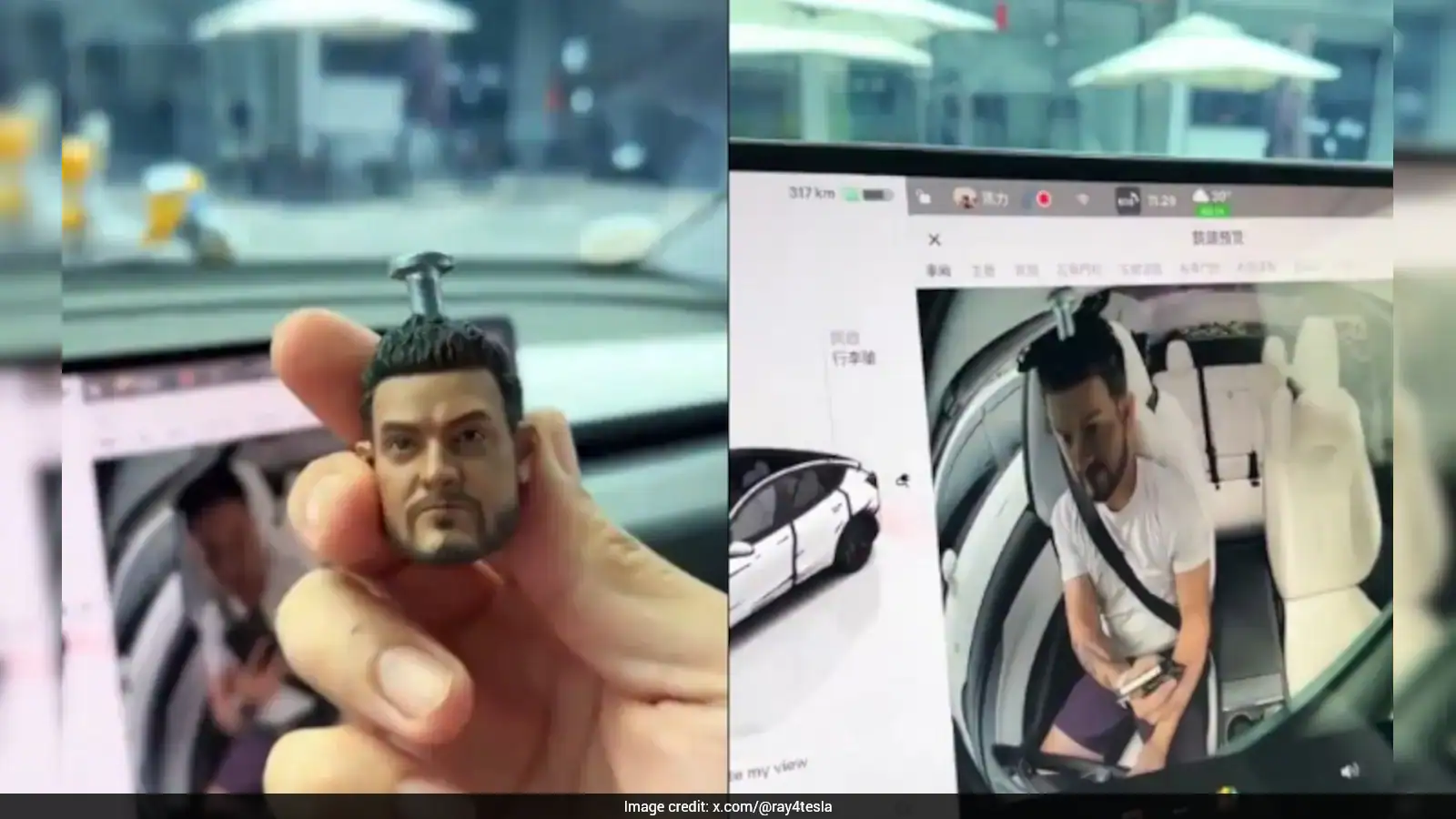
Drivers in China are reportedly using plastic doll heads, including a tiny version of Dwayne “The Rock” Johnson, to fool Tesla’s in-car camera into believing that the driver is paying attention to the road.
Small plastic figurine heads, often designed to look like celebrities, are being placed near the rearview mirror or windshield where they can be detected by the camera that monitors driver attentiveness, according to Wired.
One of the viral videos shows a Tesla driver placing a small plastic head above the rearview mirror, directly in front of the car’s cabin camera. The figurine is positioned so that the camera sees the fake face instead of the driver’s real face. Tesla’s driver-monitoring system appears to mistake the doll for a real person.
“Wow China is coming up with so many techniques to beat the FSD driver monitoring system. This one is new,” the caption read.
Wow China is coming up with so many techniques to beat the FSD driver monitoring system. This one is new pic.twitter.com/bPW8QOso7f
— John Ee (@heyJohnEe) June 5, 2026
Some drivers place a miniature celebrity head near the rearview mirror, windshield, or roof of the car. They are carefully positioned so they block the driver’s real face from the camera. The camera sees the fake head and mistakenly believes a real person is looking at the road. As a result, the driver may be able to use a phone, look away, or even fall asleep while FSD remains active.
The fake heads have become popular on Chinese online shopping platforms such as Taobao, Xianyu, and Douyin, where they are sold for about $10 to $40.
A Tesla Model 3 owner in China claimed that the plastic-head trick worked very well in his car, according to The Digital Trends. He used a small fake head that looked like a bald man resembling Dwayne “The Rock” Johnson and placed it near the rearview mirror to block Tesla’s cabin camera.
The outlet reports that he used the fake head during a 400-mile road trip and kept it in place for around 250 miles while using Tesla’s highway Autopilot.
The report said that, unlike normal situations where Tesla quickly warns drivers who look away from the road, the fake head allowed him to go for up to 30 minutes without receiving any attention alerts. He was eating sunflower seeds with one hand and filming the video with the other hand.
Before Tesla introduced its in-cabin camera, some drivers used steering wheel weights to trick the car into thinking someone was holding the wheel. Tesla later added a cabin camera to better monitor driver attention, but now this too bypasses the safety checks.
The issue comes at a time when Tesla is already facing a consumer fraud lawsuit in China over its “Full Self-Driving” (FSD) software.
The case was brought by 10 Tesla owners who claim they were misled into buying the FSD package. The owners say they paid 56,000 yuan (about Rs 7.85 lakh) each between 2019 and 2021.
However, when Tesla rolled out its advanced driving-assistance software in China, it only supported newer vehicles equipped with HW4.0 hardware. Owners of older HW3.0 vehicles, including cars produced between 2019 and 2023, were left out. They are seeking more than 3.95 million yuan (around Rs 5.53 crore) in damages, according to Electrek.