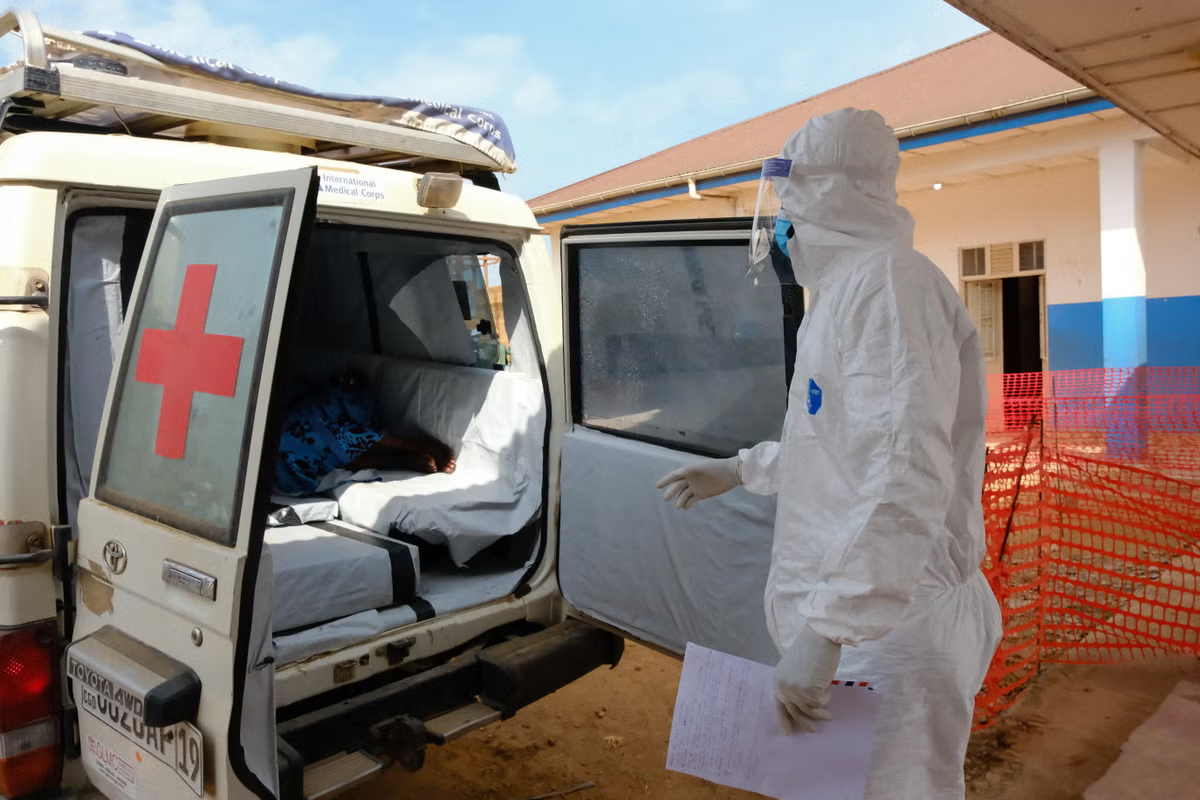
Pregnant women are increasingly avoiding hospitals in the Democratic Republic of Congo (DRC) during one of the worst Ebola outbreaks in history, risking a second health crisis as maternal deaths rise.
Health workers on the ground say fear is keeping pregnant women away from health centres, preventing them from receiving important medical checks and risking potentially more dangerous home births.
The United Nations Population Fund (UNFPA) has recorded a number of extra maternal deaths in the eastern Ituri province, epicentre of the outbreak, they told The Independent. They believe the extra deaths were connected to Ebola.
“In three cases, we are certain. Either the woman was scared to go to the health facility because of Ebola, or she had symptoms consistent with Ebola,” said Noemi Dalmonte, UNFPA’s deputy representative in the DRC.
Confirmed numbers remain relatively low, with seven maternal deaths compared to two in Ituri province during the same week of last year, but it has triggered fears of a sharp spike in preventable maternal deaths.
Since the Ebola outbreak was declared just over a month ago, confirmed Ebola cases across the DRC and neighbouring Uganda have risen to at least 894, with more than 200 deaths, according to Africa’s Centres for Disease Control and Prevention (Africa CDC). Experts say it is far from its peak and the real infection rates could be far higher.
The outbreak is caused by the rare Bundibugyo virus, which has no approved vaccines or treatments and was not tested for in the early days. The more common Zaire virus, for which there is a vaccine, was responsible for most of DRC’s past 16 outbreaks of the disease.
So far 74 patients have recovered from the disease across eastern Congo and Uganda. Experimental treatments are being developed for Bundibugyo.
The outbreak is concentrated in Ituri, which accounts for more than 90 per cent of the cases. Cases have also been recorded in the North Kivu and South Kivu provinces and have spread across the border to Uganda, where 19 confirmed cases have been reported and two people have died.
In the provincial capital of Ituri, Bunia, prenatal consultations at one clinic have dropped dramatically, and medical director Dr Sonny Mwembo told AP that attendance has fallen from around 60 expectant mothers a month to just 10.
Save the Children told The Independent they have seen a decrease in patients attending health centres in certain villages, with some pregnant women asking medical professionals to come to their homes to avoid health facilities.
Cédric*, a team member whose wife is six months pregnant, said she is no longer attending prenatal consultations because the nurse who had conducted her last check-up later fell ill and died of Ebola.
Women say they are scared of the risk of infection, and misinformation about the cause of the disease is also rife, with some members of the community blaming international NGOs.
“This epidemic started in a mining area. The province is affected by war but the area is not really a war zone. There are not a lot of [people], who are used to humanitarian workers,” said Ms Dalmonte.
The head of Africa’s CDC warned on Tuesday that the outbreak could be the worst ever. It could cost billions of dollars to contain later if critical weaknesses in the response are not addressed quickly, Director-General Jean Kaseya said. Alongside the DRC and Uganda, another ten countries considered at risk.
Across the world, donors have pledged $910 million (£689m) in support, but Africa CDC official Wessam Mankoula said less than $90m had actually been made available to use.
“Some of those pledges just came recently, two days ago, following the engagement with different countries either from the continent or outside of the continent,” Dr Mankoula said. “We’ll keep following up with different member states and different partners about their commitment to turn those pledges into actual money,” he added.
Efforts to contain the spread of the virus spread have been hampered by weak health infrastructure, misinformation and the fallout of global aid cuts, including the slashing of US aid overseen by President Donald Trump last year.
“Last year was a shock to the system in the DRC – it’s one of the least developed countries with one of the highest maternal mortality rates,” said Dalmonte. “That shock created a situation that made an outbreak easy because the health system was very dependent on international aid.”
Ebola contact tracing has also fallen to 43 per cent coverage, according to Oxfam, due to budget shortfalls and the withdrawal of US funding for disease surveillance. It is far below the 79 per cent recorded a month into the 2018-2020 DRC outbreak.
“For those 800 confirmed cases, we should have between 17,000 to 35,000 contacts that should be in our contact list,” Dr Mankoula said. Currently only around 4,000 contacts have been tracked and are being evaluated, less than 15 per cent. “We are still far from controlling the situation of this outbreak,” Dr Mankoula added.
Ebola infection during pregnancy is associated with a near-total loss of the baby and a high risk of the mother dying from severe bleeding, but maternity care suffered particularly from aid cuts. The Independent reported last year on the deadly impact already playing out in Uganda and Zimbabwe.
Women also account for a significant proportion of recent confirmed cases due to their increased likelihood to take on caring roles.
Esther Ileli supports UNFPA midwives in Bunia across different hospitals, and has been based in Ituri province for six years. She told The Independent that there is a lack of Ebola-specific protective equipment for midwives. Despite that, they continue to work and have helped treat women for obstetric emergencies who were also at risk from Ebola exposure.
“This is a very stressful situation with a heavy workload. We have to consider how to help births, as well as protection and prevention of Ebola,” she said. “There is mistrust of midwives, and doctors and nurses have also died.”