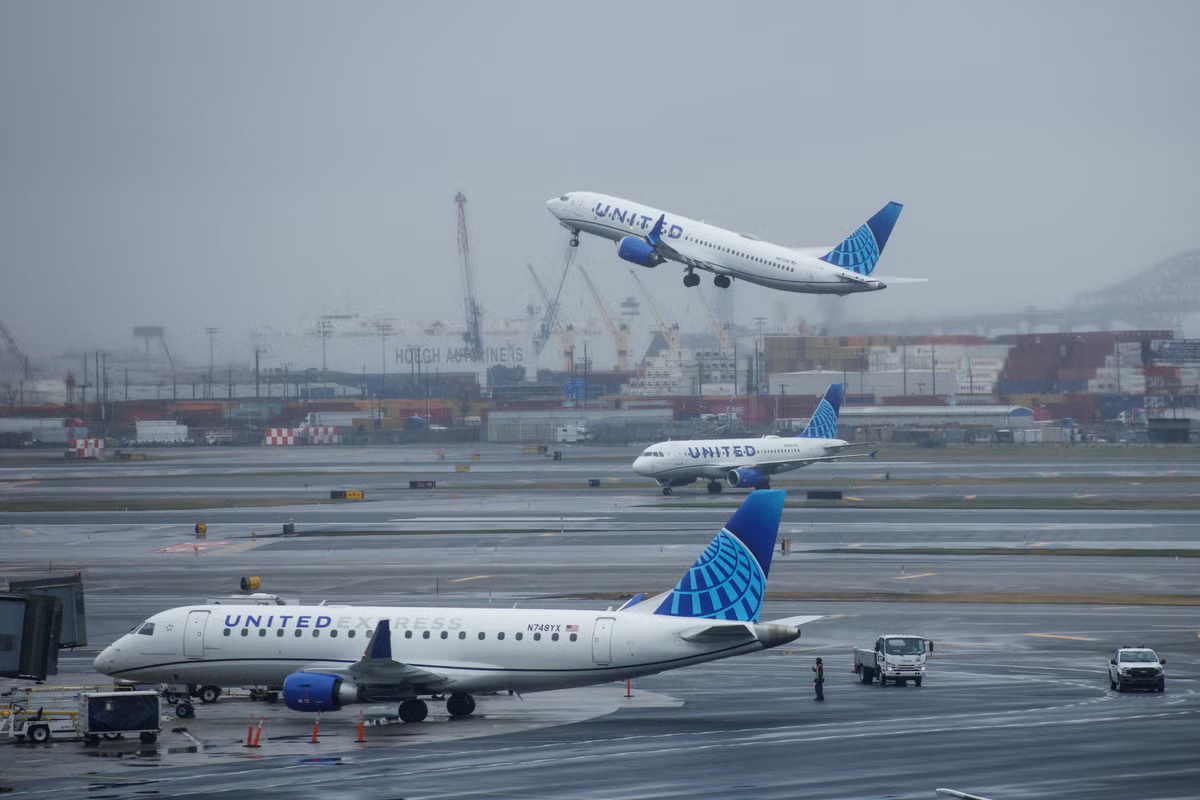
The Federal Aviation Administration is spending nearly $4 million on an artificial intelligence initiative to reduce close calls on airport runways as recent incidents have sparked fears among fliers.
The FAA’s deal with software giant Palantir Technologies involves using an AI tool called Foundry to analyze hundreds of thousands of records from government agencies and other sources, according to Politico.
“This data has always been there,” a high-ranking FAA official told Politico on condition of anonymity. “The problem is this data was always siloed.”
Neither the FAA nor Palantir immediately returned Saturday inquiries from The Independent, and Politico said Palantir didn’t comment when contacted.
But FAA Deputy Administrator Chris Rocheleau told Politico earlier this month that “Palantir has been a great partner for us” and that “we continue to get more refined on how we use that tool.”
Worries about aviation safety have been fueled by a series of accidents and near-misses at or near U.S. airports.
They include the deadly March collision of a plane and a fire truck at New York City’s LaGuardia Airport and the plane that struck a highway light pole and a bread truck before landing at New Jersey’s Newark Airport on May 3.
Late last month, FAA Administrator Bryan Bedford revealed that the agency began working with Palantir to review safety data since the January 2025 midair collision of a military helicopter and a passenger plane that killed 67 people in Washington, D.C.
The company’s Foundry tool is reportedly being used to analyze information about runway incursions, which the FAA describes as any airport incident “involving the incorrect presence of an aircraft, vehicle or person.”
Funding for the project came from President Donald Trump’s signature domestic spending legislation, the One Big Beautiful Bill Act, which the nonpartisan Committee for a Responsible Federal Budget think tank has estimated will add more than $5.5 trillion to the national debt through 2034.
A review of runway incursion data showed only three documented this year, with the FAA saying others were still being investigated or had yet to be added to its public database, Politico said.
But 2023 marked one of the worst years for airport incidents in the past decade, with the annual number more than doubling to 11 during a surge in air traffic following the COVID-19 pandemic, according to Politico.
Using Foundry has reportedly already led the FAA to ban parallel landings — during which planes descend side-by-side — at California’s San Francisco International Airport after the program identified unspecified safety issues.
But the AI wouldn’t have been able to prevent the LaGuardia collision, which killed two Air Canada Express pilots, because it’s engineered to detect recurring patterns and potential risks not to predict a single event with multiple contributing factors, according to Politico.
Robert Sumwalt, a former chairman of the National Transportation Safety Board, said AI presented an opportunity to “enable the FAA to gain greater awareness of real and potential safety risks.”
“Of course, one thing to guard against is over-reliance on AI,” he told Politico. “At least for the intermediate term, human involvement with such data analysis will be essential.”
Earlier this week, Sumwalt’s successor, NTSB Chairwoman Jennifer Homendy, told reporters she recently watched an FAA demonstration of Foundry as it was “looking for hot spots across the national airspace — and it was live,” Politico said.
“It was pretty impressive,” she said.
Palantir is one of three companies vying for a $12 billion contract to use AI to help air traffic controllers reduce flight delays through a program called Strategic Management of Airspace Routing Trajectories, or SMART.
Last week, The Air Current reported that Boston-based Air Space Intelligence was expected to beat out Palantir and French defense company Thales, citing multiple people familiar with the selection process.
The Air Current added, however, that its sources said a decision hadn’t been made and it quoted an FAA spokesperson as saying that “we haven’t awarded anything yet, but look forward to awarding a contract soon.”
Palantir has inked deals with the federal government worth billions of dollars, including a recent U.S. Army contract worth up to $10 billion.
As part of that deal, Palantir will help create a “comprehensive framework for the Army’s future software and data needs.”
The Pentagon also is relying on Palantir’s Maven Smart System, which uses AI to collect data from intelligence, surveillance and reconnaissance missions to identify military targets.
The Department of Homeland Security also entered into a five-year agreement with Palantir worth roughly $1 billion.