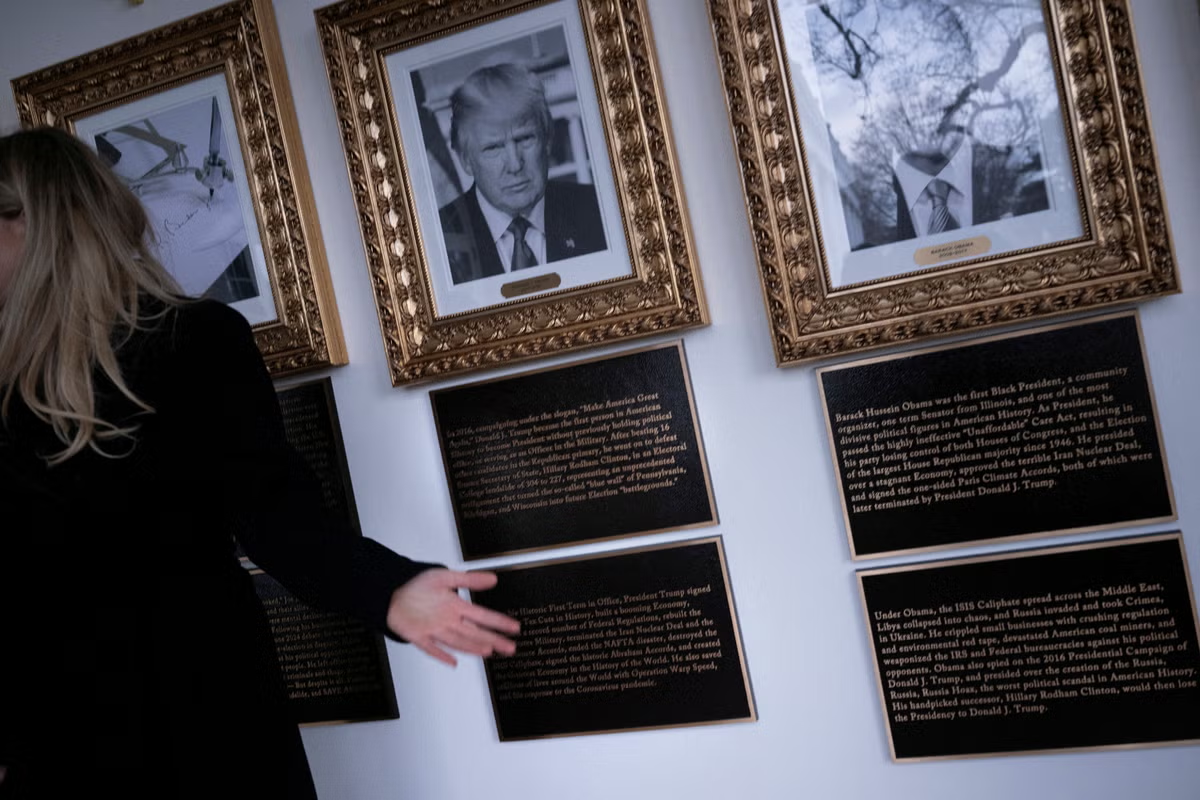
President Donald Trump’s recently installed presidential “Walk of Fame” plaques at the White House are filled with insults, distortions and outright false claims, according to historians.
The display features portraits of each president and a plaque about their time in office, all mounted in bright gold-toned frames along a prominent and frequently photographed hallway outside the West Wing.
Experts have been questioning the accuracy of the Walk of Fame since the beginning.
One historian previously said that the level of scholarship that went into the plaques, which the White House claims Trump partially wrote himself, is about as high as “drawing mustaches on other people’s portraits.”
The New York Times has polled a group of historians about the plaques, who found that the errors and exaggerations stretch across most of the 47 presidents on display, beginning with the present occupant of the White House.
The questionable facts on the Walk of Fame begin with our present president, the historians told the paper.
President Trump’s plaque claims he ended “eight wars in his first eight months” and “has built, right here at the White House, the magnificent Trump Presidential Ballroom after a 225 year wait.”
Neither of those things is true.
The president has drastically overstated his diplomatic record, as The Independent has repeatedly shown. And his claim about the ballroom is just as inaccurate.
“He’s built nothing,” Larry Sabato of the University of Virginia told The New York Times. “He’s simply torn down the East Wing.”
President Trump has spent years baselessly claiming his 2020 campaign loss was the result of a rigged election, a conspiracy theory Trump and his Republican allies repeat so often and so falsely that Democratic critics have taken to calling this rhetoric “The Big Lie.”
It’s no surprise then that Trump’s Biden plaque repeats this claim, alleging that Democrat’s 2020 win was the “most corrupt Election ever seen in the United States.”
“There is no evidence of widespread voter fraud,” Nicole Anslover of Florida Atlantic University told The New York Times.
(Trump’s first term plaque also has some misleading election claims, alleging he beat Hillary Clinton in a “landslide” when he in fact lost the popular vote by millions of ballots.)
Plenty of Republicans love Ronald Reagan, but Trump’s Walk of Fame attempts to turn the tables and describe Reagan as loving Trump.
It claims the Cold War-era POTUS “was a fan of President Donald J. Trump long before President Trump’s Historic run for the White House.”
However, as Timothy Naftali of Columbia University told The New York Times, Trump and Reagan were hardly mutual fanboys.
“As a businessman, Trump was a vocal critic of Reagan’s foreign policy in the 1980s,” Naftali noted. “In 2020, the Reagan Foundation asked the Trump re-election campaign and the R.N.C. to stop using Ronald Reagan’s likeness to fund-raise and opposed the issue of a coin with Reagan’s face paired with Trump’s.”
Reagan, in a move that would also be hard to imagine Trump approving of, granted amnesty to nearly 3 million immigrants who were in the U.S. illegally as part of a larger immigration bill.
Skipping back a little further in history, the Walk of Fame makes some interesting choices about how to describe Revolutionary War hero George Washington, America’s first president.
The plaque declined to mention how Washington personally led the federal force that put down the militias of the 1794 Whiskey Rebellion, a fact historians thought was notable given that President Trump’s supporters and militia groups led an anti-government uprising of their own on January 6, 2021, at the U.S. Capitol.
“In a display of mercy, and to avoid being perceived as a despot, he pardoned the rebels but he did not condone their lawlessness, let alone praise them as patriots,” Sean Wilentz of Princeton University told The New York Times of President Washington. “And Washington, of course, had nothing to do with instigating or inciting the insurrection.”
Trump also pardoned the rebels in his time, but he has also taken up their cause politically, describing them as unfairly targeted by the justice system and seeking to establish a roughly $1.8 billion fund that could someday compensate rioters who once attempted to overturn the 2020 election results.
Overall, historians have frequently noted the irony of the president’s highly partisan historical promenade in the White House, given that he has signed executive orders pushing to remake federal historical displays, which the Republican claimed were overrun with “divisive narratives that distort our shared history.”
In practice, as The Independent has reported, accurate historical materials at parks and historical sites discussing slavery, racism, and other unsavory parts of U.S. history have often been targeted for removal, while the White House has sought to restore memorials and military base names tied to pro-slavery Confederate figures.