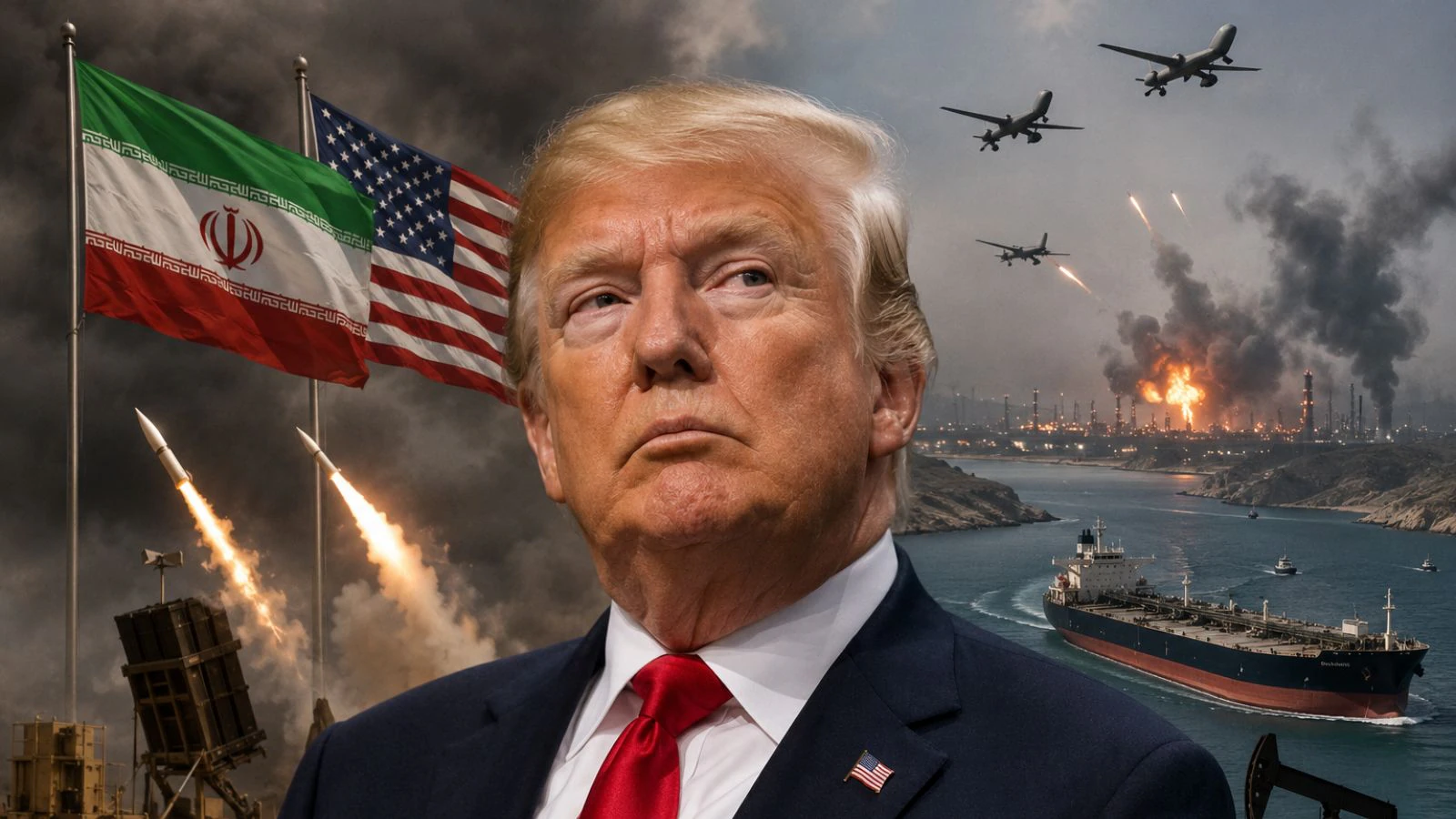
US President Donald Trump Friday said Iranian leaders would eventually have “no choice” but to reach an agreement with Washington to end the ongoing conflict, even as fresh exchanges of fire threatened the fragile ceasefire around the Strait of Hormuz.
“They’re strong, they’re proud, there are things they never thought they’d be doing that they’re going to have to do. They’ve got no choice, and it takes a little while,” Trump told NBC News’ “Meet the Press” moderator Kristen Welker during an interview in Chippewa Falls, Wisconsin.
Trump’s remarks came as the US and Iran continued negotiations to end the conflict, which entered its fourth month last week. The two countries agreed to a ceasefire in April that has since been extended multiple times, although tensions escalated again in recent days after both sides exchanged strikes near the Strait of Hormuz.
The renewed tensions have raised fears that the fragile ceasefire could collapse, threatening global energy supplies and pushing oil prices higher worldwide.
Fresh strikes test fragile ceasefire
According to news agency Associated Press, Iran fired ballistic missiles and drones towards Bahrain and Kuwait early Saturday, though Bahraini authorities said the projectiles were intercepted. Iran’s Revolutionary Guard said it had targeted the Ali Al Salem air base in Kuwait and the US Navy’s Fifth Fleet headquarters in Bahrain.
The US military earlier said it intercepted several Iranian missiles and drones launched towards Gulf allies and struck Iranian coastal surveillance radar sites in response.
“The attack drones posed an immediate threat to regional maritime traffic,” US Central Command said on social media, adding that the radar strikes were carried out “to defend against further attacks”.
Story continues below this ad
Iran’s foreign ministry accused the US of attacking surveillance facilities on Qeshm Island and near Sirik, calling the strikes a violation of the ceasefire.
Earlier this week, Iranian drones heavily damaged a passenger terminal at Kuwait International Airport, killing one person and injuring dozens, AP reported.
Rubio says US operation has concluded
US Secretary of State Marco Rubio on Wednesday told House lawmakers that the military operation, dubbed “Operation Epic Fury” by the Trump administration, “has concluded”.
Rubio described the recent strikes as “defensive in nature”, saying they were carried out in response to Iranian attacks on ships near the Strait of Hormuz.
Story continues below this ad
“In order to protect our own forces, we don’t just strike the drones, we strike the people who launch those drones. These are completely defensive in nature, but they are happening in response to an Iranian action. If they don’t shoot at those ships, we don’t shoot, but we have to respond,” Rubio said.
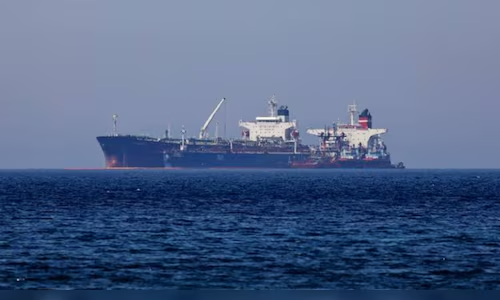
The ongoing conflict has severely disrupted global energy markets after Iran shut the Strait of Hormuz months ago. The closure of the crucial shipping corridor has pushed up global oil prices and raised petrol prices in the United States, increasing pressure on Trump and Republican leaders ahead of the midterm congressional elections.
Trump defends pace of negotiations
During Friday’s interview, Trump criticised those urging him to quickly finalise a deal with Tehran.
“It takes years to do these things,” he said.
“These people have been fighting for 47 years. They’ve been killing Americans,” Trump said, referring to Iranian leaders. “They’ve been taking off their legs and their arms and their faces have been hurt so badly and so horribly.”
Story continues below this ad
Trump compared the conflict to the Vietnam War, saying, “I’m moving very fast. I’m into three months. You know, Vietnam lasted 19 years. I’m into my third month, and all they do is say, ‘Whoa, when are you going to win?’ If I were a Democrat, nobody would be talking that way, but it doesn’t matter to me. I’ve gotten so used to it.”
The president also claimed that the US had “totally destroyed” much of Iran’s military infrastructure, while acknowledging that Tehran still retained some missile and drone capabilities.
“Most of the drone factories have been knocked out, most of the launching pads have been knocked out, and most of the missile manufacturing areas have been knocked out. But they still have capacity. They have some missiles, they have some drones,” Trump said.
“I would say percentagewise, maybe 21%-22% of their missiles. It’s a lot of missiles, but it’s not what it was when we first attacked.”
Story continues below this ad
Strait of Hormuz crisis rattles global markets
The closure of the Strait of Hormuz — a critical route for global oil and gas shipments — has emerged as one of the biggest international concerns arising from the conflict.
The disruption has sent energy prices soaring globally and raised fears of wider economic instability, especially for oil-importing countries, including India, which relies heavily on Gulf energy supplies.
Trump said earlier this week on the New York Post’s “Pod Force One” podcast that it was “unlikely” the US blockade on Iran would still be in place by Labour Day.
In the same interview, he acknowledged that negotiations with Tehran remained uncertain.
Story continues below this ad
“Do we sign a deal or we do it the other way?” Trump said. “And the other way is not nice.”
(With inputs from AP)