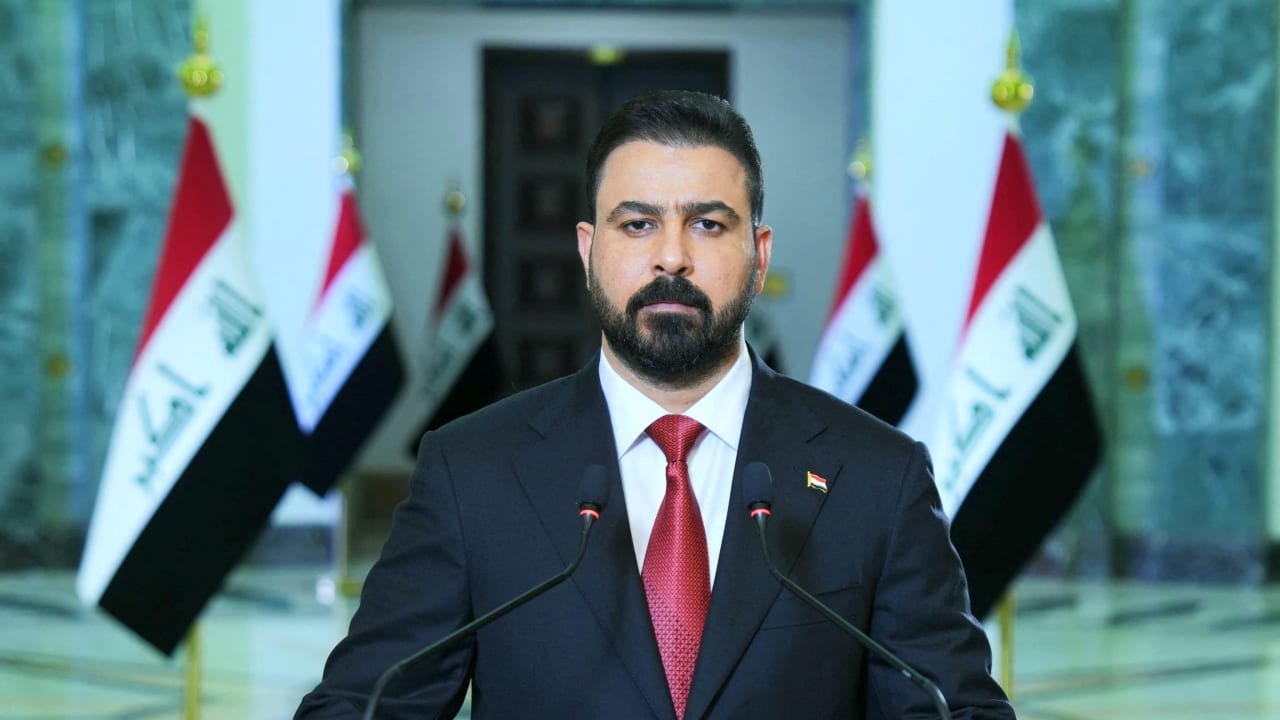
Iraq’s new Prime Minister Ali al Zaidi hosted the leaders of two Iranian-backed militias in Iraq on June 3.
He met delegations from the Asaib Ahl al-Haq Movement and the Kataib Imam Ali Battalions, the prime minister’s office in Baghdad said. On the face of it, this appeared to be yet another example of how pro-Iran groups have influence in Baghdad. However, the prime minister was hosting the delegations to show appreciation for their support of his plan to disarm these groups.
The prime minister was doing a kind of Mark Antony in Caesar’s funeral speech. He was saying one thing, while possibly doing the opposite. He thanked “Sheikh Qais al-Khazali and Mr. Shibl al-Zaidi, and their contributions to strengthening the path of state-building,” his office said.
However, the real thanks was for their willingness to confine “arms to the hand of the state, and joining under the banner of the state and the command of the Commander-in-Chief of the Armed Forces.” As such, these two powerful militias are supposed to separate themselves from the Popular Mobilization Forces and hand over their arms.
If the groups do this, then they will be only political groups, without an armed wing.
Shi’ite militias shaping Iraq’s political and security landscape
Asaib Ahl al Haq is an important group, and it has members of parliament and plays a role in the Shi’ite Coordination Framework. As such, it is one of many multi-layered militia-political groups that have tended to back Iran’s role in Iraq and the region.
Khazali, for instance, went to Lebanon back in 2017 to show support for Hezbollah. Khazali has also been sanctioned by the US.
Iraq’s prime minister was appointed in May with US backing.
The US has appointed Tom Barrack as the new envoy to Syria and Iraq, expanding his Syria role.
Barrack has supported the new Iraqi leader’s initiative. The US Embassy has also backed this new initiative. As such, the winds are all blowing in the same direction.
Iraq’s prime minister “praised the magnitude of the sacrifices offered by the sons of the armed forces and security apparatus, in all their formations, during the confrontation of the challenges that threatened the existence of the Iraqi state, emphasizing that the Popular Mobilization Forces [PMF] were one of the principal factors in achieving security stability, and that its sons today represent a fundamental pillar in the march of construction and development alongside the rest of the state’s institutions.”
The PMF is an umbrella group of some 70 armed units, most of which are designated as brigades. These brigades are linked to various militias, most of them Shi’ite and linked to Iran. These include Badr, Kataib Hezbollah, Asaib Ahl al Haq, Harakat Hezbollah al Nujaba, Kataib Imam Ali, Kata’ib Sayyid al-Shuhada (KSS), Harakat Ansar Allah al-Awfiya (HAAA), and others.
Many of the militias have only one brigade or several in the PMF. Badr is the largest and has a dozen brigades, including the 1st, 2nd, 3rd, 4th, 5th, 9th, 10th, 16th, 21st, 22nd, 23rd, 24th, 27th, 30th, 44th, 52nd, 52rd, 55th, and 110th, according to the Mapping Militants Project.
By contrast, Kataib Hezbollah has a role in the 45th-47th brigades.
In contrast, the 41st, 42nd, and 43rd brigades are Asaib ahl al Haq. Meanwhile, KSS runs the 14th brigade, Kataib Imam Ali runs the 40th, Harakat Ansar Allah al-Awfiya runs the 19th, while Harakat Hezbollah al-Nujaba is the 12th brigade according to various reports.
Iraq’s prime minister pushes to disarm PMF and strengthen state authority
Iraq’s prime minister now wants to “form a joint committee tasked with putting in place the appropriate mechanisms for implementing procedures to disengage from the Popular Mobilization Forces and confine arms to the hand of the state, within the next two days, in a manner consistent with the constitution and the law, that reinforces state authority, contributes to supporting security and stability, and entrenches the project of the strong Iraqi state capable of achieving the aspirations of its citizens.”
The challenge for Baghdad now is how to wind down all these PMF units and provide those who leave them with some kind of other job. There are an estimated 250,000 members of the PMF, although the numbers may be lower today.
Rudaw media in Iraq’s Kurdistan Region, notes that “while it is a state‑funded institution, the PMF notably includes factions widely believed to overlap with the Iran-led ‘Axis of Resistance,’ which have, since the outbreak of the Iran war in late February, carried out attacks against alleged US targets in the region in support of Tehran, often operating through shadow groups under the banner of the Islamic Resistance in Iraq (IRI).”
As such, it remains to be seen what happens with the most hardcore pro-Iranian IRI groups such as Kata’ib Hezbollah, Harakat Hezbollah al-Nujaba, and Kata’ib Sayyid al-Shuhada. Even if Asaib ahl al Haq and Imam Ali agree to leave the PMF or disarm, there are many other groups that still need to be dealt with. It doesn’t seem likely that the powerful Badr organization, run by Hadi al-Amiri, will agree to a major change. It already has significant influence over parts of Iraq’s state institutions.
It is also not sanctioned by the US.
The government in Baghdad has a stronger hand in dealing with groups that are sanctioned as Foreign Terrorist Organizations by the US. This includes many of the other major militias in the PMF, but not Badr. It remains to be seen how Iraq’s prime minister will move forward.
With Kata’ib Sayyid al-Shuhada and Harakat Hezbollah al-Nujaba rejecting disarmament, it could set up a crisis in Iraq. The government will not want a civil conflict on its hands.