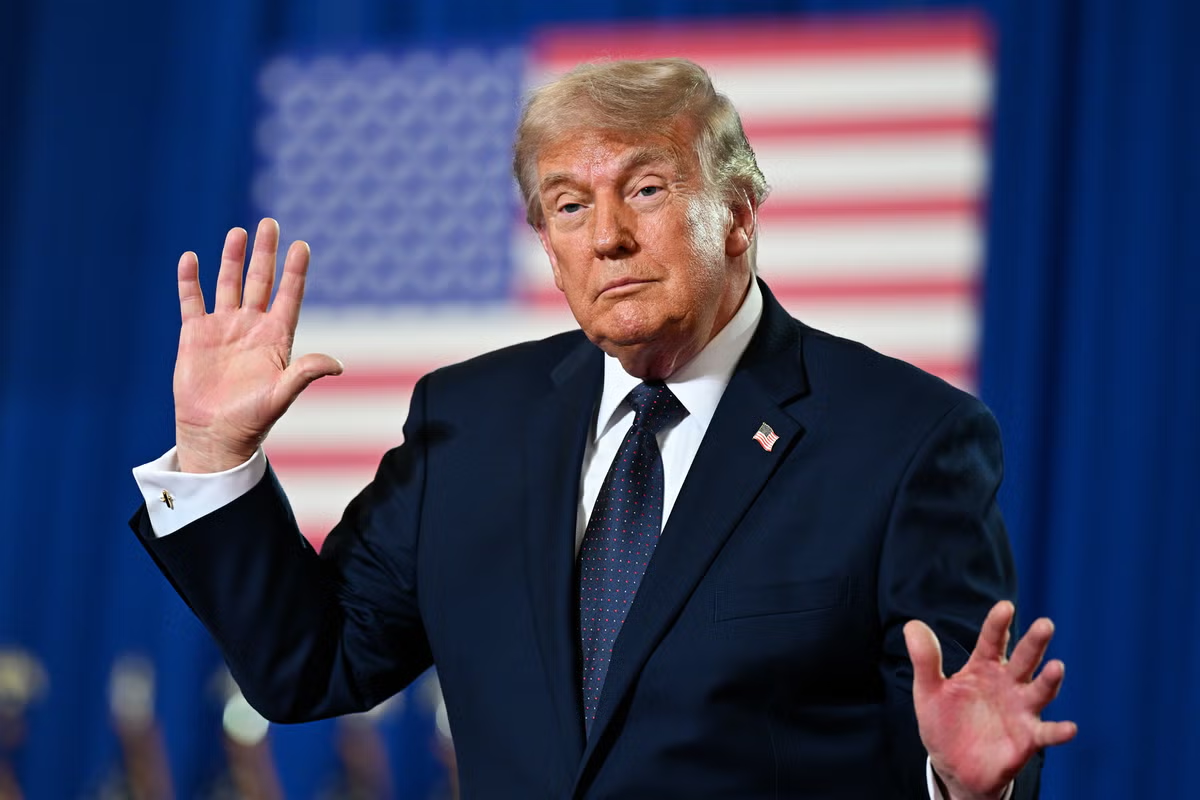
When nearly all scheduled musical performers withdrew from a concert series marking America’s 250th anniversary, citing concerns over its perceived close ties to President Donald Trump, he responded by officially taking center stage.
Trump announced he would now headline the Great American State Fair, effectively transforming the event into a rally.
This decision underscores a consistent pattern: a president who has built his public and political persona on seizing the spotlight rarely cedes it, even for a national celebration intended to be larger than any individual. It also offers a glimpse into how he might approach hosting the upcoming World Cup.
From his pre-political reality television career to hours spent entertaining at both planned and impromptu events, and proudly showcasing his various properties and efforts to overhaul the White House, the president clearly relishes the role of host. Last year, he even jokingly mused about leaving the presidency to return to full-time television work. While Trump can be a gracious, personable, and highly watchable master of ceremonies, he is also one who tends to make every event about himself.
“The president has an outsized personality,” observed Timothy Naftali, former director of Richard Nixon’s presidential library and a professor at Columbia University’s School of International and Public Affairs. “There’s a predictability to the way in which the president frames his actions — or any actions around any event associated with him — and that’s just part of who he is, and his makeup and his professional background.”
The fair, set to begin June 25, serves as a prime example. Originally planned for concerts, it will now be kicked off by a Trump rally. This follows a UFC bout scheduled at the White House on June 14. A longtime fan of cage matches, Trump has sought to bill the event, which also marks his 80th birthday, as part of the broader anniversary festivities.
Andrew Jackson threw open the White House for an 1829 Inauguration Day bash so unruly that staff eventually dispersed the crowd by moving tubs of whiskey and ice cream to the lawn. Franklin D. Roosevelt mixed pre-dinner cocktails for friends and aides at White House gatherings he playfully dubbed “The Children’s Hour.” Audrey Hepburn was among the luminaries Ronald Reagan hosted at the White House.
Trump frequently had first-term dinners with business leaders but has more fully embraced the role since returning to the White House. He built a patio area similar to one at his Mar-a-Lago estate and frequently travels to Florida and his properties in Bedminster, New Jersey, and Sterling, Virginia, to headline fundraisers and other swanky gatherings.
Asked if Trump might overshadow events meant to bring the country and the world together, White House spokesman Davis Ingle pointed to the president’s efforts to lead extensive renovations at the White House and around Washington. He said in a statement that the “historic beautification” gives the city “the glory it deserves during our nation’s historic semiquincentennial celebration — something everyone should celebrate.”
Still, Trump has found unprecedented ways to inject himself into the anniversary.
The State Department is issuing passports with the president’s picture and officials have designed a new $250 bill with his likeness. The Trump Organization, being run by Trump’s children while he’s president, applied to trademark “Trump 250″ logos and other merchandise.
The U.S. Mint is also producing a 24-karat gold commemorative coin with Trump’s face, though that recalls a half-dollar silver coin bearing the likeness of President Calvin Coolidge to help mark America’s 150th anniversary in 1926.
Ulysses S. Grant opened a Centennial Exposition in Philadelphia to mark the 100th anniversary of the signing of the Declaration of Independence in 1876. Richard Nixon, in 1971, inaugurated a five-year “Bicentennial Era” ahead of the 200-year mark, though he resigned before the big day arrived.
Nixon’s successor, Gerald Ford, then in the midst of an ultimately unsuccessful reelection campaign, began the week of July 4, 1976, by inaugurating the Smithsonian Institution’s National Air and Space Museum and attending a Kennedy Center event featuring Bob Hope, OJ Simpson and others reading patriotic texts.
On Independence Day, Ford spoke at historic Valley Forge, then traveled to Philadelphia’s Independence Hall, declaring, “Liberty is a living flame to be fed, not dead ashes to be revered.“ He also went to New York Harbor for a tall ship parade, presided over naturalization ceremonies at Thomas Jefferson’s Monticello estate and hosted a state dinner for Britain’s Queen Elizabeth II.
Still, “while Ford certainly hoped to use the bicentennial to promote his reelection campaign, he didn’t do it in such a self-aggrandizing, self-centered, narcissistic way,” said Marc Stein, a history professor at San Francisco State University and author of “Bicentennial: A Revolutionary History of the 1970s.”
Ford, added Naftali, “knew when to step out of the limelight and make sure the focus was on what mattered, which was the United States of America and the Declaration of Independence.”
Trump, by contrast, “generally has contempt for norms” and rarely mentions “the great sweep of history,” Naftali said.
Congress charged a national organization, America250, with planning commemorative events. Ahead of the 2024 election, the group drafted a memo asking whomever the incoming president was to mobilize federal agencies and welcoming presidential involvement in events and initiatives.
Asked about Trump, America250 Chair Rosie Rios said the group “has had a very supportive and collaborative relationship with the organizations planning initiatives on behalf of the president.”
But Rios’ organization is separate from Freedom 250, a mix of public and private partnerships which the Trump administration established to fund and prepare anniversary events — which has caused confusion.
America250 aims to “inspire our fellow Americans to reflect on our past, strengthen our love of country, and renew our commitment to the ideals of democracy through programs that educate, engage, and unite us as a nation.”
That might seem a departure from the “Restoring Truth and Sanity to American History” executive order Trump signed last year. It sought to beat back a “revisionist movement” responsible for “replacing objective facts with a distorted narrative driven by ideology rather than truth.”
Stein, now serving a one-year term as president of the Organization of American Historians, is helping organize “We Want More History,” a push to coordinate local events celebrating the public’s love for the subject in fact-based ways.
He said Trump’s version of history is “closer to propaganda, and it’s closer to cheerleading.”