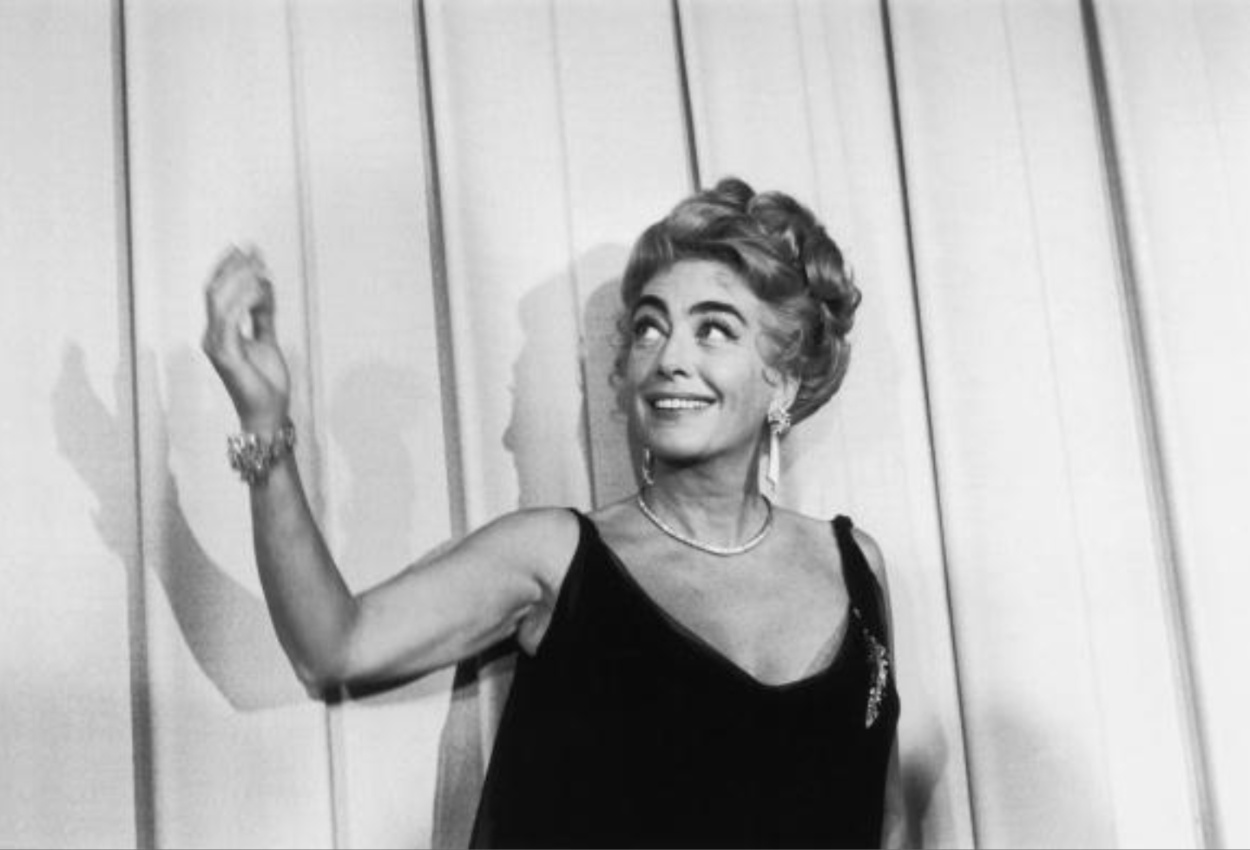
Joan Crawford (born Lucille Fay LeSueur; March 23, 1907 – May 10, 1977) was an American actress.
Crawford often played hard-working women, usually portraying characters who rose from poverty to wealth, known as “rags-to-riches” stories. These roles were especially popular during the Depression era and with women. Crawford became one of Hollywood’s most important actors and was among the highest paid women in the United States. However, her films began to lose money, and by the 1930s, she was called “box office poison” because of their poor performance.
She won the 1945 Best Actress Academy Award for Mildred Pierce.
Profile Summary
| Birth Name | Lucille Fay LeSueur |
| Date of Birth | March 23, 1904–1908 (exact year disputed) |
| Place of Birth | San Antonio, Texas, U.S. |
| Date of Death | May 10, 1977 (aged 69–73) |
| Place of Death | New York City, U.S. |
| Resting Place | Ferncliff Cemetery, Hartsdale, New York, U.S. |
| Occupations | Actress; Businesswoman |
| Spouses | Douglas Fairbanks Jr. (m. 1929; div. 1933); Franchot Tone (m. 1935; div. 1939); Phillip Terry (m. 1942; div. 1946); Alfred Steele (m. 1955; died 1959) |
| Children | 4, including Christina |
| Relatives | Hal LeSueur (brother) |
Age
Lucille Fay LeSueur was born on March 23, 1904–1908 in San Antonio, Texas, U.S.
Biography
Crawford was born in San Antonio, Texas, as Lucille Fay LeSueur. She began her career as a dancer and moved to Hollywood in 1925. She appeared in silent films, often playing hard-working young women looking for love, romance, and glamour, and later starred in sound films. MGM chose her stage name, “Joan Crawford,” through a magazine contest.
Crawford won the Best Actress Academy Award for Mildred Pierce in 1945. She continued acting until her retirement in 1970 and later died of a heart attack in New York City.
Crawford found success with Letty Lynton (1932), a film best known for the “Letty Lynton dress” designed by Adrian. The white cotton organdy gown had large ruffled sleeves and puffed shoulders, starting a trend of highlighting Crawford’s broad shoulders in her costumes. Macy’s copied the dress in 1932 and sold over 500,000 replicas in the United States.
Crawford married four times: first to actor Douglas Fairbanks, Jr., then to actor Franchot Tone, followed by actor Phillip Terry, and finally to Pepsi executive Alfred Steele. After Steele’s death from a heart attack, Crawford became involved with the Pepsi-Cola company.
Crawford adopted four children: Christina, Christopher, and twins Cynthia and Cathy. Christina later wrote the bestselling biography Mommie Dearest, which alleged that Crawford abused her children.
Personal life
Marriages
On June 3, 1929, Crawford eloped with Douglas Fairbanks, Jr. at Saint Malachy’s Roman Catholic Church (known as “The Actors’ Chapel”, owing to its proximity to Broadway theatres) in Manhattan, although neither was Catholic. Fairbanks was the son of Douglas Fairbanks and the stepson of Mary Pickford, who were considered Hollywood royalty. Fairbanks Sr. and Pickford were opposed to the sudden marriage and did not invite the couple to their home at Pickfair for eight months after the marriage.
The relationship between Crawford and Fairbanks, Sr., eventually warmed; she called him “Uncle Doug”, and he called her “Billie”, her childhood nickname, but one that close friends used throughout her life. Following that first invitation, Crawford and Fairbanks, Jr., became more frequent guests.
In May 1933, Crawford divorced Fairbanks, citing “grievous mental cruelty”. Crawford claimed Fairbanks had “a jealous and suspicious attitude” toward her friends, and that they had “loud arguments about the most trivial subjects” lasting “far into the night”.
In 1935, Crawford married Franchot Tone, a stage actor from New York who intended to use his film earnings to support his theatre group. The couple built a small theatre at Crawford’s Brentwood home and staged classic plays for select friends, including Clark Gable and Charley Chase. Tone and Crawford first appeared together in Today We Live (1933), but Crawford was initially hesitant to begin another relationship soon after her divorce from Fairbanks.
More…
Crawford met actor Phillip Terry in June 1942 after press agent Harry Mines asked if he could bring Terry along for dinner at Crawford’s home. On July 21, 1942, the couple married 10 minutes after midnight at the home of Crawford’s lawyer, Neil McCarthy, by Judge Flynn, six weeks after their first date in San Fernando Valley. On December 16, 1945, Crawford and Terry separated. Later, on March 12, 1946, Crawford filed for divorce on “grounds of cruelty”. On April 25, they divorced.
Crawford married her fourth and final husband, Alfred Steele, at the Flamingo Hotel in Las Vegas on May 10, 1955. They met at a party in 1954, by which time Steele was president of Pepsi-Cola and later became chairman of the board. They remained married until his death in May 1959.
Children
Crawford adopted her first child, a daughter, in June 1940. As a single woman, she was unable to adopt in California, so she arranged the adoption through an agency in Las Vegas. The child was initially named Joan before Crawford changed her name to Christina. Christina’s birth mother was a 19-year-old unmarried woman who had moved to Los Angeles with her family and arranged the adoption through a baby broker.
While married to Phillip Terry, the couple adopted a son (born Marcus Gary Kullberg on June 3, 1941, prior to changing his name to David Gary Deatherage) whom they named Christopher. His mother, Rebecca, had been a married woman who had become pregnant after having an affair with a neighbor. Ten days after the child’s birth, Crawford picked him up, but when Rebecca learned the child had been adopted by a celebrity, she attempted to blackmail Crawford for money, which resulted in Crawford giving the child back to her.
After his return, Rebecca’s husband was physically and emotionally abusive, refusing to let Christopher in his sight (his mother would have to hide him in closets). After he threw an infant Christopher against a wall, rupturing his hernia, Rebecca placed him back up for adoption, and he was adopted by a loving family. However, losing him devastated Crawford, and none of her other children dared mention him, as it was a tender subject for her.
More…
In 1942, Crawford and Terry adopted a boy named Phillip Terry Jr. After their marriage ended in 1946, Crawford changed his name to Christopher Crawford. In 1944, Rebecca, unrelated to this child, falsely claimed he was her son, resulting in her arrest and psychiatric hospitalization. Rebecca’s son Christopher later changed his name to Davis Gary Deatherage and published a memoir, The Other Side of My Life, in 2006. He expressed regret at never meeting Crawford, and her twin daughters shared how she felt about losing him. Christopher Crawford, not Rebecca’s son, frequently ran away from home, was expelled from several schools, and attended a military academy for high school.
In 1947, Crawford adopted two fraternal twin daughters and named them Catherine “Cathy” and Cynthia “Cindy”. They were born prematurely on January 13, 1947, and required hospital supervision for several weeks. Cathy and Cynthia are the only children Crawford adopted from the Tennessee Children’s Home Society. Their birth mother was ill and died less than a week after the twins were born due to kidney failure; their biological father abandoned their mother during birth. Their biological mother made the adoption arrangements before Cathy and Cindy were born.
Crawford’s fourth husband, Alfred Steele, took on a father-figure role to the children after his marriage to Crawford in 1955.
Death
Crawford had a heart attack on May 10, 1977, and died in her apartment in Lenox Hill, New York City. Her age was reported as 69. Four days earlier on May 6, 1977, Crawford had given away her Shih Tzu, Princess Lotus Blossom, because she was too weak to continue to care for her.
Disposing of her $2 million estate in her will, which had been signed on October 28, 1976, Crawford bequeathed $77,500 to each of her two youngest children, Cindy and Cathy, and $35,000 to her longtime friend and secretary Betty Barker, and smaller bequests to a few other people. Crawford also left money to her favorite charities: the United Service Organizations New York centre, the Motion Picture & Television Country House and Hospital, the American Cancer Society, the Muscular Dystrophy Association, the American Heart Association, and the Wiltwyck School for Boys.
She disinherited her two eldest children, Christina and Christopher, stating in her will: “It is my intention to make no provision herein for my son, Christopher, or my daughter, Christina, for reasons which are well known to them.” Both of them challenged the will and received a $55,000 settlement. She also bequeathed nothing to her niece, Joan Lowe (1933–1999; born Joan Crawford LeSueur, the only child of her estranged brother, Hal).