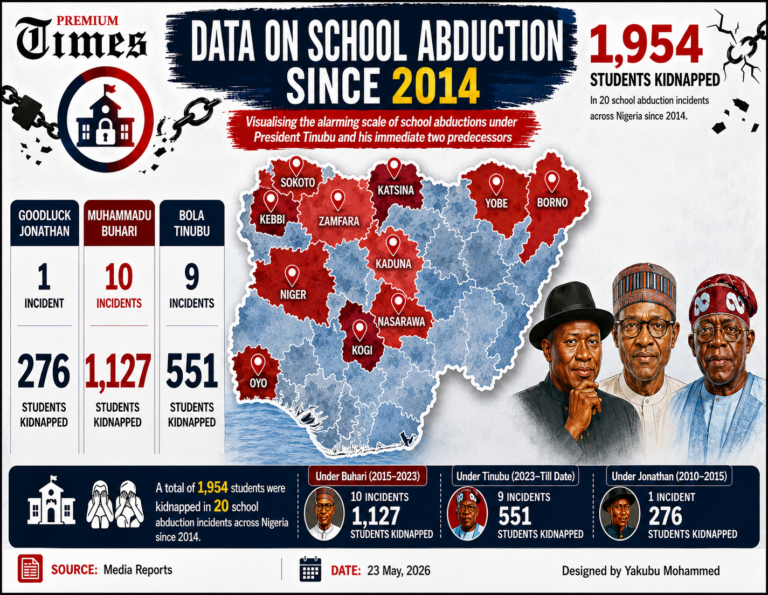
Data compiled and analysed by PREMIUM TIMES shows that the mass school abduction crisis has worsened under President Tinubu. Although his administration will mark three years in office on 29 May, it has already recorded nine mass school kidnapping incidents involving 551 students and staff members
The terrorists arrived before dawn, breaching the stillness of Yawota and Esiele communities in Oriire Local Government Area of Oyo State. Within minutes, locals in these communities said three schools were invaded, and terrified pupils, including their teachers, were herded into the surrounding bushes linking to the Old Oyo National Park, where five park rangers were killed earlier this year.
Among those abducted was the vice principal of Community Grammar School, Alamu Folawe, whose car was stolen by the terrorists and later set ablaze, the police spokesperson in Oyo, Ayanlade Olayinka, said in a statement.
“School should be a haven and a place where a child can dream of and make a better future. It should never be a place where children’s and their parents’ worst nightmares can come true,” Duncan Harvey, the country director for Save the Children in Nigeria, had said following a large-scale abduction in November 2025.
Mr Harvey added that no child should ever have to choose between learning and staying safe.
“When a school is attacked, it’s not just walls that fall; a child’s safety, dreams, and future fall with them,” he said.
Data compiled and analysed by PREMIUM TIMES shows that the mass school abduction crisis has worsened under President Tinubu. Although his administration will mark three years in office on 29 May, it has already recorded at least nine mass school kidnapping incidents involving 551 students and staff, compared to one incident involving 110 students during the first three years of his immediate predecessor, Muhammadu Buhari. The difference shows an increase of about 401 per cent.
The first three years of Goodluck Jonathan’s administration recorded no school abduction incidents. However, as the Jonathan administration approached its fourth year in office, one school kidnapping incident left 276 schoolgirls abducted from a school in Chibok, Borno State.
Since that time, mass school abduction has continued to evolve from an isolated, yet globally significant incident, into a recurring security crisis under subsequent administrations.
Under Mr Buhari, the crisis expanded from the insurgency-ravaged North-east, where it is believed to be confined. It sharply spread across several northern states, with at least 10 incidents involving 1,127 students abducted from schools in Katsina, Kaduna, Niger, Zamfara, Yobe and Kebbi.
The trend has persisted under President Tinubu, with the crisis now spreading southward. The pattern suggests that despite years of military operations, school protection measures such as the Safe School Initiative, and other security efforts introduced by federal and state authorities, mass abduction of students remains an enduring tactic used by armed groups in Nigeria.
SBM Intelligence, a Lagos-based research think tank, defines mass abduction as incidents involving five or more abductees.
The data [gathered from media reports] analysed for this report span from 14 April 2010 to 15 May 2026, a period of about 16 years.
The recent tragic history of mass school abduction in Nigeria began on the night of 14 April 2014, when Boko Haram insurgents stormed Government Girls Secondary School Chibok and abducted 276 schoolgirls. The attack, which occurred during the Jonathan administration, shocked the world and triggered the global #BringBackOurGirls campaign.
What began as a singular case has now grown into a “lucrative criminal enterprise” being exploited by terror groups to force the government to do their bidding, and in many cases, pocket multimillion naira ransom.
Four years after the Chibok incident, another mass school abduction occurred in February 2018, when Boko Haram fighters kidnapped 110 girls from Government Science and Technical College in Dapchi, Yobe State. Five of the girls died in captivity, while 104 were released, excluding Leah Sharibu, who remains missing.
By late 2020, the crisis had spread beyond the insurgency-ravaged North-east into the North-west, where heavily armed bandit groups began targeting schools on a massive scale. In December that year, bandits abducted about 300 students from Government Science Secondary School in Kankara, Katsina State.
The attacks intensified in 2021. Within months, terrorists raided Government Science Secondary School in Kagara, Niger State, and abducted 27 students; kidnapped 317 schoolgirls from Government Girls’ Secondary School, Jangebe, Zamfara; and seized 27 students from Federal College of Forestry Mechanisation, Afaka, Kaduna.
The wave continued with the abduction of 17 students from Greenfield University, Kaduna, 130 pupils from Tanko Salihu Islamic School, and 121 students from Bethel Baptist High School, Chikun, Kaduna. In Kebbi State, over 100 students were kidnapped from Federal Government College, Kebbi, while six students were abducted from Nuhu Bamalli Polytechnic, Zaria, Kaduna.
By the end of Mr Buhari’s tenure, school kidnappings had transformed from isolated incidents into a persistent security crisis affecting multiple northern states.
The trend has continued under Mr Tinubu. In October 2023, five students were abducted from Federal University Dutsin-Ma. About four months earlier, six students were also kidnapped from Federal University Lafia, Nasarawa State. In September of the same year, 22 students were abducted from Federal University Gusau, Zamfara.
In March 2024, a bandit family stormed the LEA Primary and Secondary School in Kuriga, Kaduna State, abducting 137 pupils. Around the same period, 15 pupils were kidnapped from an Islamic boarding school in Gidan Bakuso, Sokoto State.
The following year, the Sadiku-led Boko Haram faction abducted 315 students and staff from St. Mary’s Catholic School in Papiri, Niger State. This year so far, two school abductions have been recorded—26 children from Darul Kitab Islamic Orphanage and School in Kogi and the latest abduction of 46 people from Oyo schools.
The Oyo raid illustrates a growing reality. It shows a dangerous and predictable pattern of jihadis’ expansion into southern Nigeria. On the other hand, it points to the fact that the crisis of mass school abduction is no longer confined to violence hotspots in the north.
President Tinubu described the attack as barbaric, vowing that the federal government was working with the Oyo State government to rescue all the victims.
During a press briefing last Sunday, Oyo State Governor, Seyi Makinde, blamed the attack on terrorists, saying the pressure on the terror groups in the north was pushing them southward.
Following his remarks, many Nigerians raised concerns that terrorists have established a base in the South-west. But the Defence Headquarters (DHQ) countered this, describing the incident as an isolated criminal act and stating that it does not reflect the existence of any entrenched terrorist structure in the region. Some news platforms and blogs framed the DHQ position as a rejoinder to Mr Makinde.
In a response, the DHQ clarified that it did not “undermine the authority of any democratically elected leader or sought to diminish the gravity of the heinous crime committed against innocent citizens by terrorist elements.”
It further revealed that Boko Haram was responsible for the Oyo schools abductions.
“The recent incidence (sic) of kidnap in Oyo State was clearly perpetrated by terrorists of the JAS Group that have been dislodged from other parts of the country due to high-intensity operations being conducted all over,” Michael Onoja, the spokesperson for Defence Headquarters, said.
JAS is the acronym for Jama’atu Ahlis-Sunna Lidda’Awati Wal-Jihad, which translates to “People Committed to the Propagation of the Prophet’s Teachings and Jihad.”