Tuesday is primary day in New York. On the surface, everything should be hunky dory for Democrats there. The Knicks won the NBA Finals after the San Antonio Spurs blew two double-digit leads. Just over the river in New Jersey, the World Cup is underway. And polling shows Democrats look on track to win back the House of Representatives.
But good vibes can only last so long. And on Tuesday, the primaries in the city will determine if Democrats are more focused on taking on New York’s most famous export — Donald Trump — or if they want to get the Democratic Party back on track. Some may call it a Democratic Tea Party; others might say it’s a Democratic block party.
At the core of this fight are two men: Mayor Zohran Mamdani and House Minority Leader Hakeem Jeffries. Initially, it looked like the two men would have an uneasy but working relationship. Around this time in 2025, Mamdani shocked the political world when he beat former governor Andrew Cuomo in the Democratic primary for mayor.
Mamdani is now the most prominent socialist elected official. Lefties like Janeese Lewis George replicated his success in Washington, DC. They hope to repeat it in Los Angeles with Nithya Raman this November.
As such, Mamdani’s backing an army of left-wing Democrats against incumbents and in open primaries alike to give himself allies in Washington.
On the other flank is Jeffries, a product of the establishment, a protege of Nancy Pelosi and the man who would be the first Black speaker of the House. Ideally, Jeffries would like to focus more on beating Republicans nationwide to give Democrats the majority. As such, he’s backing incumbents.
But at the core of the moment is whether now is the right time for Democrats to hash out their policy disagreements or focus on taking out the GOP and holding Donald Trump accountable, even if it means setting aside ambitious policy ideas that might become cannon fodder for those on the right.
Perhaps the most obvious fight comes in New York’s 10th district. Rep. Dan Goldman, a former prosecutor and counsel during Trump’s first impeachment and heir to the Levi Strauss fortune, won this district in 2022 thanks in part to a split left-wing field.
Goldman has come under fire for his support for Israel and the fact he did not endorse Mamdani, though he defended the mayor from ugly Islamophobic attacks. Thusly, the mayor has backed Brad Lander, the former city comptroller, who cross-endorsed him and by dropping out of the ranked-choice mayoral primary tossed his votes to Mamdani and helped oput him over the top.
Polling shows Lander will likely run away with this one, which makes sense given how this Brooklyn and Manhattan district had large chunks that voted for the mayor last year.
While we’re still in Manhattan, the least ideologically-driven primary is in the 12th district, which includes the highly affluent Upper West Side and Upper East Side. It’s about 64 percent white and it boasts a median household income of $153,117.
While Jack Schlossberg, the grandson of President John F. Kennedy, and George Conway — former Republican attorney and ex-husband of his former top aide, Kellyanne Conway, who is now a staunch Trump and MAGA critic — absorbed much of the headlines, the race has largely become a race between two state legislators: Alex Bores and Micah Lasher.
Bores has sought to turn the race into a referendum on AI regulation while Lasher has received the endorsements of Gov. Kathy Hochul, former Mayor Michael Bloomberg and Jerry Nadler, who currently holds the seat and is retiring. Curiously, despite living in the district, Hizzoner the mayor has refrained from endorsing here despite the fact Gracie Mansion is located there. Jeffries has stayed mum too. Regardless, it’s become the second most expensive primary of the year and the most expensive Democratic primary, with more than $26.3 million spent.
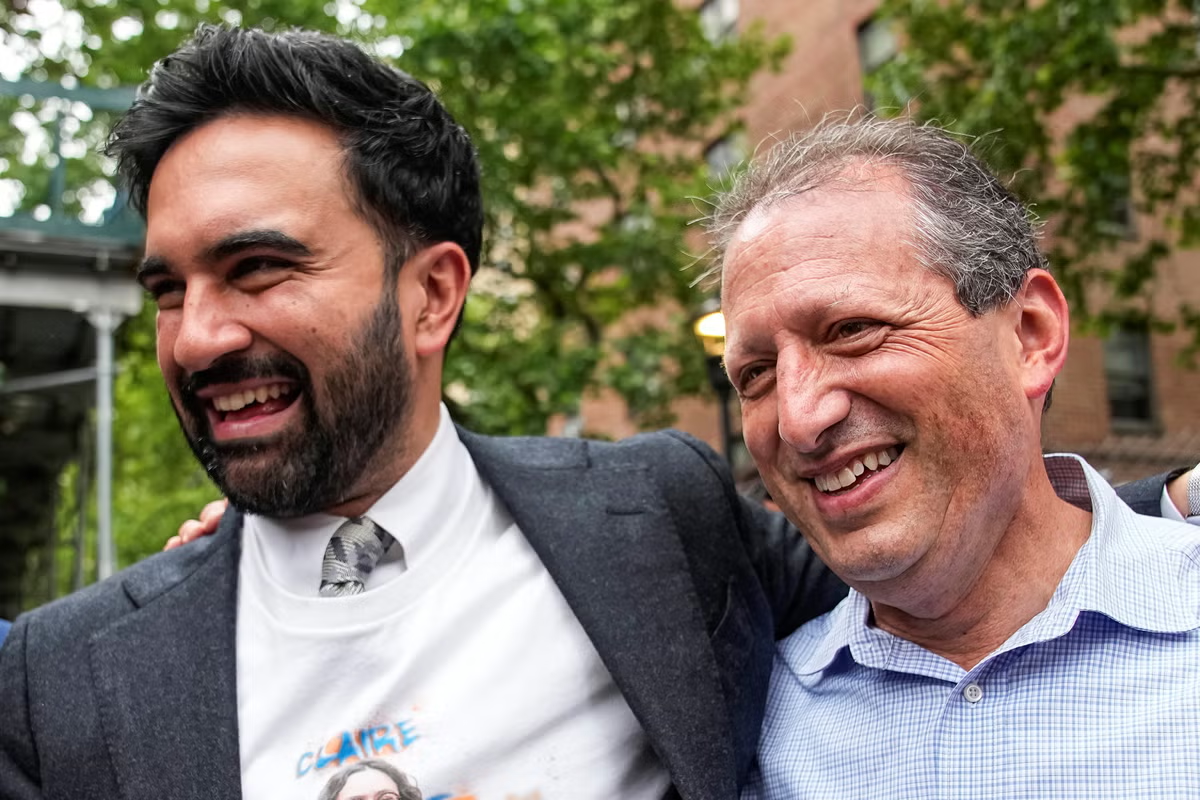
This leads us to New York 7th, where Mamdani is the young buck taking on a one-time mentor. This overwhelmingly blue district located in the heart of what political analyst Michael Lange call the “Commie Corridor,” a collection of neighborhoods in Brooklyn and Queens that comprises the base of support for the Democratic Socialists of America.
When Nydia Velázquez surprisingly announced she would not seek re-election, Mamdani saw it as the perfect opportunity to send a foot soldier and endorsed legislator Claire Valdez. That shocked Velázquez, who endorsed Brooklyn Borough President Antonio Reynoso.
This race is primarily about whether the Working Families Party, which backs Reynoso, or the DSA speaks is the main left-wing game in town. It’s also about who truly represents the area; Valdez was born in Texas and represents the inward migration into the district while Reynoso embodies the local and heavily Dominican population. As a sign of his street cred, Reynoso’s campaign highlighted Knicks star Jose Alvarado playing with Reynoso.
Speaking of proxy wars and racial politics, let’s take a skip and hop over to New York’s 13th district. This Bronx and Manhattan district has by far the ugliest of the primaries. During the mayoral primary, Rep. Adriano Espaillat, the chairman of the Congressional Hispanic Caucus, endorsed Andrew Cuomo. Shortly thereafer, he endorsed Mamdani, reflecting the district.
That might have given him a false sense of security since Mamdani endorsed Darializa Avila Chevalier. Unlike other endorsements by Mamdani, Avila Chevalier has not held elected office before and he endorsed her relatively late. Avila Chevalier has come under fire for her past tweets, such as saying “Israel doesn’t exist,” and another saying “No more police at all ever.”
For his part, Espaillat is not only coming under fire for his endorsement of Cuomo, but the fact he has received money from the American Israel Public Affairs Committee (AIPAC). But Espaillat has criticized Avila Chevalier for attending a protest event the day after the October 7th attacks in Israel by Hamas. In addition, Espaillat’s adviser Rusking Pimentel came under fire after he accused Avila Chevalier of trying to make the district more Haitian and Muslim.
Perhaps the most peculiar part of this intranecine fight within the New York Democratic Party is the fact that Rep. Alexndria Ocasio-Cortez (D-N.Y.) has remained on the sidelines throughout these primaries.
Ocasio-Cortez began the resurgence of the socialist left in New York when she pulled off her stunner victory against House Democratic Caucus Chairman Joe Crowley. That triggered Jeffries’s ascent to the job and his eventual assumption to becoming Minority Leader. Ocasio-Cortez was an ally of Lander when he ran for comptroller. Her and Velázquez’s endorsement of Mamdani in the primary last year boosted the insurgent with Latino voters.
But Ocasio-Cortez has stayed out of all of the primaries, focusing instead on promoting left-wing candidates in Georgia, Pennsylvania and Montana as she becomes a sought-after surrogate. It sort of makes sense. Ocasio-Cortez works with Goldman and she is a member of the Congressional Hispanic Caucus that Espaillat leads. As a fellow Puerto Rican, Velázquez is also a longtime mentor in New York’s notoriously ethnic politics.
In addition, Ocasio-Cortez is clearly weighing whether to run for Senate Minority Leader Chuck Schumer’s seat or make a bid for the White House. Ocasio-Cortez has since grown from a pugnacious left-winger the way Mamdani is now to a savvier political operator who chooses her fights carefully.
But while Mamdani may hope to send a beachhead to Washington, sending Democrats who are far to the left to Congress might make it difficult for Jeffries to have a governing majority and will give Republicans new boogeymen (and women) to include in their campaign ads.