By Onibiyo Segun
ABUJA, Nigeria–Nigeria’s Department of State Security (DSS) has dismantled a Sahel‑linked arms pipeline supplying the gunmen behind the Papiri school mass kidnapping, arresting five suspected weapons couriers — including two foreign nationals — in what security officials describe as one of the most significant disruptions of a cross‑border terrorist logistics network in recent years.
The breakthrough exposes a transnational weapons corridor stretching from Niger Republic’s Diffa region into Nigeria’s forest sanctuaries, feeding rifles, ammunition, fuel, and communications gear to kidnapping and insurgent cells across Kaduna, Niger, Kebbi, and the Middle Belt. Security analysts say the arrests confirm long‑held suspicions that the November 2025 Papiri abduction — one of Nigeria’s largest school kidnappings since Chibok — relied on a well‑organized, foreign‑supported logistics system, not merely local bandit activity.
The Department of State Services (DSS) arrested five suspected arms couriers, including two foreign nationals from Niger Republic, in what security officials describe as a major disruption of a cross-border weapons network linked to the November 2025 mass abduction at St. Mary’s Catholic Primary and Secondary Boarding School in Papiri, Niger State.
Security sources said the suspects were captured during intelligence-led operations targeting trafficking routes moving rifles, ammunition, fuel, communications equipment, and logistics to armed groups across northwestern and north-central Nigeria.
Months of surveillance and intelligence collection identified movement patterns used by weapons couriers crossing border regions and forest corridors.
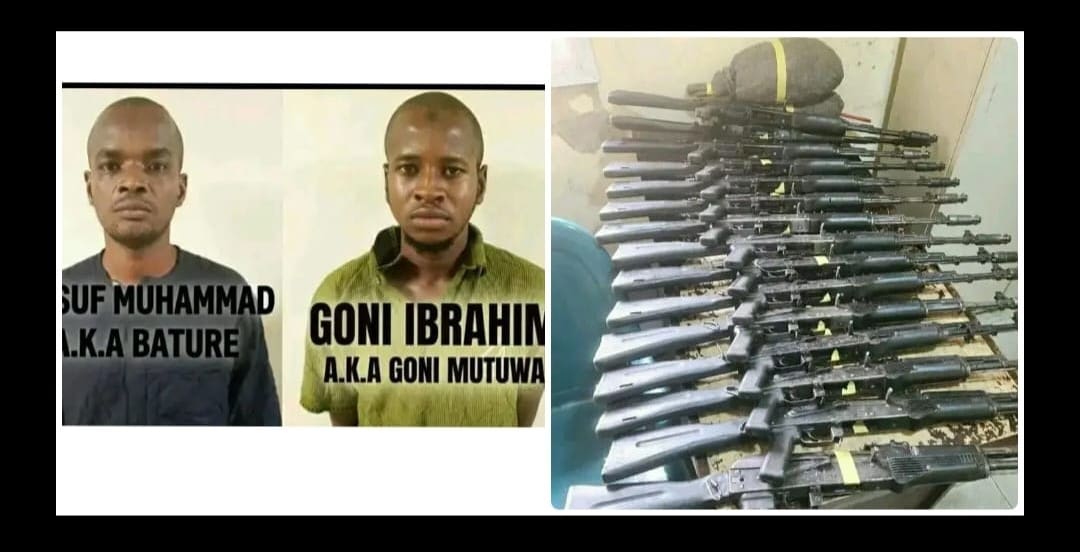
Among those arrested were Yusuf Mohammed, also known as Bature, and Mubarak Ibrahim, suspected of links to Jama’atu Ahlis Sunna Lidda’awati wal-Jihad (JAS), Boko Haram’s original faction.
The pair were intercepted along the Zaria-Kaduna Highway while allegedly receiving a weapons consignment for insurgent and kidnapping networks operating across Kaduna, Niger, Kebbi, and parts of the Middle Belt.
The interception corridor lies south of notorious kidnapping zones around Rijana and Buruku and connects to routes toward Birnin Gwari forests, Kachia County, and western forest belts extending toward Kainji Lake Reserve.
Security officials say these corridors increasingly function as logistical arteries linking weapons suppliers, couriers, and armed cells moving between northwestern Nigeria and border regions near Niger Republic and Benin.
Further arrests included Goni Ibrahim, an international weapons courier from Niger Republic’s Diffa region, and his associate Tukur Sani.
Security operatives recovered 15 AK-103 rifles, 15 magazines, and 1,434 rounds of ammunition concealed in a vehicle.
Another suspect, Alhaji Adamu, also known as Gado Banufe, was arrested in Yauri, Kebbi State, alleged to supply arms, transportation, and logistics to armed groups around Kainji Lake Reserve.
Papiri Attack Exposed Forest Sanctuary Network
Preliminary investigations connected the suspects to the November 21, 2025, attack on St. Mary’s Catholic School in Papiri, where over 300 predominantly Christian pupils, teachers, and staff were abducted from dormitories during the night.
The Papiri abduction became one of Nigeria’s largest school kidnappings since Chibok, surpassing Kankara, Jangebe, and Dapchi. Military officers previously assessed that Jama’at Nusrat al-Islam wal-Muslimin (JNIM), the al-Qaeda-linked Sahel coalition, may have facilitated the operation.
Security analysts cautioned against conflating armed Islamist movements in West Africa.
JNIM operates mainly in the Sahel, while JAS and ISWAP emerged from Boko Haram in northeastern Nigeria. Ansaru and Lakurawa refer to other militant networks in northwestern Nigeria and neighboring border regions.
Nigerian security agencies have not publicly attributed Papiri to a specific terrorist group.
Some officials describe the perpetrators as ‘heavily armed kidnapping gangs.’
Others note increasing cooperation between criminal networks and jihadist actors.
Thirty-eight days after the raid, all surviving students and staff were released in phases following intelligence collection, security operations, negotiations, and pressure on the kidnappers.
Weapons Pipelines and Expanding Kidnapping Networks
The Nigeria Security Tracker, launched at the U.S. Capitol Visitor Center, highlighted international concern over terrorism, mass kidnappings, and armed violence across Nigeria.
Analysts told TruthNigeria that incidents documented through the tracker underscore the strategic importance of the Niger-Kebbi-Kaduna corridor, where forests and border regions are increasingly used for mobility, concealment, logistics, and hostage-holding operations.
Dr. Bawa Mohammed, senior researcher at the Centre for Conflict and Security Studies in Abuja, told TruthNigeria that, “the arrests reveal a deeper transformation in Nigeria’s kidnapping economy.”
Mohammed added: “What happened in Papiri was not a random bandit raid.”
“Operations involving hundreds of hostages require weapons procurement networks, fuel suppliers, transport coordinators, safe routes, communications handlers, and armed protection teams”, Mohammed said.
“These are organized systems”, Mohammed noted.
Mike Ofuo, retired DSS Director, said the recovery of military-grade rifles suggests access to transnational trafficking structures.
“The significance is not the rifles alone. The network moving weapons from Niger Republic through Kaduna toward Kainji forests supports future attacks,” Ofuo explained.
Ofuo added that, “Kainji Lake Reserve is strategically valuable for movement, kidnap camps, evading operations, and connecting with trafficking routes toward Benin and the wider Sahel.”
School Attacks Spread Beyond Traditional Conflict Zones
The arrests come amid renewed concern over attacks on schools.
In April, armed attackers kidnapped children in Kachia County, Kaduna, killing one girl during ambush.
In May, terrorists raided schools in Ahoro-Esinle, Oriire County, Oyo State, abducting pupils, teachers, and school officials, including principal Rachael Alamu.
Teacher Michael Oyedokun was reportedly killed in captivity while hostages appeared in videos pleading for government intervention.
Security analysts say such attacks create psychological pressure, generate publicity, undermine confidence in state protection, and provide bargaining leverage.
Dr. Barada Detoun, an antiterrorism consultant, said, “hostage videos function as propaganda tools to amplify fear, pressure authorities, and demonstrate operational reach.”
More than 1,500 students were abducted in mass school attacks between 2020 and 2025, according to Reuters, showing hostage-taking persists as a strategic weapon.
The DSS has not issued a public statement on the arrests.
Investigations continue to identify additional suppliers, financiers, and cross-border facilitators linked to the Papiri kidnapping network and other emerging terrorist-linked abduction cells.
Onibiyo Segun reports on terrorism and conflict for TruthNigeria.