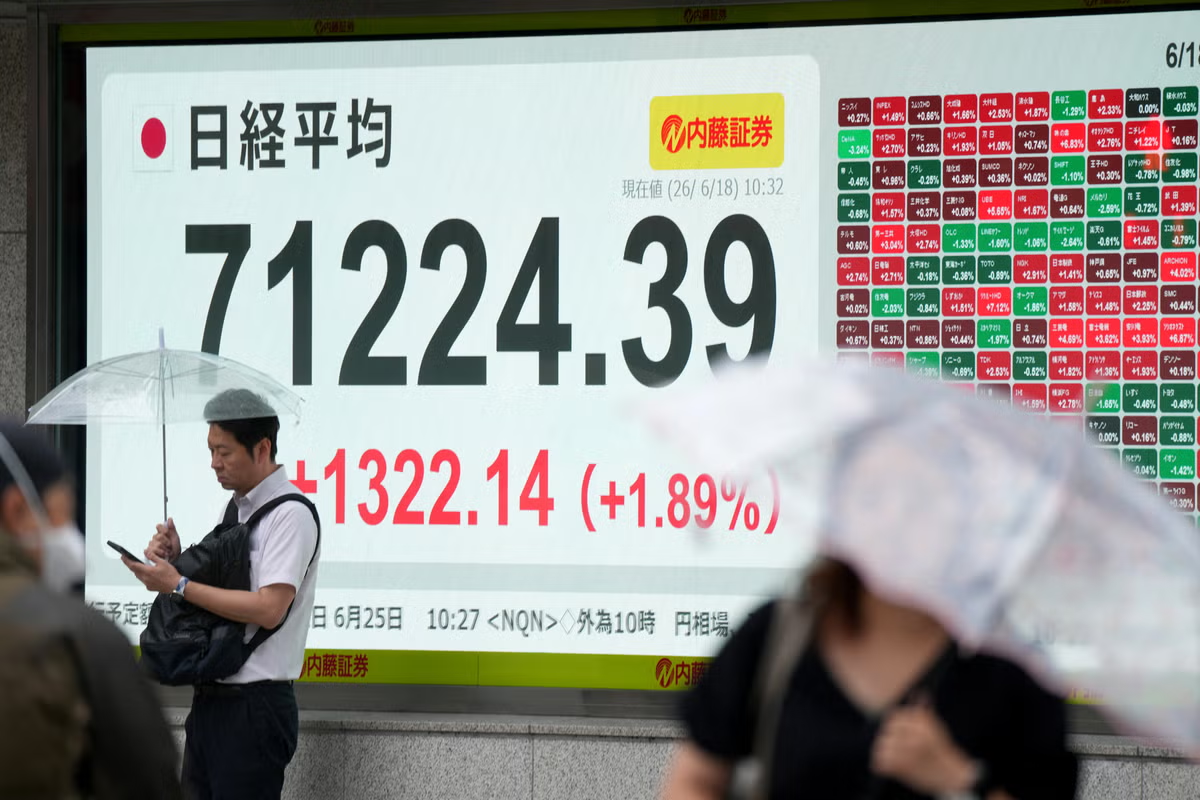
Japanese and South Korean stock markets soared on Friday, buoyed by a fragile peace in the Middle East that saw the crucial Strait of Hormuz reopen.
The development also sent oil prices tumbling further, alleviating immediate inflation concerns across global markets.
The reopening of the Strait of Hormuz, following the lifting of a US blockade on Iran on Thursday as an interim peace deal took effect, allowed oil tankers to resume passage.
Brent crude futures dropped 1 per cent to $79.03 a barrel, marking a significant 9.5 per cent weekly decline.
However, analysts cautioned against complacency, with Madison Cartwright, a senior geo-economics analyst at the Commonwealth Bank of Australia, warning: “Future governance of the strait will be led by Iran and Oman, creating scope for Iran to impose a ‘maritime service’ fee.”
She noted the current toll-free transit was guaranteed for only 60 days. “It undermines international norms on free navigation and sets a precedent that could be followed by others.”
The positive sentiment propelled Japan’s Nikkei index up 0.8 per cent to a new record for the fifth consecutive session, extending its weekly gain to 8.5 per cent.
South Korea’s benchmark index surged 3.1 per cent, contributing to a substantial 15.3 per cent weekly rise. Mainland China, Hong Kong, and Taiwan’s stock markets remained closed for public holidays.
Meanwhile, the US dollar strengthened significantly, with the dollar index set for a 1 per cent weekly gain at 100.78, hovering near a 13-month high against major peers.
This dollar surge pushed the Japanese yen to its weakest level in two years, intensifying speculation that Japanese authorities might soon intervene to stem the currency’s slide.
The dollar’s robust performance was largely attributed to a hawkish shift from the Federal Reserve, which led markets to anticipate more than one interest rate hike this year. Although the central bank held rates steady as expected on Wednesday, nine of 19 officials signalled higher borrowing costs.
New Fed chair Kevin Warsh reiterated a commitment to price stability. This outlook hit short-term treasuries, with two-year US treasury yields rising 9 basis points this week to 4.18 per cent. However, longer-dated bonds saw some relief from falling oil prices, with 10-year yields down 3 bps to 4.45 per cent and 30-year yields slumping 7 bps to 4.90 per cent, their lowest in two months.
“The curve remained notably flatter than before the meeting, reflecting the combination of higher expected policy rates and firmer confidence in the Fed’s inflation-fighting credibility,” Molly Nickolin, strategist at Morgan Stanley, said.
The cash treasuries market in Asia was closed due to the Juneteenth holiday in the US.
Wall Street futures saw a slight dip of 0.2 per cent after an overnight rally. Intel shares, however, jumped 10 per cent to a record high following an announcement by US president Donald Trump that iPhone maker Apple had agreed to collaborate with Intel on designing and manufacturing its chips in the US.
In the UK, the British pound dipped 0.1 per cent to $1.3195, extending a 0.7 per cent overnight drop after the Bank of England kept interest rates on hold in a 7-2 vote.
Greater Manchester mayor Andy Burnham’s victory in a parliamentary bye-election was also noted, removing a key obstacle to a leadership challenge against prime minister Keir Starmer.
The strong dollar exerted pressure on precious metals. Spot gold slipped 0.5 per cent to $4,188 per ounce and silver spot 0.8 per cent to $65.30 an ounce.