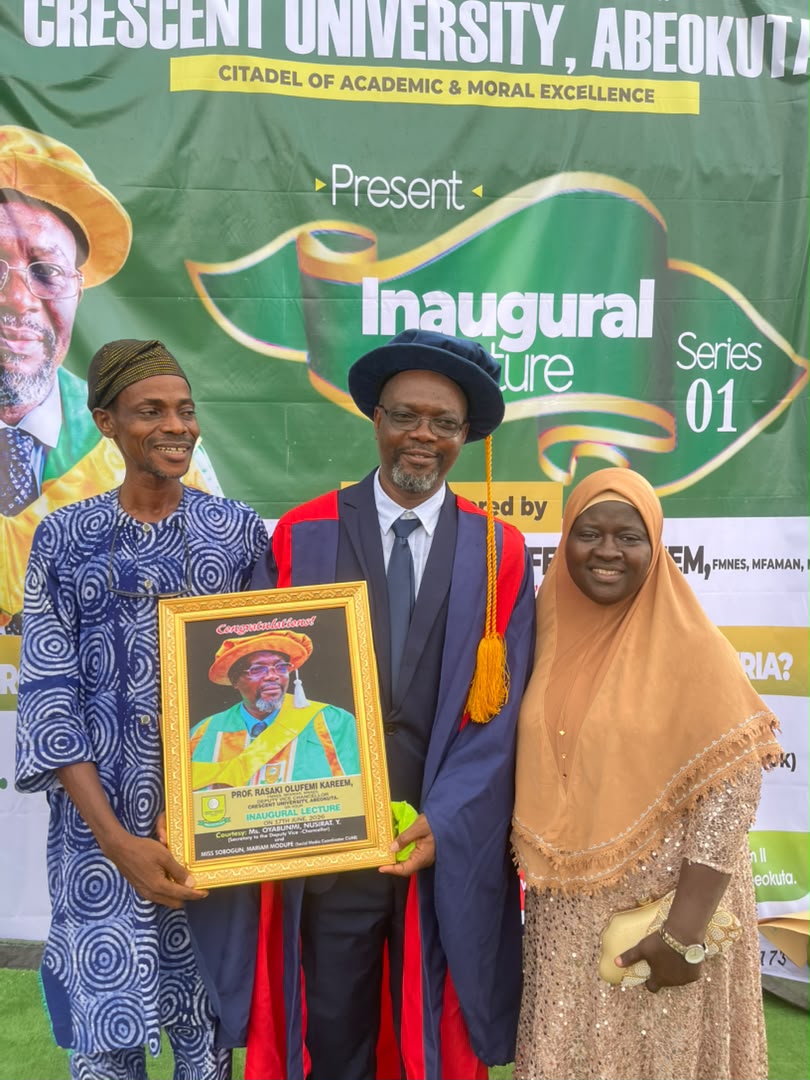
By Daniel Oluwatobiloba Popoola
Professor Rasaki Olufemi Kareem has identified efficient management of resources, rather than their abundance, as the key to Nigeria’s economic transformation and sustainable development.
Speaking at the first ever Inaugural Lecture of the Crescent University, Abeokuta, titled, “Resource Efficiency Vs. Economic Development: Whither Nigeria”, the renowned economist argued that although Nigeria is richly endowed with oil, gas, solid minerals, fertile land and a rapidly growing population, millions of citizens still live in poverty because resources have not been effectively managed and deployed.
Professor Kareem, also the Deputy Vice Chancellor of the University, explained that while Resource Economics focuses on the efficient and sustainable use of scarce resources, Development Economics seeks to improve living standards, reduce poverty and promote economic growth.
According to him, resource efficiency enhances productivity, lowers production costs, stimulates innovation, protects the environment and lays the foundation for long-term development.
Professor Kareem also highlighted the phenomenon known as the Dutch Disease or Resource Curse, noting that countries blessed with abundant natural resources often fail to attain corresponding economic progress because of poor governance, corruption, weak institutions and excessive dependence on resource revenues.
“Nigeria’s challenge is not the absence of resources, but the inefficient management and utilisation of those resources,” he said.
The Professor maintained that sustainable development in Nigeria would depend largely on effective resource management, strong institutions, sound governance, investment in infrastructure, technology and human capital, consistent development policies and active community participation.
Drawing from decades of research in fisheries, agriculture, economic growth, poverty, governance, food security and climate change, Professor Kareem demonstrated that efficient resource use has a direct impact on productivity, economic growth and citizens’ welfare.
He stressed that transparency and responsibility remain indispensable to sustainable development.
“Sustainable economic development can only be achieved when resources are utilised efficiently, transparently and responsibly,” he stated.
The scholar added that resource efficiency is critical to poverty reduction, food security, job creation and the attainment of the Sustainable Development Goals.
As part of measures to reposition the economy, he recommended diversification beyond oil, stronger institutions, improved governance and a more robust anti-corruption framework.
He also advocated increased investment in agriculture and food security, greater support for research, innovation and technology, adoption of sustainable resource management practices and enhanced public awareness on the importance of resource efficiency.
Professor Kareem summed up his message with a call for a paradigm shift in the country’s development strategy.
“Nigeria’s future prosperity depends not on the abundance of its resources, but on how effectively and efficiently those resources are managed for the benefit of all citizens,” he declared.
He urged policymakers and stakeholders to embrace resource efficiency as a pathway to inclusive growth, poverty reduction, food security and sustainable national development.