The US military launched fresh strikes on a fortified Iranian island near the Strait of Hormuz on Wednesday as diplomacy slowed and Iran restarted attacks on its neighbours.
US Central Command said the military attacked a ground control tower on Qeshm Island in “self-defence”, claiming Iran had tried and failed to attack Kuwait and Bahrain with missiles.
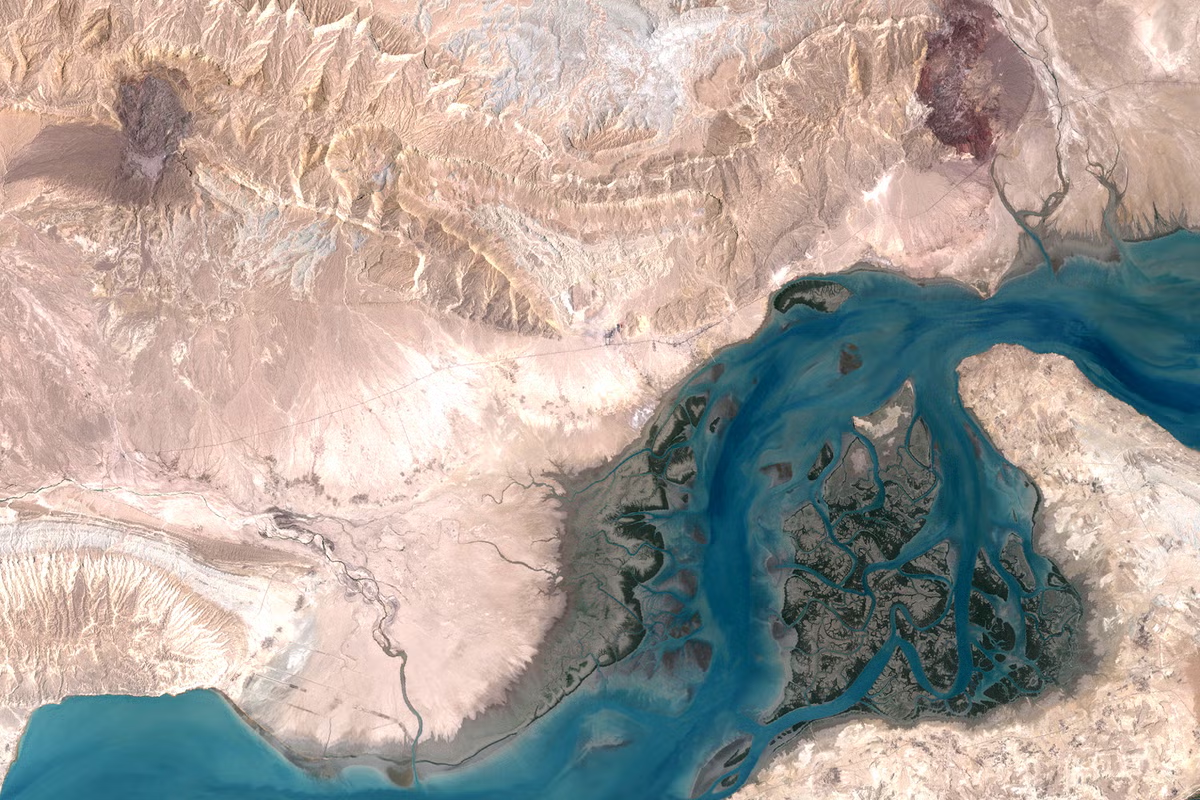
Residents reported hearing early morning explosions on the 558sq mile stretch off the mainland, which has been used throughout the conflict to attack ships passing through the closed waterway.
At the height of the war, Qeshm was briefed as a possible target for a US ground offensive as Washington looked at ways to break Tehran’s hold on the Strait of Hormuz.
In peacetime, the island is a tourist destination dotted with salt caves and the remnants of fortifications installed by European empires.
The Royal Indian Navy operated out of the island until 1863, and the last coaling station for the navy was abandoned in 1935 at the request of the Shah of Iran.
Since then, Iran has reconstituted the island with missiles, drones and fast-attack boats, giving it strategic importance for control of the Strait of Hormuz.
Exact details are kept confidential, but retired Lebanese Brigadier-General Hassan Jouni, a military and strategic expert, told Al Jazeera previously that the island has the ability to strike from an underground “missile city”.
According to Can Kasapoğlu, a defence analyst, satellite imagery suggests Iran has installed a “significant portion of its anti-ship missiles in underground launch positions on Qeshm”.
He wrote for the Hudson Institute, a conservative think tank based in Washington, that “any US campaign in the region would likely centre on two decisive islands: Kharg and Qeshm”.
Kharg Island handles some 90 per cent of Iran’s oil exports, and taking it would give the US the ability to disrupt Iran’s energy trade and place enormous pressure on the economy.
Iran has fortified the island with additional surface-to-air missiles and laid traps, including anti-personnel and anti-armour mines in the waters surrounding it, CNN reported, citing people familiar with US intelligence.
Qeshm, meanwhile, operates as the Islamic Revolutionary Guard Corps’ “primary denial hub”, a much larger base designed to shut the door on traffic approaching the Strait of Hormuz, Mr Kasapoğlu explained.
“Taking Qeshm is also most likely the harder fight,” he wrote. “The island’s size, terrain, and proximity to the mainland favour the defender. Iranian reinforcement efforts there would likely be continuous.”
Even if the US can take it, it would come at a high cost with relatively little strategic return, he said.
Rashid Al-Mohanadi, vice-president of Centre of International Policy Research and an expert in Gulf security, told The Telegraph that “Qeshm is likely to have the whole shebang” prepared for a possible invasion.
“Of course the island would have anti-ship capabilities, the coast is likely mined, the beaches booby-trapped and so on,” he said, adding that an additional threat would come from Iran’s ability to launch strikes from the mainland.
The US said on Sunday 31 May that it had conducted “self-defence strikes” on Iranian radar and drone control sites in Iran’s Goruk and Qeshm Island, in what it said was a response to “aggressive” actions from Tehran.
Early in May, a senior US official told Fox the military had carried out strikes on Qeshm, but that renewed strikes did not mean they were looking to restart the war or end the ceasefire agreement with the strikes.
Since mid-March, Trump has repeatedly said he is close to a deal to end the fighting and allow negotiators to tackle thorny issues, including the future of Iran’s nuclear programme.
Trump has said his top priority is to stop Iran from acquiring nuclear weapons. Iran denies it is developing a nuclear bomb and says its atomic programme is for peaceful purposes.
Tehran is seeking access to billions of dollars in oil revenues, waivers on crude exports, a lifting of a US blockade on its ports and continued leverage over the strait, traversed by a fifth of the world’s oil and liquefied natural gas traffic before the war.