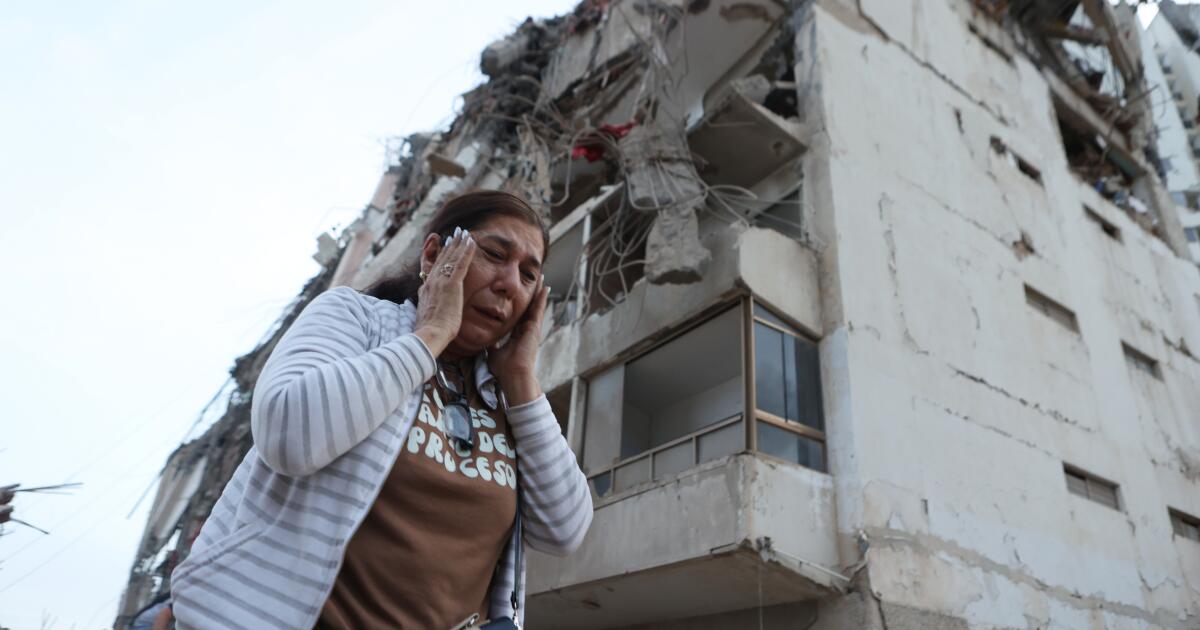
CARACAS, Venezuela — Rescue workers and civilians scrambled to pull survivors from the rubble Thursday as Venezuela struggled to recover from a pair of earthquakes that toppled scores of buildings, leaving at least 188 people dead and thousands homeless, resulting in widespread panic.
The casualty numbers seemed certain to rise as officials reported that more than 200 people were trapped in debris and at least 157 were missing.
Many Venezuelans were combing through wreckage in search of loved ones, while others turned to social media in an effort to find relatives and friends who had vanished in the disaster.
“We don’t know anything about what happened to him and are desperate,” Denise Casique wrote on Facebook, seeking help to find a missing friend. “If you’ve seen him, please send information.”
The main airport serving Caracas, the capital, shut down after it was heavily damaged, delaying the entry of aid crews from the United States, Mexico and other nations that have vowed to help.
“We are in a race against time to rescue” people trapped in the rubble, Jorge Rodríguez, president of the National Assembly, said in a message to the nation.
The double quakes — with magnitudes of 7.2 and 7.5 — struck shortly after 6 p.m. Wednesday, causing widespread electrical blackouts and cutoffs of gas supplies. In Caracas, home to about 3 million residents, many buildings were damaged and scores of casualties were reported.
Television and social media were filled with scenes of toppled and damaged buildings, including entire apartment blocks that appeared to be tottering as desperate residents camped out on the streets.
Hardest hit appeared to be the northern coastal state of La Guaira, which stretches along the Caribbean about 20 miles north of Caracas. It is a popular seaside escape for residents of the crowded capital.
The earthquakes struck as many people were out in the streets, in restaurants and cafes on the beach in La Guaira celebrating an annual holiday marking the birth of St. John the Baptist. The partying turned to gloom after the temblors.
“Everyone here is doing what they can, but no specialized help has arrived,” said Jose Pirela, 30, a fisherman in La Guaira who were among the many people joining makeshift rescue crews digging into debris from downed buildings. “All we can do is pull out stones and rubble with our hands. We need help. People are very afraid.”
Many people still appeared in shock. Thousands slept in the streets throughout the hardest-hit areas.
“The earth shuddered, the street rose up,” recalled Arturo Rivero, who had gone to La Guaira for the day with his family to enjoy the beach. “It was terrible. … When it stopped shaking, then we began to see the devastation — collapsed buildings, people hysteria, shouting. Massive destruction all along the beach avenue, people trying to help others trapped in buildings.”
The United States is deploying search and rescue teams from Los Angeles and Fairfax County, Va., to Venezuela to help in recovery efforts, Secretary of State Marco Rubio told reporters in Bahrain.
Because the airport is badly damaged, the U.S. Department of Defense will be charged with deploying the assets into the country, Rubio said.
“We are also helping them with some overhead imagery, especially in coastal areas where they do not have full visibility over what the damage has been or what the impact has been,” he said.
Rubio said the United States will know how to help in Venezuela’s long-term recovery in the next 48 hours, when the scope of the damage to the country’s infrastructure will be better understood.
The first earthquake — with a magnitude of 7.2 — struck at 6:04 p.m. with an epicenter about halfway between San Felipe, the capital of Yaracuy state, and the coastal town of Morón, according to the U.S. Geological Survey. The second, measuring 7.5, struck 39 seconds later with an epicenter about four miles to the east.
The second quake produced nearly triple the shaking energy as the first, with the fault rupturing to the east for more than 100 miles, sending quake energy right into the international airport and La Guaira.
The earthquakes — which may end up as the deadliest to hit Venezuela in almost a century — represent another stiff challenge for the Washington-backed government of acting President Delcy Rodríguez. She assumed office this year after U.S. forces swooped into the capital in a predawn raid on Jan. 3 and arrested her predecessor, Nicolás Maduro.
Maduro and his wife were flown to New York to face drug trafficking charges, which they deny. Their forced departure, and the ascent of Rodríguez, turned Venezuela from a U.S. adversary into a nation whose leadership now works closely with the Trump administration.
Many Venezuelans have already expressed disappointment that economic improvements expected after the U.S. intervention have not materialized.
Oil-rich Venezuela, a country of 28 million that was long among the wealthiest nations in Latin America, has suffered a decade of economic decline and mass emigration.
U.S. authorities have blamed the corrupt and incompetent leadership of the leftist Maduro and his predecessor, Hugo Chávez, both longtime U.S. antagonists. Before his arrest, Maduro and his supporters put the blame for the nation’s economic free fall on punishing U.S. sanctions that have throttled the economy.
Special correspondent Mogollón reported from Caracas and Times staff writer McDonnell from Mexico City. Times staff writers Rong-Gong Lin II in San Francisco and Ana Ceballos in Washington and special correspondent Cecilia Sánchez Vidal in Mexico City contributed to this report.