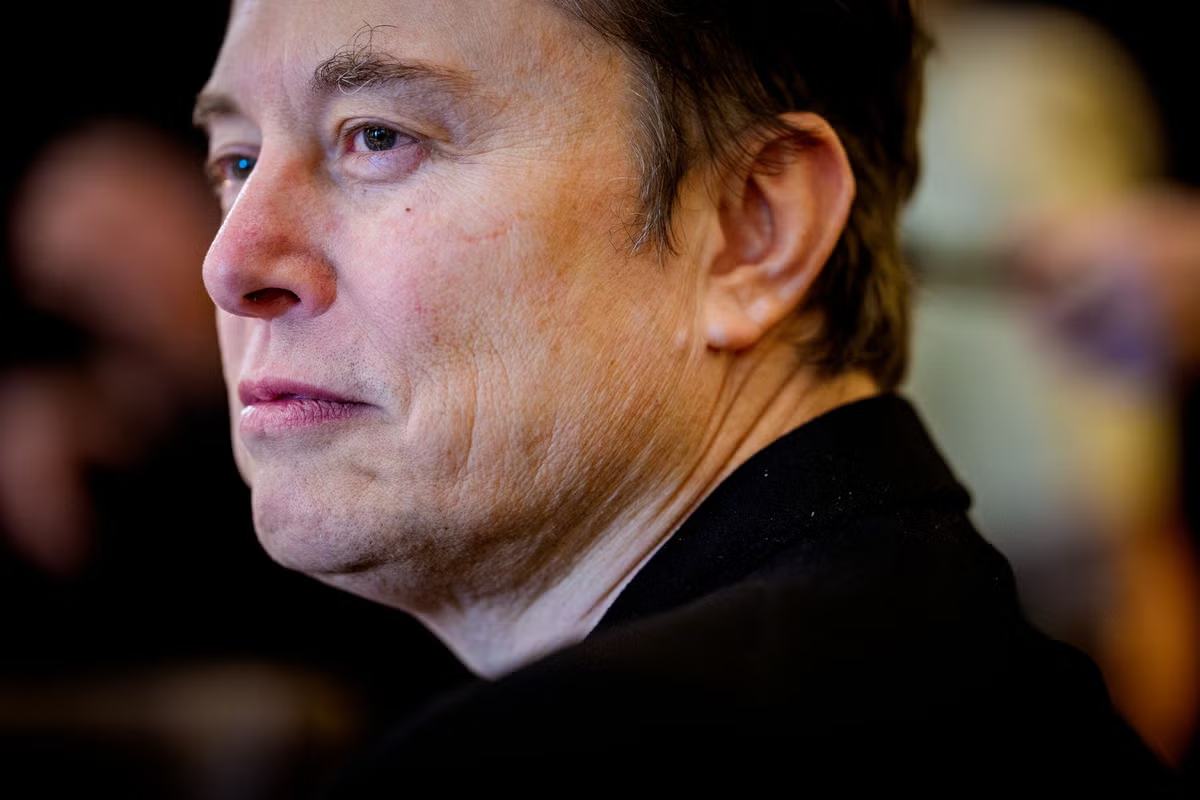
The last time SpaceX launched a rocket in South Texas, charter boat captain Eddie Reyes was just two miles from the pad, inside his pontoon boat with a group of paying customers.
They watched on as a blast of flames erupted and shockwaves rattled the boat. While the arrival of Elon Musk’s Starbase has boosted Reyes’ family fortunes – his charter business thrives, and his nephew works for SpaceX – residents say the same rockets are causing significant damage.
Shockwaves from launches are cracking the ceiling, loosening window seals, and sinking the foundation of Reyes’ mother’s home. She is among dozens of residents now suing Musk’s company for damages. Despite this, Reyes says, “You can’t stop progress.”
Many in the Rio Grande Valley share this sentiment, willing to embrace Musk’s interplanetary ambitions and their consequences. SpaceX’s rapid expansion brings jobs, visitors, and global attention, yet it also fuels lawsuits, environmental concerns, and a growing divide among the region’s 1.4 million residents.
After SpaceX’s record‑setting $1.75 trillion IPO on Friday – which will raise $75 billion partly to scale Starship from intermittent test launches to potentially weekly flights – the pressures facing residents around Starbase are set to intensify.
Tino Villarreal, city commissioner of Brownsville, a city bordering Starbase, starkly summarized the situation: “This company is literally shaking the earth. By the amount of workforce it wants to produce, by the actual wavelengths that are shaking our soil.”
SpaceX declined to comment for this story.
The clashing realities of Starbase were underscored ahead of the Starship launch last month – the largest rocket take-off and landing in the Indian Ocean – when contract worker Jose Bautista, 25, suffered a fatal fall at a nearby SpaceX facility, an episode first reported by the San Antonio Express-News. He was the most recent SpaceX worker to die or suffer serious injuries in Musk’s rush to colonize Mars.
On TikTok, a video posted by local policy researcher Etienne Rosas demanding the company take accountability generated thousands of likes. A cousin of Bautista thanked him in the comment thread, adding “my family is in need of prayers.”
But others defended SpaceX in response to Rosas, claiming the company wasn’t responsible for the death. One person suggested that Bautista, even in death, would be able to “see an accident for what it is.” The person, who didn’t respond to Reuters’ request for comment, added: “Projects of magnitude like the Hoover Dam for example always claim many lives and the project continues. It’s the American way.”
A spokesperson for the City of Starbase declined to comment. The Occupational Safety and Health Administration, which is investigating the incident, declined to comment. A representative for Bautista’s family declined comment.
The Cameron County Sheriff’s office directed Reuters’ comment requests to SpaceX.
SpaceX, which didn’t respond, has yet to acknowledge Bautista’s death publicly.
When construction began on the Starbase SpaceX site in 2014, Boca Chica was a small cluster of homes along the Mexico border and a popular beach for Brownsville residents. Now, two launch sites tower almost 500 feet above the beach and the expanding neighborhoods of Airstream trailers, tiny homes, and new mansions.
SpaceX hopes to one day manufacture components for as many as 1,000 Starships in the town’s Starfactory – a 1 million square-foot advanced manufacturing facility – and the Gigabay, a 380-foot-tall structure for assembling the rockets.
The town has its oddities. A SpaceX employee, Bobby Peden, was elected mayor last year soon after the town was incorporated. The town is setting up a police force, and has discussed opening its own municipal court – in which Peden would serve as interim judge.
At the local school, Ad Astra, young children are taught to work “with numbers into the thousands – far beyond kindergarten standards,” according to the school’s website. The local bar, Astropub, is only open to SpaceX employees.
“When I showed up, we had one street with houses, we were building rockets in tents, and we didn’t have water or a sewer system,” said Kathryn Leuders, who was general manager of Starbase before it was incorporated. Now “you’re raising families, and you’re raising children in this community that is Starbase, that’s also got a launchpad in its back yard. It’s a really cool thing.”
Like the Mars colony depicted in a massive mural on the side of Gigabay, the town serves as a potential model for the future of interplanetary colonies. On a recent evening ahead of the Starship launch, the streets buzzed at 5 p.m. with employees streaming from Starbase buildings on bicycles while convoys of Cybertrucks lined the highway to Brownsville, passing sculptures of Musk and a sign stating, “Mars Embassy. Future Location.”
“I’ve been to NASA, and you don’t get anywhere near something like this,” said Nicholas Poindexter, a pest control worker and space enthusiast who had traveled from Indiana to see the Starship launch. “Last time I was here I thought, holy cow, you could throw a rock and hit” a rocket.
Many local officials have welcomed Starbase as a boon to one of America’s poorest regions. An impact report produced by the Greater Brownsville Economic Development Corporation in March stated that Starbase has created 5,000 jobs and brought in $100 million in tourism revenue over the last year.
Wearing a SpaceX ‘Starship’ t-shirt, Brownsville city commissioner Villarreal pointed out new restaurants serving the increasingly affluent workforce, in between boarded-up store fronts and run-down homes.
Musk “has moved at the speed of light, and I think that’s helped Brownsville also really move a lot faster in our growth and development,” said Villarreal. “It’s injected a steroid into Brownsville.”
Some local Rio Grande Valley residents initially welcomed SpaceX. Maria Pointer lived in the region for almost two decades when she sold her home to SpaceX in 2020 after meeting with Musk. “We were excited,” she said. “I really felt, at the time, that we deserved the moon as the gas station to wherever all the Elons of the world wanted to go in interstellar space.”
Over time, Pointer has become less optimistic, saying the town has become less friendly. In April, she went to Starfactory to film an interview with an Italian news crew, beneath a huge “X” near the entrance to the building, where her kitchen once stood. A security guard approached and instructed them to leave. “It was very military,” she said.