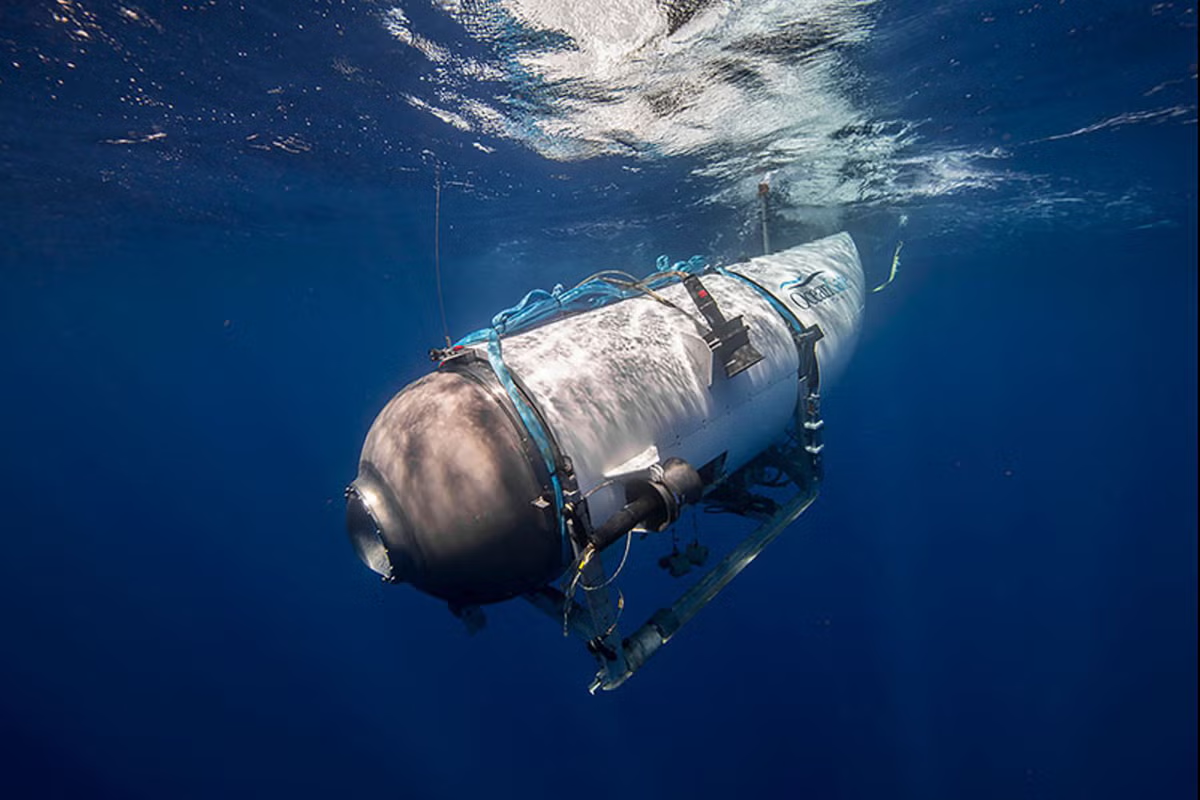
The damning final report into the Titan submersible implosion has blamed a multitude of factors for the 2023 disaster, including design flaws and failures by the company that launched the doomed expedition.
Five people were killed when the sub made a deep-sea voyage to the wreckage of the Titanic; a British businessman, a French explorer, a father and son, and the CEO of the company that operated the dives.
In the newly released 136-page investigation, the Transportation Safety Board of Canada highlighted a series of failures that led to the underwater catastrophe.
OceanGate, the company behind the expedition, did not know “how long the Titan’s pressure hull would remain structurally intact when used repeatedly for dives to the depth of the Titanic” the report said.
The Washington state-based company built a pair of 1/3 scale models of the Titan to test how it responded to pressure, with six tests being carried out on the models. However, both failed at depths above the resting place of the Titanic, investigators found.
Inspectors noted in the report that normal engineering practices would expose full-scale models to “hundreds, possibly thousands,” of test cycles.
While tests equivalent to the Titanic’s depth and deeper were carried out, there was no further analysis to understand if the hull could fail after repeated use, they said.
The Titan’s carbon fibre cylinder was accumulating damage each time it was exposed to extreme pressures on deep-ocean dives, the report says. However, the “as-built properties of the Titan’s carbon fibre cylinder were never validated to ensure they met the theoretical values used in the design process.”
Also, the construction and testing of the Titan “did not follow standard engineering practices.”
The report stated that there was “no precedent for diving a human-occupied carbon fibre submersible to the deep ocean,” with OceanGate acknowledging publicly and internally that its operations involved risk, the report said.
However, “over the course of OceanGate’s operating history, some OceanGate employees with expertise in specific areas left the company or were dismissed after raising safety-related concerns or expressing differing perspectives from the CEO,” the investigators said, listing multiple examples.
The Canadian report’s conclusions echo those reached by the U.S. Coast Guard Marine Board of Investigation and the U.S. National Transportation Safety Board last year.
In its 2025 report, the NTSB noted that the carbon fibre composite pressure vessel contained “multiple anomalies” and failed to meet strength and durability requirements.
The report followed the Coast Guard’s own 2025 probe into the incident, which also blamed the carbon fibre hull for the implosion but also branded safety procedures at OceanGate as “critically flawed.”
Canadian officials noted that the vessel may have sustained damage on a number of occasions, including when it collided with the port bow of the Titanic in 2022. Almost two weeks later, a loud bang was heard when the Titan surfaced from another dive, according to all three reports.
The vessel was also left outside and exposed to the elements from July 2022 until February 2023, Canadian officials and the U.S. Coast Guard noted.
TSB Chair Yoan Marier said in a press release that the organization has been calling for “stronger regulatory surveillance in the marine sector for years.”
“When it came to the Titan, critical information existed across multiple federal governmental organizations, but no one was responsible for connecting the dots,” Marier said.
“Without a complete picture of the operation, the Titan continued to operate in Canada without regulatory oversight.”
The Titan expedition launched from St John’s, Newfoundland, in Canada. British businessman Hamish Harding and French Explorer Paul-Henri Nargeolet were among the five people killed in the implosion, along with Pakistani businessman Shahzada Dawood and his 19-year-old son, Suleman.
The father and son’s remains were returned as “slush” in “two small boxes,” Suleman’s mother Christine Dawood later told The Guardian.
Stockton Rush, the co-founder of OceanGate, was also killed in the implosion. Had he survived, the U.S. Coast Guard said in its report that it would have contacted the Justice Department for their consideration on whether to pursue manslaughter charges.
OceanGate’s other co-founder Guillermo Söhnlein told Sky News last year that he cannot defend Rush over of the issues relating to the vessel’s hull.
According to Söhnlein, who left OceanGate in 2013, Rush “did what he did, and he said what he said.”
However, Söhnlein added that while it could be “easy” to see Rush as a “criminal”, for those who knew him prior to the disaster he was a “human being just like us.”
More details here...