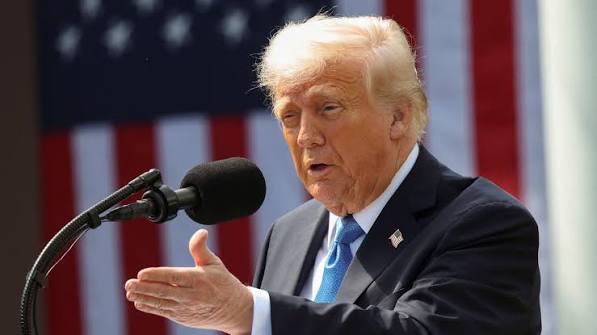
(US President Donald Trump. Photo by BBC)
US President Donald Trump has hit back at critics of his agreement with Iran, branding those accusing him of making concessions to end the war as “fools,” as negotiations in Switzerland on implementing the deal approach.
Oil prices tumbled after Trump and his Iranian counterpart separately signed the accord aimed at ending the Middle East conflict, with provisions to reopen the Strait of Hormuz, though a further two months of negotiations now lie ahead.
The signing took place unexpectedly on Wednesday at a candlelit dinner with French President Emmanuel Macron at the Palace of Versailles a venue carrying significant historical weight as the site where the treaty ending World War I was signed.
Macron, for whom hosting the signing represented a notable diplomatic achievement following his recent hosting of the G7 summit, reportedly reacted enthusiastically as Trump signed.
Hours later, Trump took to social media to dismiss critics, pointing to record stock market highs and falling oil prices as evidence his approach toward Iran had succeeded, and describing detractors as envious, malicious, or simply misguided.
Iranian President Masoud Pezeshkian also signed the agreement, with foreign ministry spokesman Esmaeil Baqaei noting that attention would now shift to testing its implementation. Crude oil fell more than three percent on Thursday, extending losses seen since news of the deal first broke over the weekend.
The agreement is intended to formally end the US-Israeli conflict with Iran, which saw five weeks of intense fighting before a ceasefire in early April and severely disrupted shipping through the Strait of Hormuz, driving up global energy prices.
Pakistani Prime Minister Shehbaz Sharif, whose country helped mediate the deal, said it would take immediate effect, with Iran expected to reopen the strait right away; he also signed the accord.
A two-month negotiating period now begins, with attention focused on the strait’s reopening and progress on talks regarding Iran’s nuclear programme, which Washington has long suspected of concealing weapons ambitions.
Macron described the deal as enabling peace, the toll-free reopening of Hormuz, and a 60-day window to finalize agreements on nuclear, ballistic, and regional security matters.
Some confusion remains over next steps, as the agreement had originally been expected to be signed in Switzerland on Friday by Iran’s chief negotiator Mohammad Bagher Ghalibaf and US Vice President JD Vance.
While Baqaei suggested an in-person ceremony was no longer necessary, Sharif indicated that an official signing event would still proceed in Switzerland on Friday, alongside the start of technical talks.
Under the agreement, the US has committed to immediately lifting oil sanctions that have crippled Iran’s economy, and once a final nuclear deal is reached, Washington will help facilitate release of a $300 billion reconstruction fund backed by regional nations.
The head of the UN’s atomic watchdog, Rafael Grossi, said the agency stands ready to begin outlining the practical steps needed to implement the deal, with US officials indicating that Iran would dilute its enriched uranium stockpiles, potentially through on-site down-blending under international supervision.
Notably, Iran’s ballistic missile programme was not addressed in the agreement, despite longstanding Israeli pressure for its dismantlement, with Baqaei stating firmly that Iran’s defence capabilities would not be subject to negotiation under any circumstances.
The deal has drawn mixed reactions domestically in both countries. Some hardliners in Iran have criticized the conflict as an imposed war, drawing comparisons to the 1980s war with Iraq, with Ghalibaf describing the outcome as a US failure even as Pezeshkian called it historic.
In the US, the conflict which claimed the lives of 13 American service members and consumed a significant portion of military ammunition stockpiles has unsettled some of Trump’s political allies.
Republican Senator Bill Cassidy described the agreement as one of the worst foreign policy blunders in decades, arguing that Iran’s nuclear ambitions remain unchecked and that the episode has demonstrated the effectiveness of threatening the strait.
Even Fox News highlighted criticism suggesting the deal grants Iran substantial financial benefits without requiring it to dismantle its nuclear programme.
Meanwhile, although the agreement specifies that Lebanon should be part of the broader equation, it remains unclear whether the conflict on that front will be addressed within the 60-day window.
Lebanon became entangled in the wider conflict after Hezbollah launched rocket attacks on Israel in March in support of Iran, prompting an extensive Israeli military response including airstrikes and a ground invasion.
Although violence in Lebanon has eased since the deal’s announcement, an Israeli drone strike in the south of the country killed one person on Thursday, according to Lebanese state media.