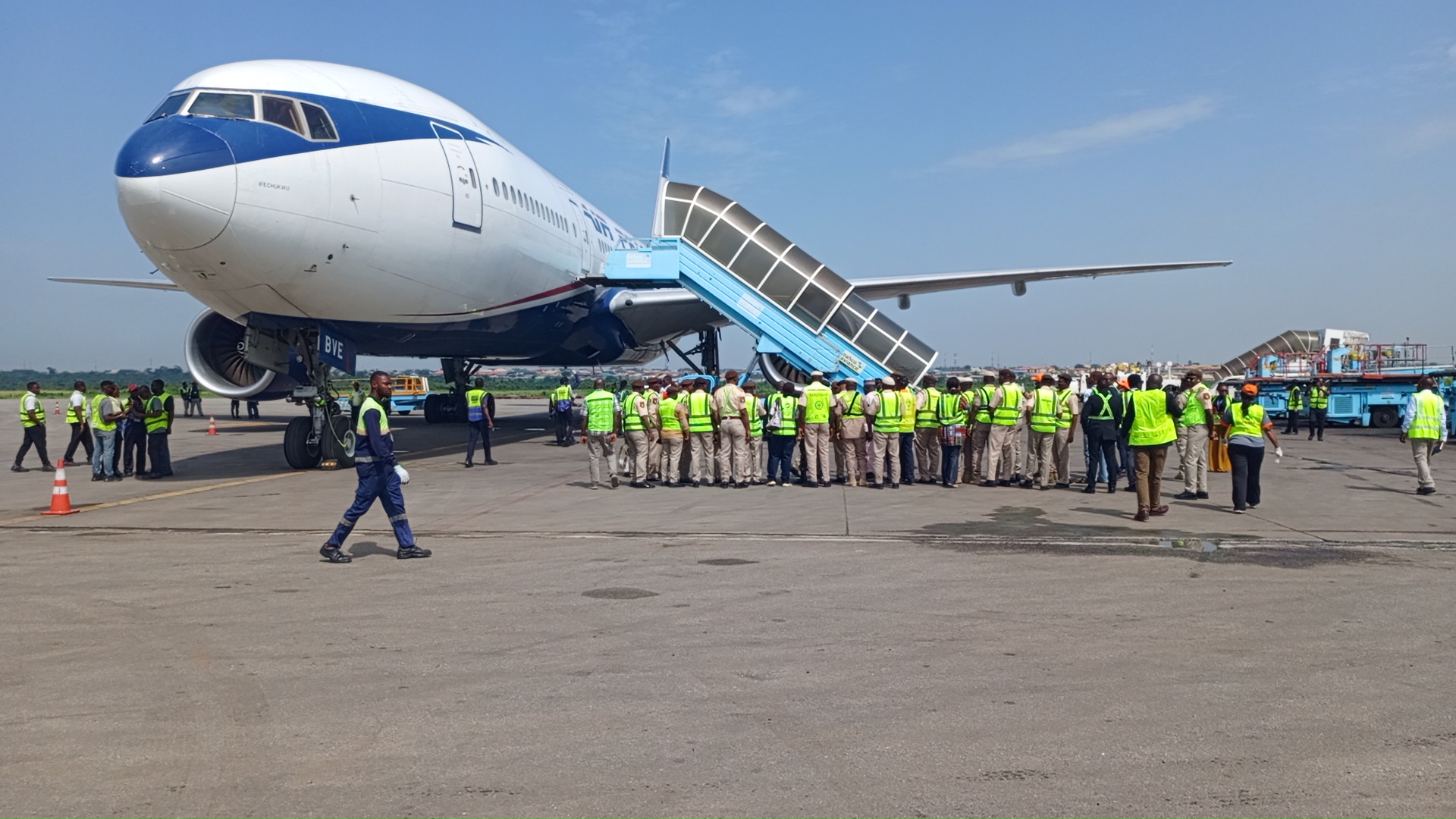
The returnees were flown in on a government-arranged evacuation flight operated under the coordination of the Ministry of Foreign Affairs and relevant agencies.
The first batch of 258 Nigerians evacuated from South Africa arrived in Lagos on Wednesday, marking the beginning of a federal government-coordinated repatriation exercise launched in response to weeks of xenophobic attacks against foreign nationals in the country.
The returnees, comprising men, women and children, landed at the Murtala Muhammed International Airport (Cargo Terminal) aboard a specially arranged Air Peace flight, the first of five evacuation flights approved by President Bola Tinubu to bring home more than 1,000 Nigerians who registered for voluntary evacuation.
Officials of the Ministry of Foreign Affairs, the Nigerians in Diaspora Commission and other government agencies received the evacuees on arrival and commenced documentation and profiling before they are reunited with their families and enrolled in reintegration programmes.
Speaking at the airport, the Acting High Commissioner of Nigeria to South Africa, Alexander Temitope Ajayi, said the returnees had endured a traumatic experience but were relieved to be back home.
“I want to start by thanking the Almighty God for bringing us this far and for bringing us here safely,” Mr Ajayi said.
“The people you see here today are our fellow Nigerians who have decided to come back home to escape the irresponsible violence that has been taking place in South Africa. They are in good spirits and have been looking forward to returning home since we started this process.”
He disclosed that the 258 evacuees constitute the first batch in the planned evacuation exercise and commended President Tinubu for personally driving the initiative.
According to him, the president became deeply concerned shortly after the crisis began and established a direct communication channel involving the Presidency, the Ministry of Foreign Affairs and the Nigerian High Commission in Pretoria to monitor developments and coordinate the response.
“From the very day the crisis started, Mr President established what we called a hotline communication between himself, the Ministry of Foreign Affairs and the mission in South Africa. Every day, he sought updates on developments and possible actions,” he said.
Mr Ajayi added that the Presidency also set up a crisis monitoring unit to track the situation across South Africa’s nine regions, where anti-immigrant demonstrations spread in recent weeks.
He said President Tinubu had directed as far back as April that all Nigerians willing to return home should be evacuated.
Welcoming the returnees on behalf of the federal government, the Minister of State for Foreign Affairs, Sola Enikanolaiye, acknowledged the trauma many of them had endured and assured them of government support for their reintegration.
“My fellow Nigerians returning home, you are most welcome,” the minister said.
“I am happy to welcome you in the name of Mr President, but at the same time I am saddened because I know the kind of trauma our people have gone through. We are very sorry that this happened.”
He said President Tinubu remained committed to improving conditions in Nigeria so that citizens who travel abroad would do so out of choice rather than necessity.
Mr Enikanolaiye also revealed that the federal government had fully paid Air Peace for the evacuation operation and commended the airline for what he described as its patriotic support.
He disclosed that government, working with state governments and the private sector, had developed support measures and incentives to assist the returnees as they rebuild their lives.
The minister said Nigeria would continue to engage South Africa diplomatically to prevent a recurrence of attacks against its citizens.
“We believe in diplomacy. We believe in engagement. We believe in dialogue,” he said.
He explained that the two countries already have institutional frameworks, including the Nigeria-South Africa Binational Commission and an Early Warning Mechanism established through a memorandum of understanding, to address emerging tensions and protect nationals of both countries.
Mr Enikanolaiye said the government intended to strengthen those mechanisms to ensure quicker and more proactive responses to future crises.
He stressed that migration should not be criminalised, noting that Nigerians living and working legally in South Africa contribute significantly to the country’s economy.
“If you go to South Africa today, you will find Nigerian professionals working in hospitals and Nigerian lecturers teaching in universities. They are making enormous contributions,” he said.
“Our responsibility is to ensure that our people are valued and treated better wherever they are.”
He also assured Nigerians abroad that the Federal Government remained committed to protecting them through improved consular services while urging citizens to respect the laws of their host countries.
Returnees who spoke with this newspaper recounted harrowing experiences during the attacks, saying their businesses and means of livelihood were destroyed by the violence.
Several of them described life in South Africa during the crisis as a daily struggle for survival, saying they lived in constant fear of being attacked.
“Life and death was 50-50 for us,” one of the returnees said, expressing relief at returning to Nigeria.
The returnees thanked the Federal Government for facilitating their evacuation, saying the intervention had saved them from an increasingly dangerous situation
The arrival of the returnees marks the first phase of one of Africa’s largest coordinated repatriation exercises in recent years following renewed xenophobic attacks in South Africa.