NABATIEH, Lebanon — Sweating under a powerful afternoon sun, the crowd slapped their chests in time with the chanter’s cry, his mournful refrain echoing over the abandoned, rubble-lined streets of this wounded city that has been the focus of Israel’s latest attacks in Lebanon.
“Karbala, O Karbala!” the chanter called.
“This is the tragedy of Karbala,” the crowd responded as the procession trudged through Nabatieh’s central district, pulverized after weeks of intense Israeli strikes.
Their chant referred to the site of a 7th century battle where a hopelessly outnumbered Imam Hussein, grandson of prophet Mohammad and a revered figure in Shiite Islam, was killed and beheaded in a defiant last stand against an unjust Sunni ruler.
Shiites hold their most sacred and emotionally charged annual ritual — Ashura — to commemorate Hussein’s death, honoring him as a galvanizing symbol of the fight against oppression.
This year’s procession passed reminder after reminder of the latest war to engulf southern Lebanon — on which U.S.-Iran peace negotiations also hinge. The next phase of talks, which resumed Sunday in Switzerland, was postponed Friday amid renewed fighting between Israel and Hezbollah in and around Nabatieh.
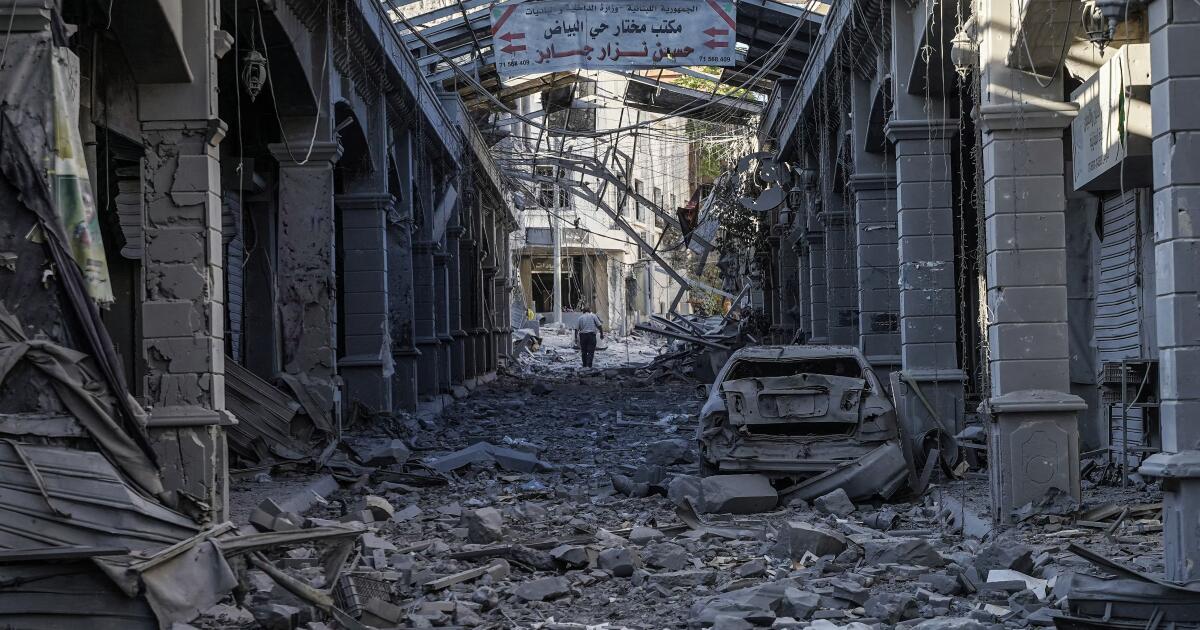
Here was the city’s historic souk, now a disfigured maw of masonry and rebar. Near a bulldozer, the forlorn husk of a car hunkered in the midst of a store’s wreckage. Every few feet were cairns of glass swept away from shattered storefronts.
“With spears and swords!” the chanter cried.
“Arise, O protector of the homeland!” the crowd responded.
The Battle of Karbala took place in what is now Iraq, and for the few hundred residents who braved a shaky ceasefire to return to this city, it has never felt closer.
A view of the destruction as Lebanese residents return to their homes in Nabatieh on June 15 following a ceasefire agreement reached between the U.S. and Iran.
(Houssam Shbaro / Anadolu via Getty Images)
“Here, where we are now, this is Karbala,” said Hussein Nahleh, a 33-year-old architect whose home in Nabatieh was destroyed, but nevertheless insisted on commuting from his shelter in the Lebanese capital, Beirut, to participate in Ashura.
“After a war, to return here after what Israel did to us, it’s the victory of blood over the sword. This is Karbala,” he said.
Lebanon’s battered Shiite community is taking stock of the destruction wrought by yet another confrontation between Israel and the Iran-backed Lebanese Shiite militant group Hezbollah.
Faced with an Israeli government whose leaders openly see the permanent uprooting of Lebanon’s Shiites as a military objective — and a Hezbollah that vows to fight for every inch of Lebanese territory no matter the cost in blood and treasure, Shiites grapple with an existential challenge not only to their role in Lebanon’s long-term future, but even their very presence in their heartland areas.
That challenge can be seen in almost every corner of Nabatieh, a city of some 90,000.
Israeli troops advanced to its outskirts and didn’t enter, but their strikes pummeled what had been an economic powerhouse of Shiite business affluence.
Every street presents a tableaux of desolation. Water, electricity and communications infrastructure, barely restored after a previous fight with Israel, are out again. And the Israeli army remains a few miles south, its presence marked by the occasional plume of smoke where its artillery hits, and the rip of machine-gun fire.
A study by the Lebanese government’s National Council for Scientific Research determined Nabatieh and its environs had suffered the most devastation of all areas in the war, with almost 10,000 housing units destroyed or damaged.
“The amount of destruction, the amount of shelling … it was very difficult. This was the worst attack the city has endured,” said Hussein Faqih, who heads the Civil Defense in Nabatieh.
After more than 100 days of work, and having suffered the loss of nine paramedics to Israeli attacks along with 43 wounded, he looked almost bereft with exhaustion. The ceasefire provided little respite, Faqih said.
“If anything, it’s harder for us to operate, because you don’t know if Israelis will attack you,” he said, adding that a lot of residents weren’t able to return because Israeli troops would fire if they approached.
Moments later, Faqih answered his phone. When he got the caller’s message, his face turned blank.
“I got word. My parents’ house, my daughter’s house, my house; the Israeli enemy bombed them,” he said, as his eyes brimmed with tears.
Initially, there were no plans to hold Ashura in Nabatieh this year, said Mehdi Sadeq, head of Nabatieh’s Emergency Rescue Service, a charity organization.

The Lebanese army deploys in the area as residents return to their homes in Nabatieh following the agreement reached between the U.S. and Iran.
(Houssam Shbaro / Anadolu via Getty Images)
But when the truce was announced last week and the fighting largely abated, it triggered a trickle of returnees on Wednesday; not much, but “enough to hold a ceremony,” Sadeq said.
Sadeq and his team of volunteer paramedics began to prepare what they could, insisting on going ahead even when a flurry of Israeli strikes overnight frightened many of the returnees back to their shelters. Still, Sadeq acknowledged the Ashura ceremony would be much diminished compared with previous years.
“You’d have tens of thousands of people and sheikhs in the streets, all roads closed to cars, processions all over the city, food being served. That’s why they called it ‘The City of Hussein.’ That’s all gone, of course,” Sadeq said.
“But the yearning for Ashura, the eagerness, the tears in people’s eyes; that has doubled, because people are living Karbala in their lives.”
Standing in the half-finished cinder-block basement of the house that serves as the Ambulance Service’s HQ, Sadeq tipped a bowl of chopped onions into a large pot, stirring slowly as the oil sizzled.
Peppers followed, along with a healthy sprinkling of spices.
“It’s chicken curry. We do a different dish every day for the communal meal,” Sadeq said, nodding at the pot.
“We’re expecting 200 people. It’s a trial. If it goes well, more will come.”
Ashura processions are usually dramatic affairs, with chanters singing elegies or dirges dedicated to Hussein, while audience members beat their chests and engage in displays of mourning. Some go further, flagellating themselves or using a sword to strike their forehead to draw blood. The rituals culminate on the 10th day of the month Muharram, which this year falls on June 26.
Sadeq, a 45-year-old whose clerical salt-and-pepper beard and calming mien manifested his upbringing as the son of Nabatieh’s imam and a scion of the city, spoke of the need for Lebanon’s Shiites to formulate a way beyond the conflicts that have marked their history. For him, Hussein’s death was about fighting oppression, yes, but also about putting the common good of the faithful above one’s self.
After all, he pointed out, even Iran was making accommodations with the United States, its longtime nemesis. That change had to resonate in Lebanon, he said.
“We have to find a sustainable narrative to end this conflict, without forgetting what we sacrificed and that Israel is a killer,” he said.
“We have to look out for our future and our new generations, to be strong in realms other than weapons.”
The war-weariness in Sadeq’s words reflects the exhaustion felt throughout Lebanon, but especially among the Shiites who form a third of its 6 million residents.
Two wars in as many years with Israel — both launched on other’s behalf but with outsized consequences borne here — have resulted in thousands of dead, a million-plus displacement crisis and the leveling and occupation of wide swaths of the country.
First came October 2023, when Hezbollah struck Israel in support of Hamas’ attack on Israel. That triggered an Israeli response, culminating in a ferocious campaign that felled much of Hezbollah’s leadership. Hundreds were killed, and Israel invaded parts of Lebanon.
In November 2024, Hezbollah submitted to a humiliating truce that allowed Israel to continue attacking for 15 months without it firing a shot. It was the lowest moment in the group’s 44-year history. It appeared a spent, hopelessly outclassed force whose time had come to an end.
Which made it all the more surprising — to allies, enemies and even the group’s own supporters — when Hezbollah lobbed a barrage of missiles and drones at northern Israel on March 2.
In this conflict, almost 4,000 people in Lebanon have been killed — a higher death toll than Iran’s — including 746 women, children and health workers; and more than triple that wounded. Israeli forces have stabbed farther into Lebanon, occupying more than one-tenth of the country — earlier this month they captured the 12th century fort that overlooks Nabatieh — and have razed dozens of villages.
“None of the wars in the past included what we have now,” said Paul Salem, a senior associate at the Center for Strategic and International Studies.
Previously, Lebanese were able to return to homes they had fled. Now there’s nothing to return to. “This time, many towns and villages no longer exist,” he said.
While the war’s outcome remains a matter of debate, it has nevertheless flipped the narrative on Hezbollah, revealing a resurgent force that can inflict pain on Israeli troops and fight Israeli advances with drones and antitank missiles.
Many of Hezbollah’s supporters, meanwhile, point to Iran and its willingness to fight as proof that Lebanese should turn to Tehran, not Washington, to protect themselves from Israel.
At the same time, Israel — which was not party to the Iran-U.S. ceasefire negotiations — has given no indication it will withdraw from Lebanon.
Seemingly unperturbed by Israel’s presence were the congregants who gathered Wednesday for Ashura.
As the sun began to lower, the men gathered in a circle, the tempo of their chest-thumping accelerating with the intensity of their chants.
“We remain loyal to our promise, O Hussein!” they shouted. “Our soul is in your hands, O Hussein!”
A day later, Israeli strikes intensified once again, underscoring the precariousness of any cessation of hostilities. Sadeq and other officials decided to switch the Ashura procession to Beirut.
“We had no choice. It’s too hard to stay,” he said.