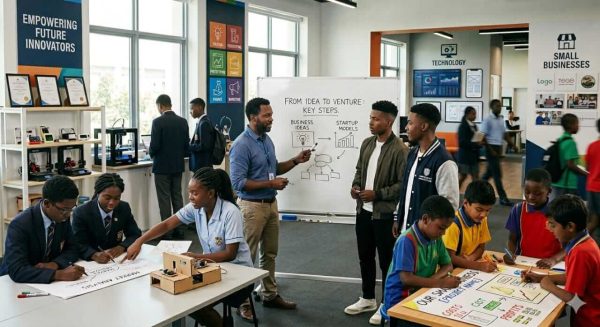
Entrepreneurship education should not only be taught in university, but also at every academic level. In my perception, early exposure to entrepreneurial concepts and skills helps cultivate entrepreneurial mindset at a young age, enabling beneficiaries to create job opportunities or self employment.
This brings to my memories how my secondary school friend was making money while she was in school at her early age and also supporting her parents in training some of her siblings. This was by bringing her ideas into reality and turning it into goods and services that are needed in the society. This reminded me that at that time, she wasn’t just an entrepreneur, she created value for herself in society. Now she has her own business, which she is running, and also a great network while still attending university.
Entrepreneurship education is important at all academic levels because it develops passion in students in choosing a career at an early age. It also develops confidence in young students and builds communication and decision making skills at a very early age.
Additionally, entrepreneurship education improves creative, critical, and innovative thinking. This will increase the abilities of students to analyse, interpret, observe, and solve problems in the society, starting from an early age. It also reduces dependency and enhances independence in job seeking, imbuing students with the ability to create jobs for themselves and others in the country.
Also, most students in secondary schools are unable to further their education because of lack of finances. Students can no longer pursue their goals. But with entrepreneurship, students can create job opportunities for themselves even before entering into universities to avoid financial setbacks or becoming school dropouts.
In Nigeria, more than 30,000 students graduate from schools every year and still do not have a job. Some students who are in school are going through financial struggles. Two months ago, the price of gas was N1,300. Now it is N1,700. The cost of petrol has also increased, which has resulted in the increase of transport fare for those students who do not reside in campus hostels. The cost of foodstuffs has also increased. The same goes for house rent and school fees.
How exactly are students meant to survive this when the prices of things are increasing every day?
School is no longer about just learning. It is about who can afford it. At this point, your dreams will depend on your pocket, not your passion.
Ultimately, unemployment is a problem that is affecting most developing countries. It is identified as one of the major challenges faced by Nigerian youths. In some countries, children above 18 are being paid a monthly allowance and might have finished college, while in Nigeria there is no monthly allowance and some students above 18 might still be in secondary school.
Introducing entrepreneurship in secondary and primary schools will help students create jobs for themselves, witness economic transformation, innovation, creativity, become self-reliant, and also reduce the level of poverty in the country.
. Aminone, a 200 Level Journalism and Media Studies student at Delta State University Abraka, can be reached via [email protected].