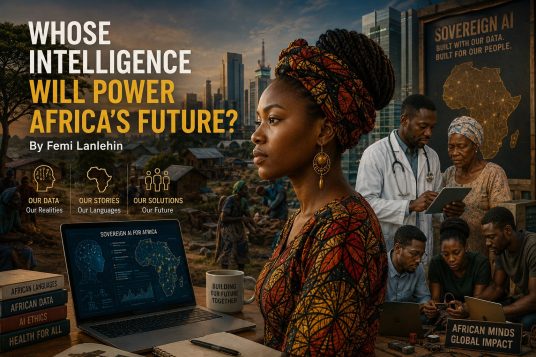
Artificial Intelligence has become the major and defining technology of our generation. Much like the internet reformed communication, AI is becoming the foundation upon which future economies, governments, healthcare systems, educational institutions, and businesses will operate. Yet, as Africa rushes to embrace this new technological transformation, an uncomfortable question remains largely unanswered:
Whose intelligence will power Africa’s future? At the moment, most of the AI systems employed across the African continent are developed elsewhere. They are trained principally on foreign datasets, built to solve foreign problems, and optimised for foreign markets. While these systems are good and somewhat effective, they often lack a deep understanding of African realities, cultures, languages, economies, and social structures.
This is why the conversation around Sovereign AI has become one of the most crucial discussions Africa must have this decade.
Sovereign AI refers to a nation’s ability to develop, control, govern, and deploy artificial intelligence systems using its own infrastructure, data, talent, and strategic priorities. This is not about technological isolation. It is about technological independence. Sovereign AI is no longer optional for Africa. It is a necessity.
One of the greatest limitations of today’s off-the-shelf Large Language Models (LLMs) is that they do not fully grasp our realities. They may understand English, French, or Portuguese fairly well, but Africa is home to more than 2,000 languages and countless dialects.
In Nigeria alone, there are over 500 indigenous languages. Beyond language itself are the nuances that define human communication: cultural expressions, local idioms, traditional knowledge systems, social contexts, economic realities, and community behaviours. In essence, what you cannot understand or express clearly in language, you cannot reason through fully or communicate effectively. Your linguistic grasp bounds your thoughts and exchange.
An AI model trained primarily on Western data will understand the phrase “healthcare access” differently from someone living in an underserved Nigerian community where the nearest hospital is several kilometres away. It will struggle to understand and appreciate how informal markets operate, how local businesses transact, how community structures influence decision-making, or how cultural beliefs shape healthiness-seeking behaviours. Artificial intelligence is only as intelligent as the data from which it learns.
If Africa’s stories, experiences, languages, and realities are inadequately entered or missing from the training data, Africa’s interests will inevitably be missing from the intelligence produced. I assure you, this challenge extends beyond language.
Many AI systems are built around assumptions and do not adequately reflect African settings. Financial models may fail to comprehend informal economies. Agricultural systems may overlook indigenous farming practices. Healthcare algorithms may not accurately represent African disease patterns. Educational models may not align with local curricula or learning environments. As a result, we risk becoming consumers of intelligence that was never designed for us. The consequences are significantly appalling.
Countries that are not in control of their digital infrastructure often find themselves dependent on external technologies, external policies, and external priorities. The same principle applies to artificial intelligence. If Africa continues to rely entirely on foreign AI systems, we risk outsourcing one of the most strategic assets of the 21st century: intelligence itself.
This is why Nigeria and Africa must begin investing aggressively in the development of indigenous AI capabilities. We need African datasets. We need African research institutions. We need African AI laboratories. We need African cloud infrastructure. We need African language models. And most importantly, we need African innovators building solutions for African problems.
The good news is that Africa possesses all the ingredients required for success. The continent has one of the youngest populations in the world. Every year, thousands of talented software developers, engineers, data scientists, researchers, and entrepreneurs emerge from our universities and technology ecosystems.
Across Lagos, Nairobi, Kigali, Cape Town, Accra, Cairo, and other innovation hubs, a new generation of builders is already creating solutions that challenge traditional assumptions about Africa’s technological capabilities.
What remains is a coordinated commitment to scale. Governments must recognise AI as a critical national infrastructure. Universities need to modernise curricula to include artificial intelligence, machine learning, and data science. Private sector organisations should be intentional about investment in local research and development.
Investors need to support African AI startups with patient capital. Regulators must create frameworks that encourage innovation while protecting citizens. And most importantly, collaboration must become the norm.
No single government, company, or institution can build Africa’s AI future alone. The development of sovereign AI requires partnerships between governments, academia, industry, civil society, and international stakeholders who believe in Africa’s potential.
In my own journey developing BELLS AI, a healthcare and mental health triage platform designed specifically for African populations, I have seen firsthand the importance of contextual intelligence. Healthcare decisions are deeply influenced by culture, language, accessibility, economic conditions, and local healthcare infrastructure. Building solutions that genuinely serve people requires an understanding that goes beyond algorithms. It requires empathy, context, and lived experience. The same principle applies to artificial intelligence at scale. Africa does not merely need access to AI. Africa needs ownership.
We need systems capable of understanding our languages, interpreting our realities, solving our challenges, and creating opportunities for our people. This is not simply a technological ambition; it is economic, cultural, and security, and ultimately, a developmental imperative.
The leading nations in artificial intelligence will shape the future of global competitiveness, productivity, innovation, and influence. Africa cannot afford to be absent from that future. For too long, Africa has been viewed as a market for technologies developed elsewhere. The AI era presents a unique opportunity to change that narrative.
We can become creators rather than consumers. Builders rather than buyers. Producers rather than recipients. The future of Africa’s digital economy should not be written by foreign intelligence. It should be co-authored by African minds, powered by African data, and guided by African priorities.
Femi Lanlehin, a Technology Innovator, Healthcare Entrepreneur, CEO of Flint Bells Ltd, Founder of BELLS AI, and Founder of BELLS Initiative writes from the United Kingdom.