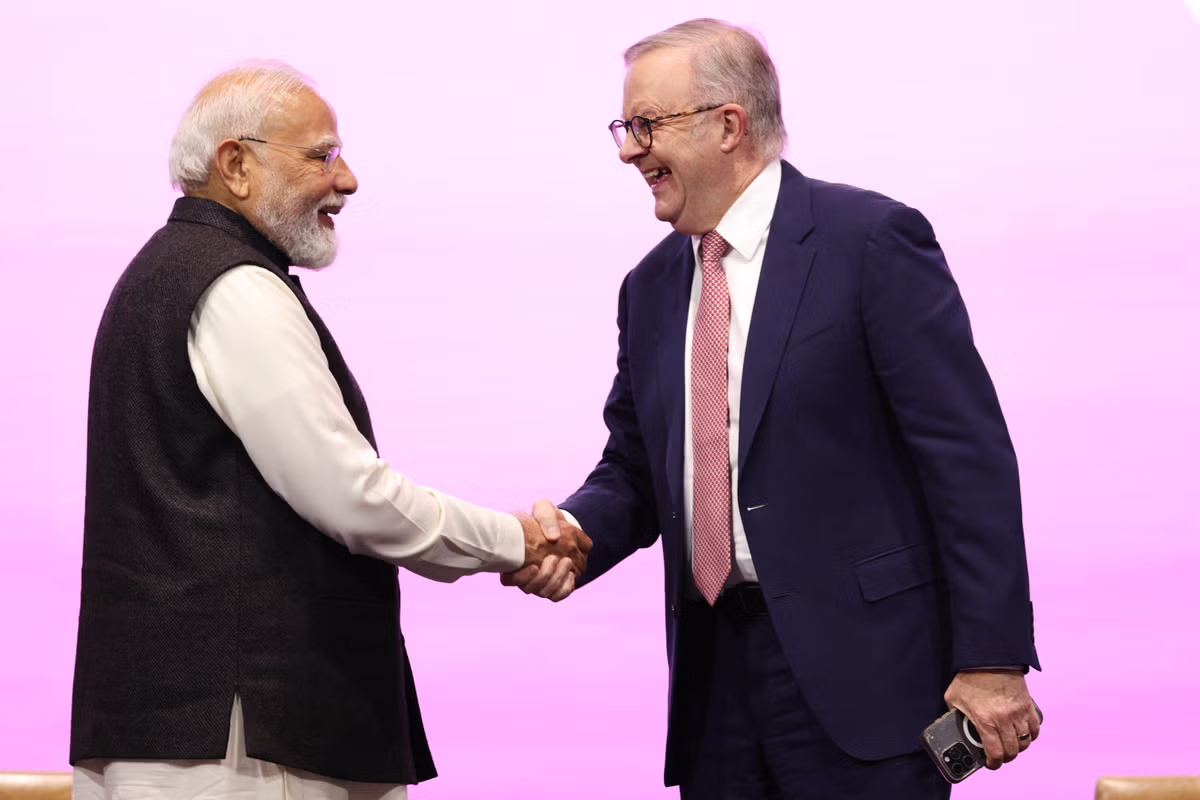
Australia has finally signed a deal to sell uranium to India, nearly 12 years after the two nations agreed to nuclear cooperation.
The deal, signed on Thursday, is expected to provide a boost to Australia’s mining industry while helping India meet the target of installing 100 gigawatts of nuclear energy capacity by 2047.
Australian prime minister Anthony Albanese and visiting Indian counterpart Narendra Modi also agreed to deepen cooperation in renewables, critical minerals and green hydrogen.
Canberra is looking to diversify trade beyond its reliance on China amid Beijing’s growing aggression in the Pacific.
“Australia and India are close partners and even closer friends,” Mr Albanese said after finalising the deal with Mr Modi. “The arrangement facilitates Australian uranium exports to India to help increase the share of non-fossil fuel power capacity, providing an additional market for Australian resources sector.”
Mr Modi, who is on a three-day visit to Australia, said the deal was crucial for bolstering India’s nuclear energy ambitions. He stressed the strategic importance of the bilateral partnership saying it presented “historic opportunities” to advance “peace, stability, freedom of navigation and a rules-based order” in the Indo-Pacific.
The leaders didn’t disclose how much uranium would be sold, or when.
The export of Australian uranium to India was stalled in 2014 due to concerns that it could be used for non-peaceful purposes like making weapons.
India is one of the nine countries in the world with nuclear weapons.
Mr Albanese told reporters the Indian leader had agreed to purchase uranium exclusively for peaceful purposes, under the safeguards of the International Atomic Energy Agency.
Australia sits on the world’s largest known uranium resources but the country doesn’t use any nuclear power or weapons and all uranium is exported under nuclear non-proliferation arrangements.
India, home to 1.4 billion people and a growing middle class, aims to install 100 gigawatts of nuclear power capacity by 2047, enough to power nearly 60 million homes a year.
The South Asian nation has doubled its installed capacity of nuclear power over the past decade, but it still accounts for just 3 per cent of its electricity.
India isn’t a signatory to the Nuclear Non-Proliferation Treaty, which recognises only the US, China, Britain, France and Russia as nuclear powers. Australia, which is a signatory country, refuses to sell uranium to non-signatories.
India says that the treaty is discriminatory because it only recognises as legitimate nuclear powers countries that tested nuclear devices before January 1967, disqualifying it permanently. India was hit with international technology sanctions and uranium trade bans after it conducted nuclear weapons tests in 1998.
After meeting Mr Modi at a business event, Mr Albanese called him a “living bridge” between Australia and India.
India is Australia’s fifth-largest trading partner after China, Japan, the US, and South Korea. Nearly a million people in Australia claim Indian ancestry out of a population of 28 million.
Mr Modi arrived in Melbourne on Wednesday night but his visit was marred by protesters who held signs that read “stop Indian invasion” and “Modi go home, take the rest with you”.
On Thursday evening, police were deployed in force outside an indoor arena in Melbourne where Mr Modi was scheduled to address thousands of expatriate Indians later in the day.
The Indian leader has staged large-scale events during his overseas trips and has addressed packed stadiums in Britain, the US and other countries with large expatriate Indian populations. Thousands of supporters thronged one of Sydney’s biggest indoor stadiums during his last visit three years ago.