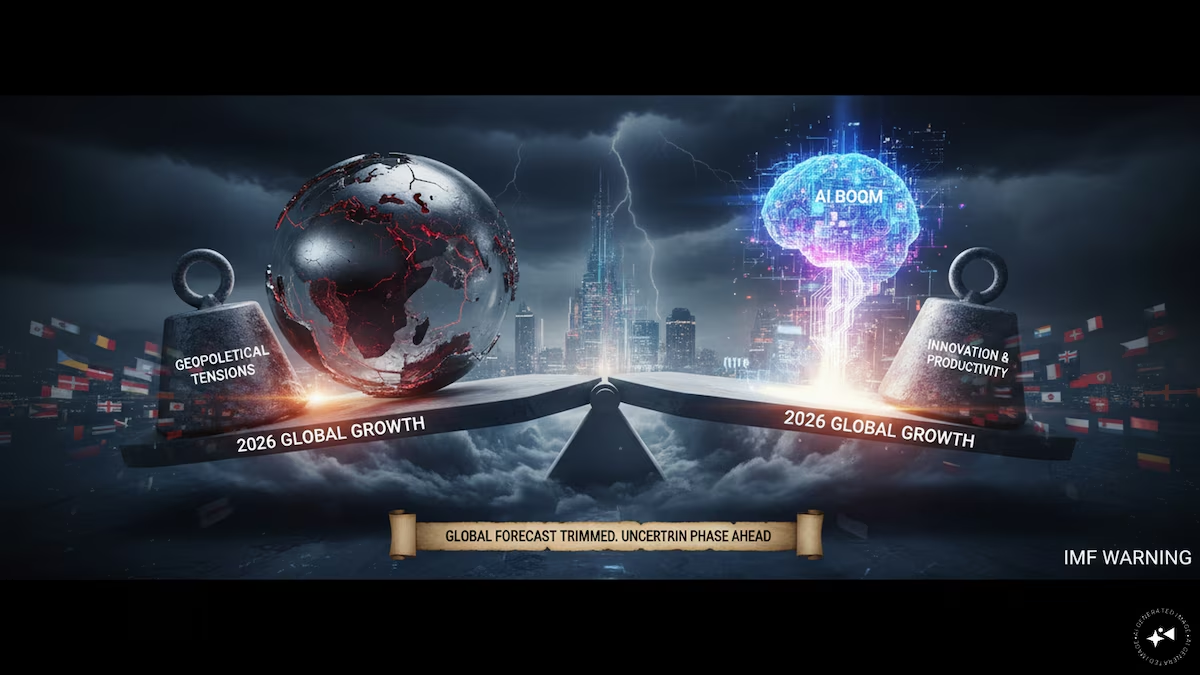
In its July 2026 World Economic Outlook Update, the IMF lowered its 2026 global growth forecast by 10 basis points to 3%, while raising its 2027 estimate by 20 basis points to 3.4%. Even with the upward revision for next year, global growth remains below the 3.5% average recorded in 2024 and 2025.
The Fund said the global economy has so far proved more resilient to the West Asia conflict than initially feared, but cautioned that the recovery is becoming increasingly uneven. Countries benefiting from the AI-driven technology cycle are outperforming, while energy-importing economies with limited participation in the technology value chain continue to lag.
“The modest slowdown reflects the effects of the war in the West Asia being partly offset by accelerated demand-driven momentum in the global technology cycle thanks to advances in artificial intelligence (AI) and its adoption,” the IMF said.
The report added that the impact varies significantly depending on countries’ exposure to the conflict and their position in the global technology value chain. Energy exporters outside the conflict zone are benefiting from favourable terms of trade, while economies integrated into the AI-led upturn are seeing stronger activity despite being energy importers. By contrast, growth is weakening among energy-importing economies with limited participation in the technology value chain, a group that includes many low-income countries.
AI boom cushions war shock, but gains remain uneven
The IMF described the global economy as being shaped by two opposing forces — a negative supply shock from the West Asia conflict and a positive technology shock driven by rapid advances in AI.
Economies integrated into the AI supply chain have emerged as clear beneficiaries despite higher energy prices. The top four net exporters of AI-related hardware — Taiwan Province of China, South Korea, Thailand and Malaysia — recorded an average upside growth surprise of 4.4 percentage points in the first quarter of 2026. By comparison, the rest of the world posted an average downside surprise of 0.3 percentage point.
World trade is expected to slow sharply, with trade volume growth moderating from 5% in 2025 to 3.5% in 2026, before recovering to 4.3% in 2027. The IMF’s baseline assumes the Strait of Hormuz begins reopening in mid-July and returns broadly to pre-war operating conditions by March 2027.
India retains growth leadership
Despite a modest downgrade, India continues to stand out as one of the world’s fastest-growing major economies.
The IMF projects India’s GDP growth at 6.4% in FY27, 10 basis points lower than its April forecast, before accelerating to 6.7% in FY28, a 20-basis-point upgrade. On a calendar-year basis, the economy is expected to grow 7% in 2026 and 6.4% in 2027.
The Fund said India’s growth will continue to be supported by strong private consumption and resilient services activity.
Global inflation fight gets tougher
The IMF also delivered a more hawkish inflation outlook, saying the global disinflation trend has stalled.
Headline inflation is now projected at 4.7% in 2026, 30 basis points higher than forecast in April, before easing to 3.9% in 2027, which is also 20 basis points above the previous estimate. While inflation expectations have risen for 2026, longer-term expectations remain broadly anchored.
Oil to remain elevated, food prices under pressure
The Fund expects energy prices to remain above pre-war levels throughout 2026.
“Energy prices are projected to remain higher than they were before the war,” it said.
It expects average crude oil prices of $89.27 per barrel this year, around 9% higher than projected in April, before easing to $78.70 per barrel in 2027. Crude oil prices are forecast to rise 31.8% year-on-year in 2026, while natural gas prices are projected to increase 22%, fertiliser prices 26%, and food prices 8%.
According to the IMF, inventory drawdowns have so far helped cushion the impact of reduced oil flows through the Strait of Hormuz, preventing an even sharper spike in global oil prices.
Risks remain tilted to the downside
Although risks are more balanced than they were in April, the IMF said they continue to be skewed to the downside.
A renewed escalation in the West Asia could trigger another surge in commodity prices, prolong supply disruptions, tighten global financial conditions and weaken growth. Faster trade fragmentation, shrinking fiscal buffers and a correction in AI-driven market expectations remain key downside risks.
On the other hand, quicker normalisation in energy markets, stronger AI investment and lower trade barriers through renewed international cooperation could provide an upside to growth.
Policymakers urged to stay disciplined
The IMF said policymakers face a difficult balancing act between containing inflation, supporting growth and protecting vulnerable households.
It urged central banks to remain focused on price stability while preserving their operational independence, warning that monetary policy may need to remain tighter for longer if inflationary pressures persist.
On the fiscal side, the Fund cautioned against broad-based subsidies, tax cuts and price controls. Instead, it advocated targeted support, rebuilding fiscal buffers and stepping up investment in skills, energy and digital infrastructure to maximise the long-term gains from artificial intelligence.