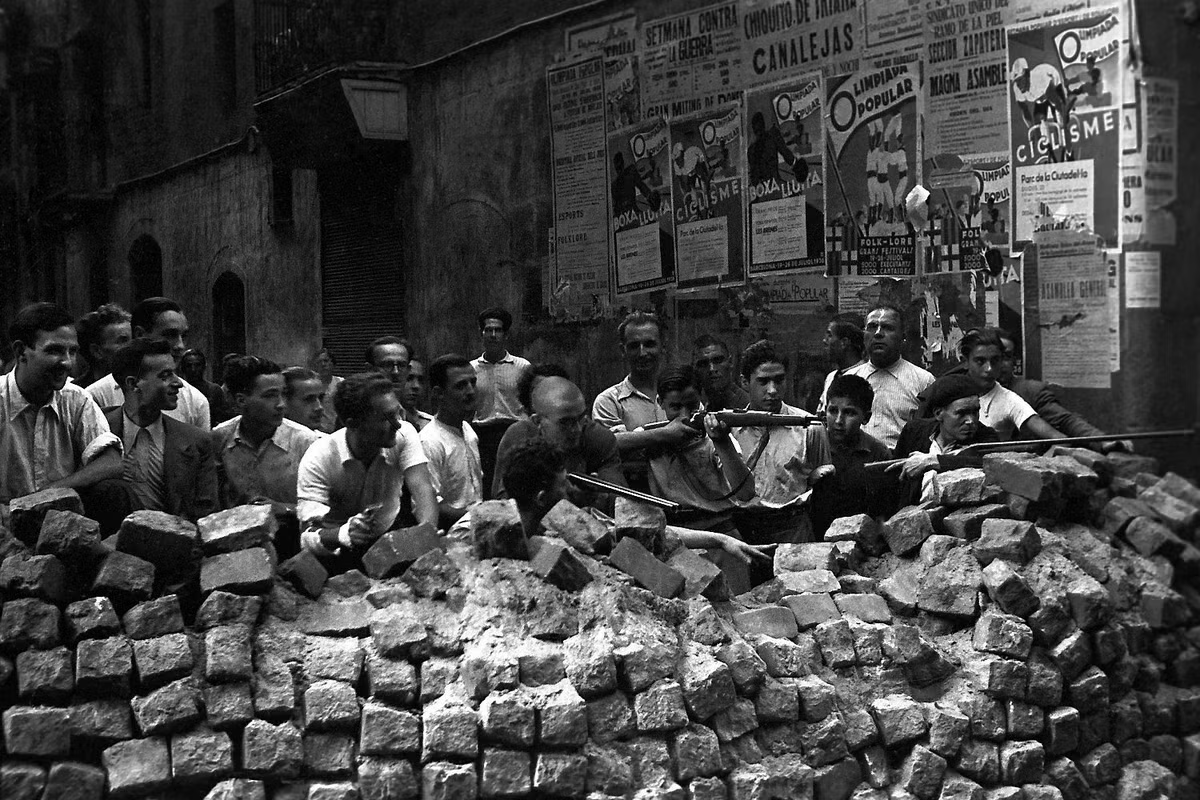
Today is the largely forgotten 90th anniversary of one of 20th century’s history’s most significant events – a tragic military and political development that, in some senses, represents the real beginning of the Second World War.
For on this day exactly nine decades ago (ie., two years before the Nazi takeover of Czechoslovakia and three years before Hitler’s invasion of Poland), a war in south-west Europe started in which the Germans perfected their weaponry and tactics ahead of the wider conflict which they were actively planning and preparing for.
Nazi Germany deliberately used that south-west European conflict – the Spanish Civil War – to develop their tactical bombing techniques, fighter aircraft formation tactics and to debut their notorious Stuka dive bombers.
On the ground, the German military in Spain developed artillery techniques which later helped enable the Nazis to militarily succeed in the first years of the Second World War.
German battle experience in Spain also allowed the Nazis to make huge gunnery improvements to the tanks which would later be deployed in the wider war. And battle experience in Spain was also used by the Germans to detect armour problems in their tanks – and to correct those problems in time for their invasion of Poland in September 1939.
The Nazis also used the Spanish war to give thousands of their troops war experience before the official start of the Second World War. Germany deployed up to 19,000 military personnel to Spain – mostly airmen and Luftwaffe ground crews, but also tank crews and infantry instructors, as well as SS men to train Spanish police and others in torture and interrogation techniques. What’s more, Germany’s ally, Fascist-run Italy, supplied tens of thousands of troops to help Franco’s side in the war.
Today’s 90th anniversary is particularly important for two specific reasons. Firstly, because July 1936 saw secret partly British-originating help being given to the de facto Nazi-aligned side right at the start of the Spanish war – and secondly because July 1936 also saw massive German assistance to that same Nazi-aligned side.
The war began on 17 July 1936 as a right-wing political and military revolt against the democratically-elected Spanish government. But one of the main rightist rebels – General Francisco Franco (who was to become leader of Spain for several decades) – was stranded in the Canary Islands (where he had been posted by the Spanish government to prevent him linking up with other potentially rebellious senior military officers).
So to help him escape and join the other rebels in Spanish-controlled northern Morocco, UK military intelligence appears to have ‘unofficially’ allowed one of its assets (a former agent) to accompany a UK-owned, UK-based aircraft from London to the Canaries on 11 July – so that it could then be used to fly Franco from there to Spanish northern Morocco.
What’s more, either before or during the operation, recent research suggests that the British Foreign Office was fully informed about aspects of the flight, but did absolutely nothing to try to stop it. In addition, Britain’s traditional ally in the region, Portugal, was fully aware – and indeed made refuelling facilities available to the aircraft.
The British plane’s delivery of Franco to pro-rebel Spanish Morocco then allowed him to send a secret mission from there to Hitler, asking for aircraft to ferry troops and equipment from rebel Spanish-controlled northern Morocco to Spain. Hitler agreed and sent a fleet of transport aircraft to do the job and fighters to protect them. Its very likely that the German leader realised the geopolitical advantage of trying to prevent Spain from being able to later form any potential alliance with Britain and France. The German-and-Italian-run troop and equipment ferrying operation was, at the time, the biggest military airlift in aviation history – and without it the extreme right revolt in Spain would probably not have succeeded in overthrowing Spanish democracy.
But what Hitler probably did not realise at the time was the military advantage that a German-assisted extreme right-wing victory in Spain would later give him in the wider war (ie., what became the Second World War) that he was anticipating. For Spain had significant reserves of an ultra-hard and ultra-heat-resistant metal, tungsten, which Nazi Germany was able to use for crucial machine tools for making weapons and for weapons themselves, especially from 1941 onwards when Russian tungsten was no longer available to Hitler (due to his invasion of the Soviet Union).
Despite partially successful allied measures to reduce Spanish tungsten exports to Germany, that Spanish tungsten almost certainly helped the Nazis to maintain their war effort in world War Two, especially between 1941 and 1943. Indeed, in those three years, Germany got a third of its crucial tungsten supplies from Spain.
The question of when the Second World War actually started is a challenging one. For many Austrians and Czechs, it arguably started in 1938 with the Nazi takeover of Austria and Czechoslovakia. But for some Spanish historians and others, the real start of the Second World War is often seen as having occurred in their country. For the Spanish Civil War (with full German and Italian involvement) cost up to 900,000 Spanish lives and injured hundreds of thousands more. Some half a million houses were destroyed – and, during the war and in its aftermath, 150,000 Spaniards were executed, predominantly by right wing forces, especially Franco’s police and others, often trained by the Nazi SS.
The use of a British aircraft to ferry General Franco from the Canaries to Spanish rebel-controlled northern Morocco was a crucial action which played into Hitler’s hands – for, if Franco had not been flown to Spanish Morocco, he would almost certainly not have been able to send his mission to the Nazi leader and the crucial airlift would not have ben mounted on the required scale and would not have been protected by German fighter aircraft.
But there is still one the very substantial mystery surrounding the British aircraft’s role (and that of a UK military intelligence former agent to unofficially assist Franco). It was one of the most consequential actins taken in Britain in the run-up to the Second World War – and it has always been assumed that British political leaders were totally unaware of the British-associated role in ferrying Franco from the Canaries to Spanish rebel military headquarters in northern Morocco.
But emerging evidence suggests that UK diplomats and almost certainly the Foreign Office’s intelligence service, MI6, probably did know what was going on. If it was simply the War Office’s intelligence service which knew, it might have been more likely that the Foreign Secretary, Anthony Eden, would not have been told about the unofficial UK-based operation to help Franco.
However, if the Foreign Office knew, then it becomes increasingly likely that senior politicians, including Eden, were aware of the operation to ferry Franco into the heart of the military rebellion. And that operation, involving a British-owned-and-operated aircraft, a London airport (Croydon) and a UK intelligence asset tragically ended up helping Hitler in very substantial ways and can arguably be seen as a key part of the real beginning of the Second World War – or at least the run up to it.