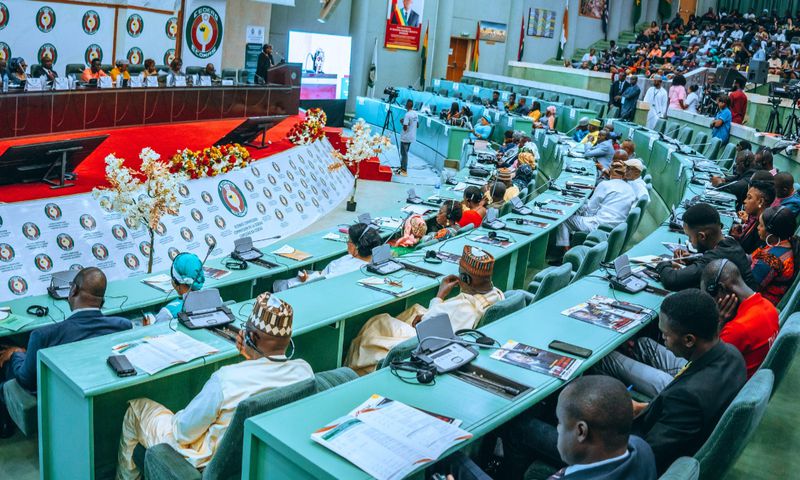
The Economic Community of West African States (ECOWAS) is at a critical crossroads, with regional leaders demanding renewed unity, institutional reforms and concrete action to restore citizens’ confidence in the integration project.
The call was made at the opening of the 96th Ordinary Session of the ECOWAS Council of Ministers in Freetown, Sierra Leone, where the regional bloc confronted the political, security and economic challenges threatening to weaken West African integration.
The two-day ministerial meeting, which opened on Thursday, precedes the 69th Ordinary Session of the ECOWAS Authority of Heads of State and Government.
The Chairperson of the ECOWAS Council of Ministers and Sierra Leone’s Minister of Foreign Affairs and International Cooperation, Alhaji Musa Timothy Kabba, said the region could no longer afford to allow internal divisions and emerging challenges to undermine the collective vision of West African integration.
Kabba said citizens’ expectations of ECOWAS had never been higher, stressing that the regional organisation must become more responsive, united and innovative in addressing emerging challenges and delivering tangible benefits in peace, security, economic opportunity and social progress.
“Our citizens’ expectations have never been higher,” he said, urging member states and ECOWAS institutions to ensure that the organisation’s integration agenda translated into practical improvements in the lives of citizens.
He said West Africa’s current challenges required a renewed commitment to dialogue, solidarity and mutual respect, describing the principles as essential to lasting peace and sustainable development.
Kabba said Sierra Leone’s own journey from conflict to peace and from recovery to resilience had strengthened the country’s conviction that dialogue and cooperation remained the surest path to stability and development.
He urged ECOWAS to remain faithful to the vision of its founding fathers, who recognised that the destinies of West African countries were inseparably linked.
“As we work together over the coming days, let us remain guided by our common purpose and inspired by the vision of the founding fathers of ECOWAS, who understood that our individual destinies are inextricably linked to our collective future,” he said.
The call for unity and a more citizen-centred regional organisation was reinforced by the President of the ECOWAS Commission, Dr Omar Alieu Touray, who said the bloc must now move beyond the celebration of its 50-year legacy and translate its shared vision into concrete action.
Touray said ECOWAS had passed through one of the most challenging periods in its history, marked by complex political transitions, evolving security threats, economic uncertainty, an increasingly fragile global environment and the withdrawal of three member states.
“Together, we have steered our community through one of the most challenging periods in its history,” Touray said.
He said the ECOWAS Commission had nevertheless remained committed to implementing the decisions of the Authority of Heads of State and Government, preserving institutional stability, maintaining channels of dialogue and cooperation and safeguarding the continuity of Community programmes and institutions.
The convergence of the positions of the Council Chairperson and the ECOWAS Commission President underscored the growing urgency for the regional bloc to move beyond declarations and make its integration agenda more relevant to ordinary citizens.
For Touray, the challenge facing ECOWAS is not merely to preserve the structures of regional integration, but to strengthen them and make them more effective in responding to the realities confronting West Africa.
He said that, following the commemoration of ECOWAS’s 50th anniversary last year, the organisation’s focus must now be on converting its shared vision into practical actions.
“Following the commemoration of the fiftieth anniversary of ECOWAS last year, our focus must now be on translating our shared vision into concrete actions that respond to the changing realities of our region,” he said.
The ECOWAS Commission President said the organisation had continued to strengthen its institutional foundations despite the challenges confronting the region.
He highlighted the operationalisation of the Permanent Representatives Committee as an advisory organ of the Council of Ministers, as well as the completion and commissioning of the Mfum-Ekok bridge and joint border post, a major transnational infrastructure project connecting the ECOWAS and ECCAS regions.