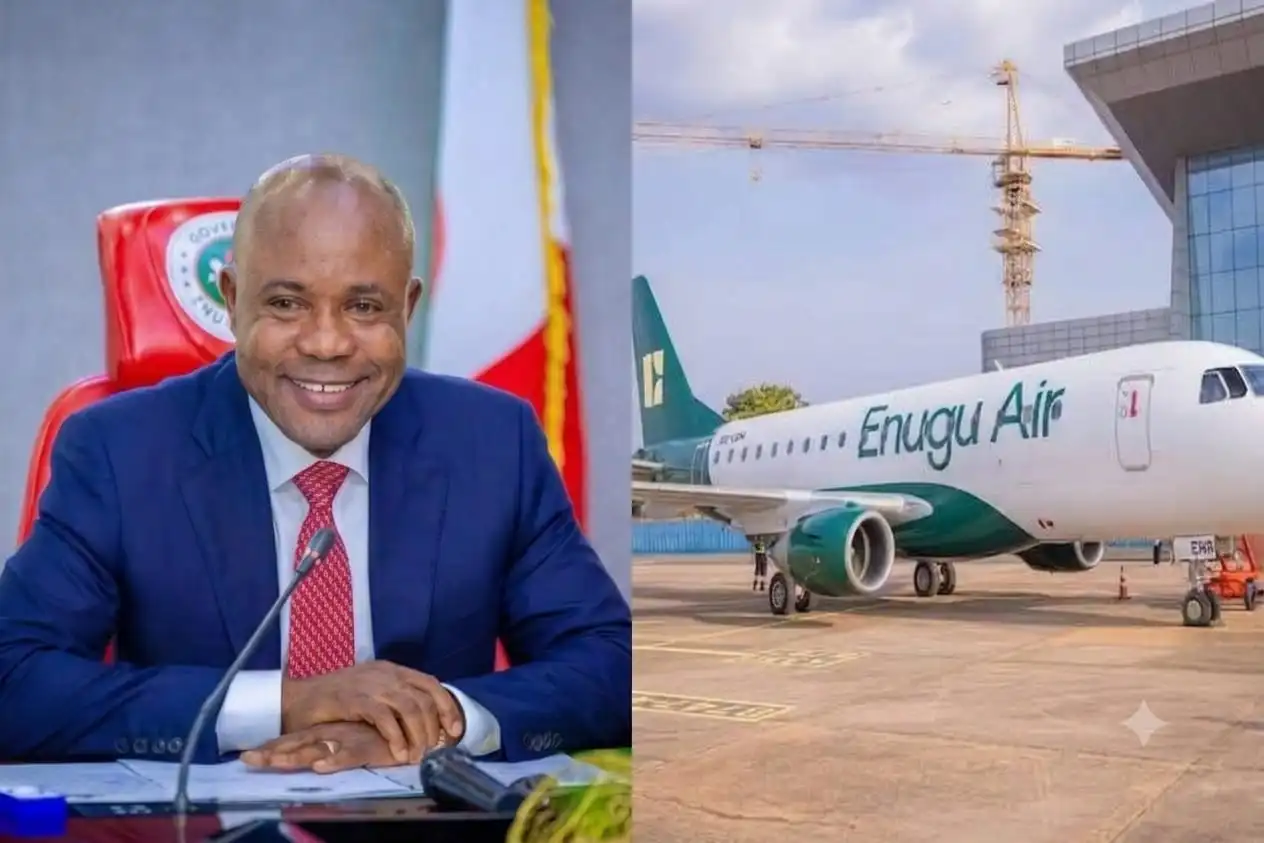
Every generation is remembered for the leaders who merely managed the present and those who dared to redefine the future. History rarely celebrates administrators who simply maintained the status quo; it reserves its highest honours for visionaries who imagined possibilities others considered unrealistic and then summoned the courage to turn those possibilities into reality.
That is why the words of Irish writer Jonathan Swift and French philosopher Gaston Berger aptly frame the unfolding story of Governor Peter Ndubuisi Mbah and the emergence of Enugu Air.
Swift reminds us that “Vision is the art of seeing what is invisible to others,” while Berger insists that “The purpose of looking at the future is to disturb the present.” Together, they capture the philosophy that has increasingly come to define governance in Enugu State—a philosophy that refuses to be imprisoned by yesterday’s limitations.
When Peter Mbah campaigned on the mantra “Tomorrow Is Here,” many dismissed it as another catchy political slogan. In a country where campaign promises often evaporate after elections, cynicism was understandable. But nearly three years into his administration, that phrase has gradually transformed from campaign rhetoric into a measurable governance philosophy.
Among the clearest manifestations of that philosophy is Enugu Air.
It is more than an airline. It is a statement of intent.
It is a declaration that Enugu no longer intends to occupy the margins of Nigeria’s economic map but seeks to become one of its defining centres of commerce, investment, tourism and innovation.
Only a few years ago, suggesting that an Enugu-based professional could attend a breakfast meeting in Abuja, conclude business in Lagos, and still return home to have dinner with family in Enugu would have sounded unrealistic.
Not because aviation technology did not exist.
Not because the distance was insurmountable.
But because the infrastructure, logistics and political will required to make such convenience possible simply did not exist.
People had resigned themselves to inconvenience.
Business executives routinely spent nights in Lagos or Abuja because flight schedules offered little certainty. Entrepreneurs postponed opportunities because travelling from Enugu often meant uncertainty. Government officials, investors, consultants, academics and professionals built extra days into simple business trips—not out of necessity, but because the system demanded it.
Many accepted that reality as normal.
Visionaries rarely do.
Peter Mbah evidently did not.
Where others saw limitations, he saw opportunities.
Where many saw geographical disadvantage, he saw strategic advantage.
Where critics saw an ambitious dream, he saw tomorrow.
Today, that tomorrow has landed.
With dedicated Enugu Air flights connecting Enugu with Abuja and Lagos, the impossible has quietly become routine.
The businessman can now conclude negotiations in Victoria Island and return to Enugu before nightfall.
The investor can attend meetings in the Federal Capital Territory without worrying whether an available return flight exists.
The civil servant no longer needs to budget for expensive hotel accommodation because official engagements extended beyond available commercial schedules.
Parents spend evenings with their children instead of hotel rooms hundreds of kilometres away.