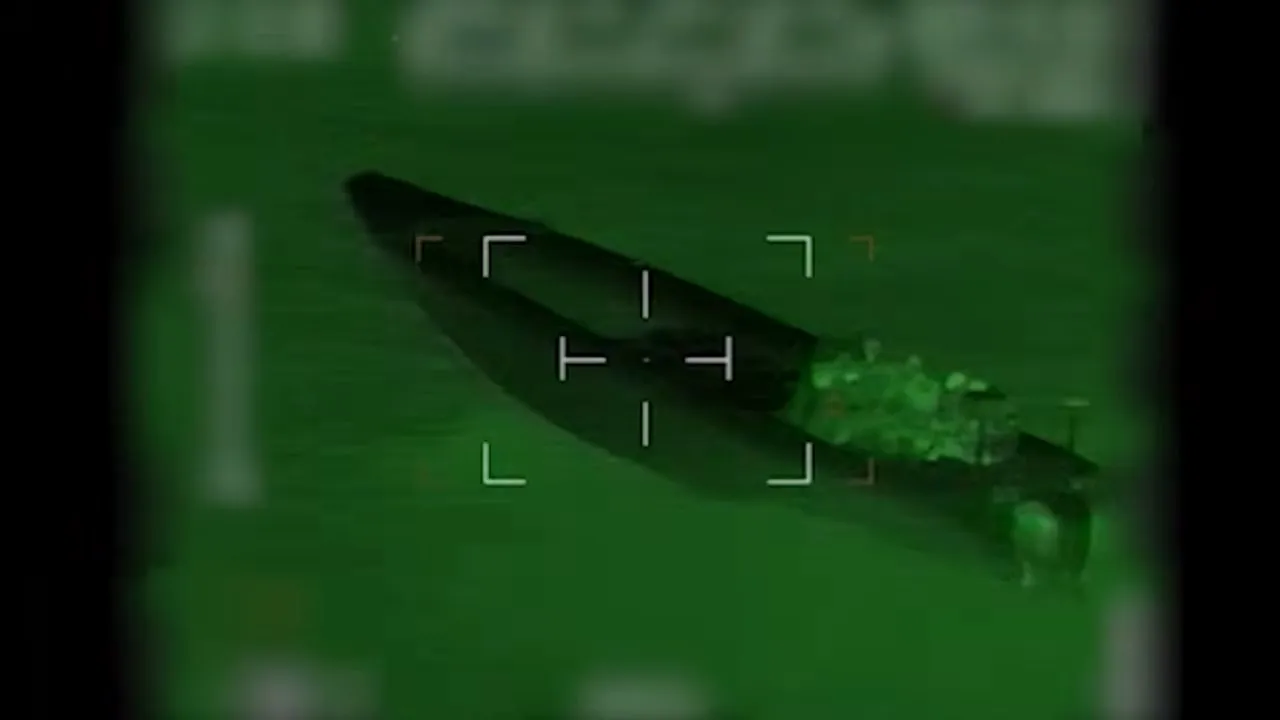
Europe’s lead agency fighting drug trafficking, the Maritime Analysis and Operations Center (MAOC), released a “call to action memo” this spring, urging countries to allow the “use of force during maritime pursuits, allowing for engine-disabling tactics and shooting,” confidential documents seen by the Washington Post, German broadcaster NDF, LeMonde in France, and NRC in the Netherlands found.
This comes as Europe is getting hit by what one DEA officer called “a tsunami of cocaine,” and follows a controversial operation in which a French Navy sniper immobilized a high-speed smuggling vessel by shooting its engines from a helicopter in October.
This marked the first time any European military had fired on one of these go-fast boats, small speedboats which can wait weeks at sea for large transport ships from South America to reach them with tons of cocaine.
French maritime officials endorsed the MAOC plan to lean towards more military-style operations, writing in a document that authorities have been unable to stop more than a fraction of smuggling vessels “due to a lack of naval assets,” the Washington Post wrote.
While 100 tons (100,000 kg.) of cocaine was seized with the aid of MAOC in the last year, the agency estimated another 770 tons had gotten through into Europe.
Cartels switch from using large cargo ships to small speedboats
Cartels have changed up the routes used to bring cocaine into the continent. While cocaine used to be transported in large container ships to major European ports, after crackdowns in cities including Antwerp, Hamburg, and Rotterdam, networks shifted to offloading the cocaine to the go-fast boats while still outside European waters, Andy Kraag, head of the European Serious and Organised Crime Centre at Europol said.
The go-fast boats then carry the shipments from the Atlantic to various points on the European coasts.
The transport ships travel from South America towards floating encampments of go-fast boats tethered together, which may wait weeks to collect their cargo.
“It’s ‘Mad Max’ at sea,” Dimitri Zoulas, head of France’s national anti-narcotics agency, said.
“This is a phenomenon never before seen [in Europe] on this scale,” he added.
Zoulas described the boats as an “armada,” and the men on board as “soldiers linked to the South American cartels who guard the boat and the cargo.”
The boats are optimized for speed, with most having at least four enormous outboard motors and capable of traveling at least 130 kilometers per hour, consuming 50-60 liters of fuel per hour at full speed. While the boats may cost hundreds of thousands of dollars, they are relatively disposable to the trafficking organizations whose shipments can be sold for over $100 million, the Washington Post cited experts as saying.
Videos of these go-fast boats have emerged online, with TikTok and Instagram videos being filmed by crews on the boats containing large jerrycans of gasoline and packages which NRC wrote resembled boxes of cannabis or cocaine.
Some of the largest go-fast boats can transport up to 5,000 kilograms of cocaine, while other ships in the fleet may be specifically designated as a supply boat, used to transport fuel, food, and water to the boats waiting for the large shipment from South America.
Kraag calls the route through the Atlantic the new “cocaine highway,” and said the smugglers use professional equipment and satellite providers such as Starlink to communicate and coordinate with each other.
“That is how those guys on the water get their orders, locate the large ships transporting the cocaine from Latin America, and consult with buyers on shore,” Kraag said.
Spain seizes 30 tons of cocaine in largest cocaine seizure recorded
The scale of the supply chain was demonstrated in a Spanish seizure of the Arconian, a cargo ship which was carrying 30 tons of cocaine, making the operation the largest cocaine seizure ever recorded.
The Arconian was also carrying tens of thousands of liters of gasoline, which the authorities believe were likely for a fleet of go-fast boats.
Contributing to the rise in cocaine in Europe is the crackdown on narcosmuggling in the US, career DEA officer and former administrator in the Trump administration Derek Maltz said.
“The cartels have shifted their focus toward Europe in the face of more aggressive interdiction and disruption operations by the United States,” the Washington Post cited Maltz as saying.
US President Donald Trump’s administration has been striking vessels it accuses of transporting illegal drugs, and has designated multiple drug cartels as terrorist organizations.
More than 200 people have been killed by US strikes on such vessels since September.
Additionally, the US demand has been shifting toward fentanyl and other synthetic drugs. This, compounded with record levels of coca plant cultivation in Colombia, has led to cartels looking to Europe for new consumers.
European proposals avoid length of Trump administration-style strikes
No European proposals have come close to advocating all of the tactics used by the Trump administration.
“There is a level of risk acceptance, which actually predates Trump’s arrival in office, that is much higher over there [in the US],” a European source told LeMonde.
While France has authorized the use of firearms to stop the go-fast boats, having snipers target the engines, customs officials emphasized that “the principle of the operation is zero casualties,” LeMonde wrote.
Britain is the only other nation to acknowledge authorizing its military to use disabling fire in counternarcotics missions has not done so anywhere near its borders, but in the Caribbean and the Gulf of Oman, officials said.
Most cocaine deliveries to Britain are by small aircraft and other means.
France and Britain declined to answer questions about the legal authorities they rely on when carrying out strikes, the Washington Post wrote.
“Any drug interdiction operations are conducted in full compliance with national and international legal frameworks,” the Washington Post cited the UK Defense Ministry as stating.
Both France and MAOC are urging other European countries to authorize the use of firearms to stop the go-fast boats and stem the flow of cocaine into the continent, as well as to cooperate and contribute more resources to the effort.
MAOC also urged countries to adopt the law implemented in Spain and Portugal that prohibits the manufacture and possession of go-fast boats.