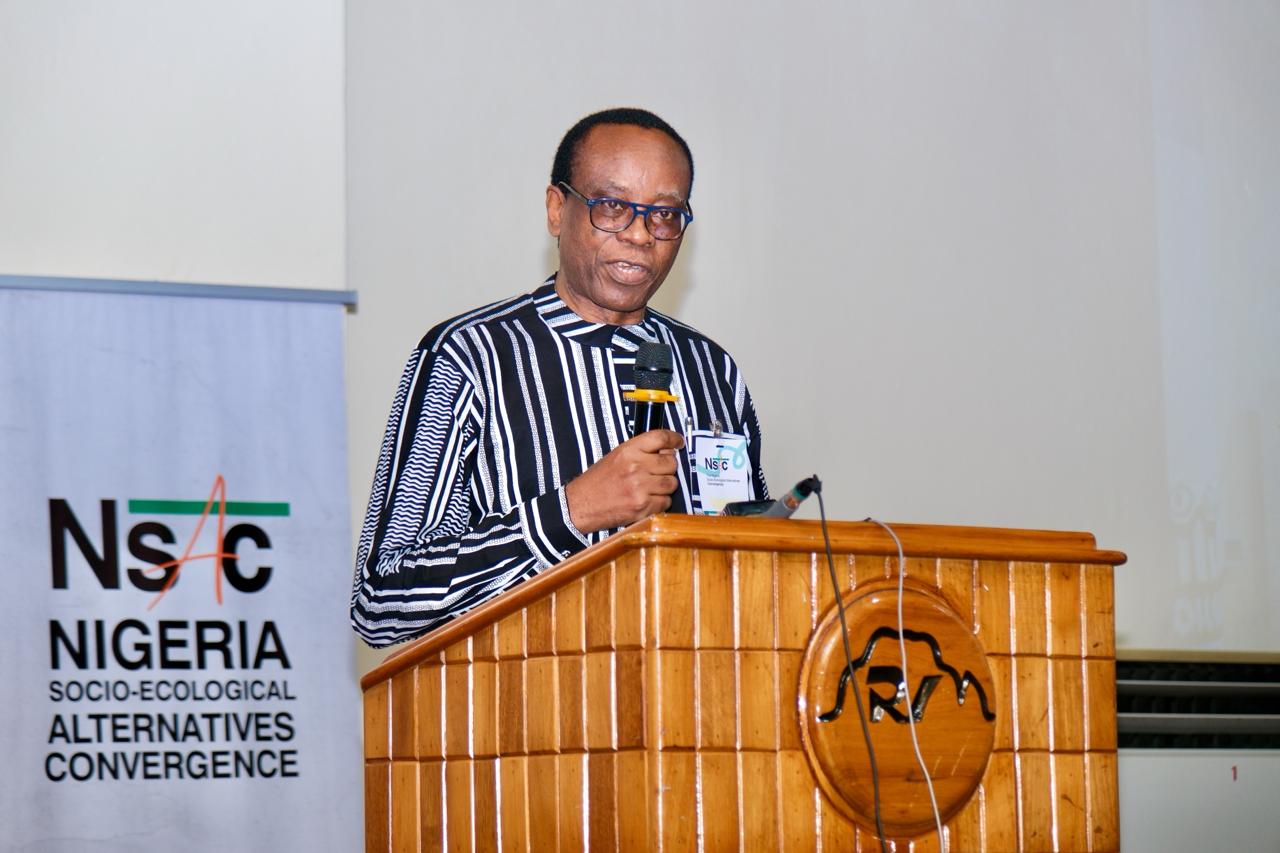
A coalition of environmental experts, traditional leaders and academics on Tuesday, 14 July, 2026 issued a stark warning that Nigeria could be heading towards another resource curse unless it radically reforms the governance of its burgeoning solid minerals sector, cautioning that the global race for critical minerals risks replicating the environmental devastation, conflict and inequality that have characterised decades of oil exploitation in the Niger Delta.
The warning came at the Third Nigeria Socio-Ecological Alternatives Convergence (NSAC) in Abuja, where participants argued that the country’s renewed enthusiasm over recent discoveries of lithium, rare earth elements, gold, platinum group metals and other strategic minerals must be matched with stronger environmental safeguards, community rights and transparent governance.
The conference, themed “Deforestation, Mining and the Crisis of Human Security in Nigeria,” brought together traditional rulers, environmental activists, academics, civil society organisations and community leaders to examine the implications of Nigeria’s growing role in the global energy transition.
The discussions followed the Federal Government’s recent announcement of what it described as a world-class polymetallic mineral province in Kaduna State, containing lithium, rare earth elements, gold, copper, nickel and platinum group metals, as part of efforts to position Nigeria as a leading supplier of critical minerals needed for electric vehicle batteries, renewable energy technologies and advanced manufacturing.
However, speakers at the convergence insisted that the country must avoid repeating the mistakes made in the oil industry.
Leading the call was Professor of Anthropology and African Studies at the University of Michigan, Prof. Omolade Adunbi, who warned that critical minerals were rapidly becoming “the new oil” and could reproduce the same patterns of environmental destruction, elite capture and violent conflict unless a new governance model is adopted.
“The world must decarbonise,” he said. “But the deeper question is what kind of decarbonisation, governed by whom, for whose benefit, and at whose cost?”
According to him, while renewable energy technologies are promoted as environmentally friendly, they rely heavily on minerals extracted from communities whose forests, rivers and farmlands could become the next “sacrifice zones.”
Drawing parallels with the Niger Delta, Adunbi argued that Nigeria’s experience with oil should serve as a warning against pursuing mineral wealth without environmental justice.
“Critical minerals may become the new oil. If they are governed through the same extractive logic that shaped oil extraction in the Niger Delta, they will reproduce dispossession, deforestation, insecurity, elite capture and ecological degradation,” he said.
He urged the government to adopt a comprehensive “Just Minerals Strategy” that would make community consent legally binding, prohibit mining in ecologically sensitive areas, guarantee environmental restoration and ensure host communities receive a fair share of the benefits.
Also speaking, renowned environmentalist and Director of the Health of Mother Earth Foundation (HOMEF), Nnimmo Bassey, questioned the country’s excitement over new mineral discoveries without first addressing the governance failures that left the Niger Delta environmentally devastated despite decades of oil wealth.
“Have we learned the lessons of almost seven decades of oil extraction in the Niger Delta?” he asked.
“We are yet to have serious conversations on what sort of development we desire.”
Bassey argued that Nigeria’s forests, rivers and communities are increasingly being sacrificed in pursuit of an extractive development model that values natural resources above human lives.
He warned that the country’s forests are disappearing at an alarming rate of between 250,000 and 300,000 hectares annually, leaving primary forests to cover only about 1.3 per cent of Nigeria’s landmass.
At the current pace, he warned, Nigeria could lose virtually all its forests by 2052.
Beyond commercial logging and agricultural expansion, Bassey criticised emerging carbon credit projects, describing them as a form of “carbon colonialism” that risks dispossessing local communities in the name of climate action.
He cited plans involving hundreds of thousands of hectares of forests in Delta and Niger states earmarked for carbon credit initiatives, arguing that such projects often exclude indigenous communities from lands they have managed for generations.
The environmentalist also linked uncontrolled mining to rising insecurity, saying degraded forests are increasingly becoming operational bases for criminal gangs.