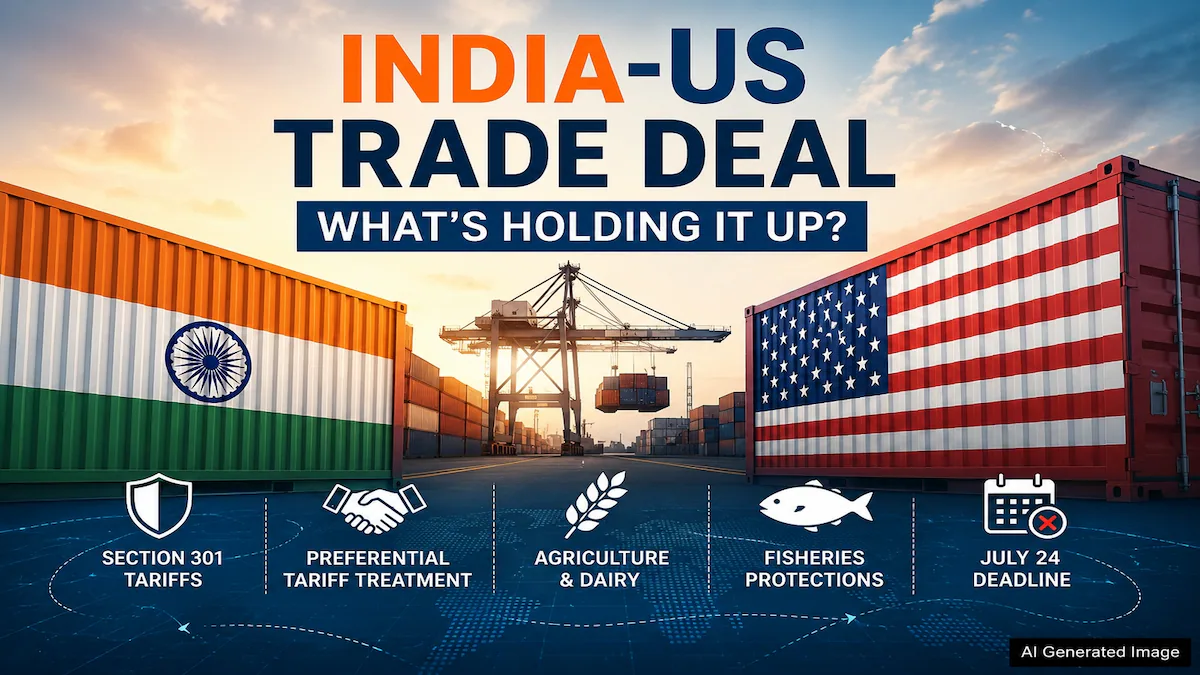
While reports have suggested the deal is “99% complete”, the Indian government has made it clear that it will not rush into signing an agreement unless its core interests are protected. Commerce Minister Piyush Goyal has dismissed reports that India rejected an interim deal, while Commerce Secretary Rajesh Agarwal has maintained that he sees no major challenge in the negotiations.
The proposed interim agreement is intended to secure early gains on tariffs and market access while discussions on a broader bilateral trade agreement continue. However, with only the most contentious issues left unresolved, the pace of negotiations is now being driven more by political and strategic considerations than technical ones.
So, what is holding up the agreement, and why is India prepared to wait beyond the July 24 deadline if necessary?
Why is the interim trade deal taking longer than expected?
Trade negotiations often become most difficult in their final stages because the remaining issues usually involve sectors and policies that neither side is willing to compromise on easily.
Former Commerce & Industry Secretary Ajay Dua believes that is precisely where the India-US negotiations now stand.
“I’m not sure whether it would come about within the next 10 days,” Dua said on CNBC-TV18, referring to the July 24 deadline.
He noted that recent statements by both the Commerce Minister and the Finance Minister suggest India is not prepared to sign even a limited agreement unless it clearly advances the country’s long-term interests.
The negotiations have been underway since late 2024, and the government appears to have adopted a carefully considered position after discussions at the highest levels.
What are the biggest sticking points?
The discussions have narrowed to two major issues that could determine whether an interim agreement is signed.
The first is India’s demand for protection against future US tariffs imposed under Section 301 of US trade law.
Section 301 allows Washington to take unilateral trade action if it concludes that another country has adopted unfair trade practices. India wants assurances that tariffs agreed under the trade deal cannot later be altered through this mechanism.
“The point is that we are not in a position to accept an agreement… unless you confirm that these tariff rates would not be changed through your Section 301 framework,” Dua said.
The second issue is India’s demand for preferential tariff treatment.
New Delhi wants tariff concessions that are at least as favourable as those extended to competing manufacturing economies such as Vietnam, Indonesia and China. If competing exporters continue to enjoy better access to the US market, Indian manufacturers could lose competitiveness despite the agreement.
Why is Section 301 such a critical issue?
For India, the concern goes beyond the tariff rates themselves. It is about predictability.
A
trade agreement is intended to provide businesses with certainty over market access and investment decisions. If one country can later impose additional tariffs unilaterally, much of that certainty disappears.
“There is going to be no meaningful agreement if you have the power and the inclination to impose duties unilaterally on items that you have already agreed upon with us,” Dua said.
From India’s perspective, an agreement has limited value if previously negotiated tariff commitments can be changed through future trade actions.
Why are agriculture, dairy and fisheries India’s red lines?
Agriculture, dairy and fisheries have long been among India’s most protected sectors in international trade negotiations because they support millions of farmers, small producers and rural livelihoods.
Opening these sectors to greater imports from the United States could have significant economic as well as political consequences.
Former Foreign Secretary Shashank said these concerns leave little room for compromise.
“I have my doubts about it because the Indians have made it clear that they cannot compromise on the basic requirements of the Indian people. Therefore, agriculture is there, fisheries are there, and dairy is also there,” he said.
He also cautioned that accepting the concessions sought by Washington could trigger “very strong domestic political fallout”.
Why does India believe it can afford to wait?
Although July 24 marks the expiry of the current pause on reciprocal US tariffs, India does not appear to view the deadline as a reason to dilute its negotiating position.
New Delhi believes that securing favourable terms is more important than concluding an agreement quickly. Officials have repeatedly indicated that any deal must protect India’s long-standing interests, particularly in sensitive sectors.
India also enters the negotiations with greater confidence than in previous years. Its economy has remained relatively resilient, it has expanded trade partnerships with several countries, and it is seen as an increasingly important strategic partner for the United States. These factors provide New Delhi with greater negotiating flexibility than it may have had in the past.
Dua argued that India has consistently defended sensitive sectors in trade negotiations at the World Trade Organization and elsewhere for decades, and there is little reason to change that approach now.
“We can wait it out. There should be no hurry,” he said.
He added that if the United States retains the ability to impose unilateral tariffs or offers better tariff treatment to competing countries, an interim agreement would deliver only limited benefits for India.
What happens next?
Neither India nor the United States has indicated that negotiations have broken down.
Instead, the talks have entered what is often the most difficult phase of any trade negotiation, where politically sensitive decisions rather than technical details determine the outcome.
Whether an interim agreement is signed before or after July 24 may ultimately prove less important than whether both sides can bridge differences over Section 301 protections, preferential tariff treatment and India’s long-standing red lines on agriculture, dairy and fisheries.
For now, the message emerging from the negotiations is clear. India remains open to an interim trade agreement, but only if it provides durable market access, protects key domestic sectors and offers terms that strengthen, rather than weaken, its long-term trade position.