When Gibraltar’s land border with Europe disappears forever this week, a brand-new fleet of London black cabs and freshly painted new red phone boxes will appear on the Rock.
It is, perhaps, an effort by the Gibraltarian government to emphasize its Britishness – just as it moves closer to Brussels.
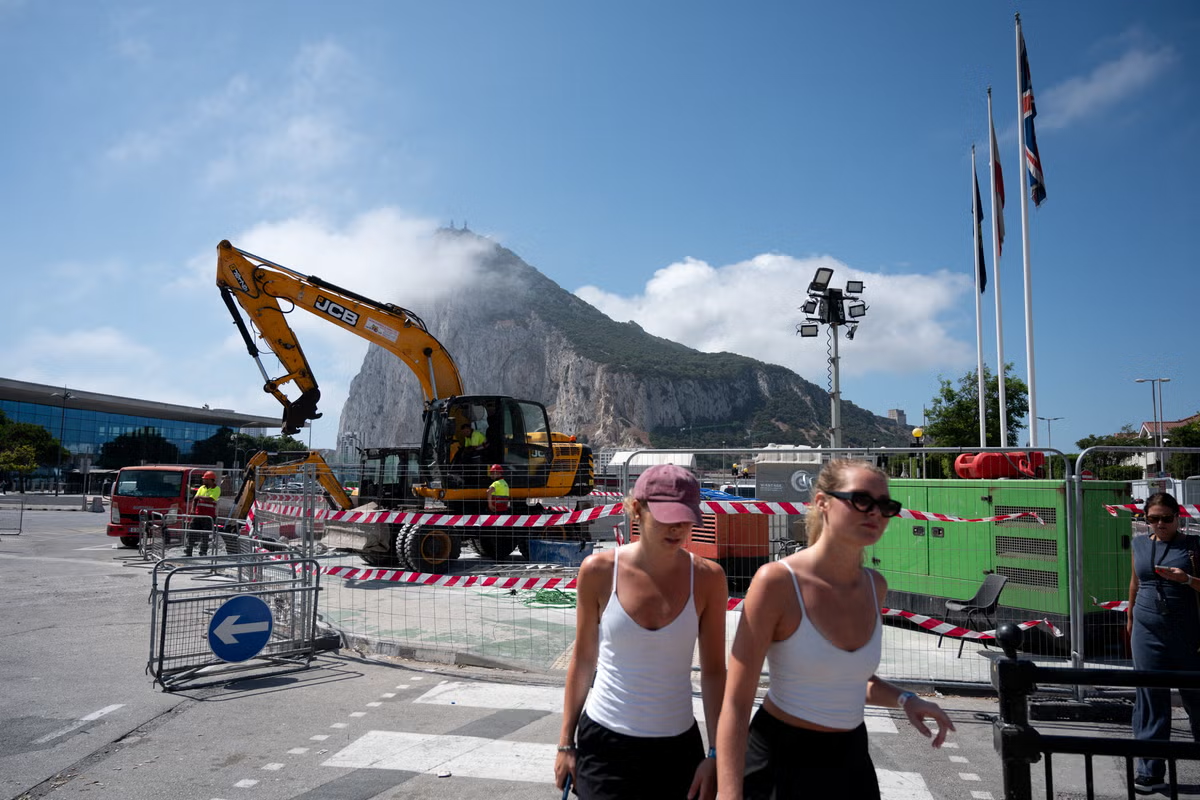
In the biggest change since Spain ceded the Rock to Britain over 300 years ago, the land border which has divided Gibraltar with its geographical neighbour will vanish on July 15 as part of a post-Brexit deal.
Famous for its Barbary Macaques, British bobbies and fierce resistance to Spanish attempts to recover the matchbox-sized territory, Gibraltar’s 40,000 residents are expected to find it easier to move around Europe having lost freedom of movement after the Brexit vote a decade ago.
Officially, they will still be subject to the 90-day stay limit, but as there will be no controls on the land border with Spain, it is unclear how this will be enforced. Locals believe it will be practically impossible to implement.
So, will this tiny isthmus at the foot of southern Spain so famous for its fondness for Britain become just another part of continental Europe?
Up to a point, say many on the Rock.
At Roy’s Fish and Chip, Roland Walker, son of the eponymous owner, is confident the closer union with Europe will only be good for Britain’s most famous dish.
“At present we get mostly British people and Americans coming in for fish n ‘chips, not so many Spaniards. Maybe if more come to visit when the Rock opens, that will be good for business,” he says.
When the land border comes down, a new transaction tax will come into force in Gibraltar. Instead of the current import duty of between 0-12 per cent, they must pay a flat 15 per cent rate which they can pass onto customers or assume.
Walker is not discouraged: “Yes, we will have to pay more tax but we will have to see how that works out. But I think this has got to be a good move. Having a hard border was the only other option and that would have been a disaster.”
Some Gibraltar residents like Mike Nicholls feel the changes will bring the good and the bad influences of continental Europe.
“I sense we will feel a little bit more European. We will be able to waltz into Spain without impediment. It will be quite odd, quite a novelty. There will be so many things you can do. It is pretty good, we have the benefits of Europe, a low tax economy and British traditions,” says Nicholls, CEO of Chestertons estate agent.
“On the other hand, we have enjoyed a low crime (society) because we are a cul-de-sac, there is no way out. Now the people we don’t want, the unsavory ones, may find it easier to come in. Here we don’t always have to close our door because it is such a community-based place.”
The alternative would be a closed border which, Nicholls adds, would be unthinkable.
“A closed border would mean businesses leaving, We would just become a sunny Falklands.”
Brian Reyes, editor of The Gibraltar Chronicle, the local paper, believes many fail to understand that the Rock is not some outpost of Little England on the Mediterranean.
“We will still be eating fish n’ chips” he says. “But you have to remember we are not English; we are a mixture of Mediterranean-British.
“There will be freedom of movement into the Schengen area for Gibraltar residents. Officially, they will be subject to the 90 day rule but it will be difficult to see how that is enforced.”
Gibraltar’s population is a hotchpotch of nationalities and religions; English, Scottish and Irish live alongside the Maltese, Genovese and Jewish and Muslims.
Llanito, the mixture of English and Spanish and other Mediterranean tongues only spoken on the Rock, is another example of the singular character of the place.
When Reyes speak, he starts a sentence in English and finishes it in Spanish.
Of course people are a little worried about such a seismic change, he says, but there is a general optimism in the air.
“People are naturally twitchy about how things are going to change and twitchy about security. It will be a huge change. Especially on the high street as they will have to pay new taxes,” he continues.
“But there is also a quiet optimism about the future. You must remember that the alternative, a hard border, would have been awful.”