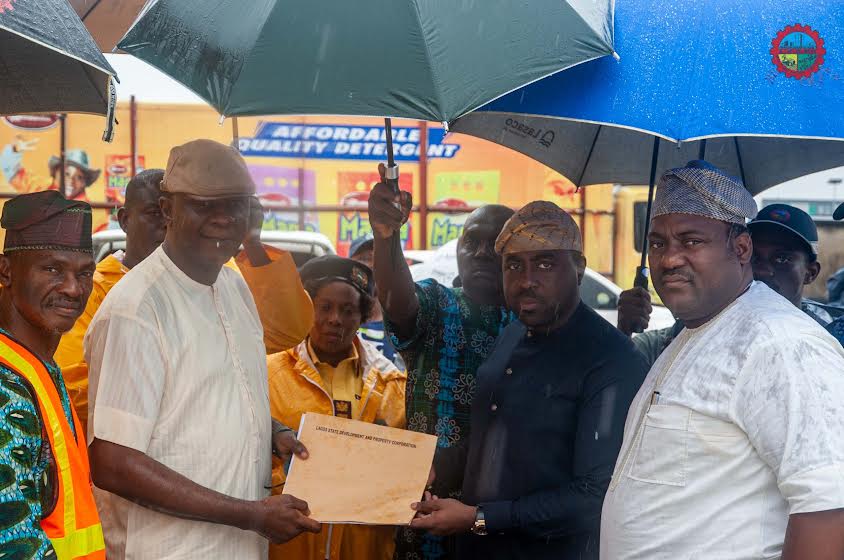
Lagos State Deputy Governor and Governorship candidate of the All Progressives Congress (APC) Dr. Obafemi Hamzat, has said the task before the next administration in Lagos will go beyond building more roads and rail lines.
According to him, the priority must be to create a city where residents can live, work and move around with safety and dignity.
He made this known during the week in an exclusive interview in Lagos while outlining the All Progressives Congress 2027 governorship manifesto.
The document, he explained, was initially drafted in 537 pages but has been reduced to 137 pages following consultations with market women, drivers, professors and other experts aimed at setting realistic priorities.
Hamzat noted that the Sanwo-Olu/Hamzat administration is in its final phase focused on completing ongoing projects under the THEMES Plus agenda and aligning them with a 25-year master plan that runs through 2035.
He cited the rail system as a key example. Government, he said, must complete the Blue Line to Okokomaiko, a 27.1-kilometre corridor, link it with the Red Line at the National Theatre, and prepare an extension from Ikeja to the airport for the incoming administration.
Beyond infrastructure, Hamzat said organisation will define his government. He explained that projects are being costed immediately to produce one-year, two-year and three-year plans. One immediate target is to ensure 60 per cent of Lagos residents have running water within the first two years.
He disclosed that reticulation from Adiyan 2 to Ogba alone is estimated at N97 billion.
On security, Hamzat made a strong case for state police, arguing that local knowledge is critical to crime prevention. Drawing from his experience growing up in Mushin, he noted that residents know those involved in crime, unlike officers posted from other states who lack that familiarity.
He added that technology is already available and government will expand the current security architecture while ensuring residents are not harassed on the streets.
He said addressing street harassment will be a priority within the first six months of his administration, emphasizing that people should be able to drive and go home without interference.
He linked the push for order to daily living, stating that government is lighting up the state with solar street lights to enable people to walk freely at night and conduct business at any time in a safe environment.
Flooding and waste, two recurring challenges, will be tackled through both engineering and behavioural change, he said.
Hamzat explained that Lagos sits two metres below sea level and that the state’s six drainage systems discharge into creeks and lagoons that also rise during rainfall, leading to tidal block and backflow. He said government’s responsibility is to ensure that canals are cleared regularly.
He also stressed the need to enforce physical planning laws, noting that building beyond approved land limits will create problems for the state in the future and such structures should be removed.
On waste management, he said landfills in the small state are becoming clogged. To address this, government is building a facility that will convert about four tonnes of the 13,000 tonnes of waste generated daily into useful resources.
Another landfill has been identified in Badagry, while moribund transfer-loading stations will be revived to reduce waste volume by up to 30 per cent before it gets to landfills. He added that opportunities in carbon credits will also be explored.
Regarding the waste-to-fertiliser plant at Odonguyan in Ikorodu, he said the PPP partner encountered structural and funding challenges.
He disclosed that a new model is now being developed at Olusosun.
Housing for the poor featured prominently in the discussion. Hamzat said the current 35 per cent subsidy on homes is not sustainable because the cost of building materials remains high.