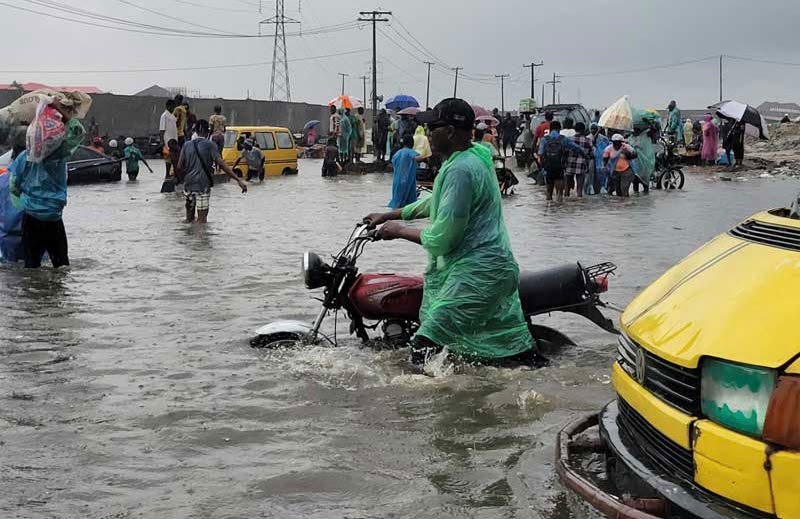
Heavy rainfall on Monday brought parts of Lagos to a standstill, leaving many commuters stranded, forcing residents to wade through floodwaters and triggering sharp increases in transport fares.
Residents, who spoke in separate interviews with the News Agency of Nigeria (NAN) in Lagos, described the downpour as one of the heaviest in recent weeks, saying it disrupted movement, delayed businesses and reduced productivity.
For many commuters, the journey to work became an exhausting struggle through flooded roads, gridlocked highways and overcrowded buses.
Mrs Odion Okiade, a resident of Alimosho axis, said rainy days had become more expensive as transport operators often took advantage of the situation to increase fares.
“My transport fare increases by at least N1,500 whenever it rains. Today’s rain was something else,” she said.
According to her, the recurring fare hikes have further worsened the financial burden on residents already grappling with the high cost of living.
Mrs Nkiru Ogbonna, who commutes from Costain, said she had to wade through knee-deep floodwaters to reach her office.
“I had to wade through knee-deep water to get to my office this morning,” she said, describing the experience as a recurring ordeal during heavy rainfall.
Mrs Chineme Onuoha, who travelled from the Cele axis, said traffic around Orile turned what should have been a few minutes’ journey into a frustrating commute.
“Something that would normally take three to five minutes to Costain took us about 25 minutes, and I got to work late,” she said.
She attributed the delay to severe traffic congestion caused by the downpour.
Another commuter, Mrs Lilian, said the combination of flooding and gridlock made her journey particularly difficult.
“It took me 45 minutes to get to Costain from Orile. The disruption will affect my productivity at work today,” she said.
She added that in spite of wearing a raincoat, she was soaked by the time she arrived at work, while transport fares had also increased.
Mrs Deborah, who lives in Ayobo near the river bordering Ogun and Lagos State, said heavy rainfall regularly disrupts movement in her community.
“When it rains, the river rises, but I still have to get to work somehow,” she said.
She appealed for measures to reduce flooding in vulnerable communities during the rainy season.
Also speaking, Mrs Oluchi Uzoma, a resident of Fantasy Island on the outskirts of Sango near Agbado, blamed indiscriminate waste disposal for persistent flooding in her area.
According to her, floodwaters have cut off communities, damaged roads and disrupted businesses.
“The rain has cut us off. We can hardly go anywhere because our roads are no longer motorable,” she said.
She said erosion had created deep, water-filled potholes that posed dangers to motorists and pedestrians.
“If you’re not careful, the next minute you’ll land in a pothole filled with water. It’s better to stay home until the rain subsides,” she said.
Uzoma added that many residents now remain indoors during heavy rainfall, while businesses that depend on customer visits record poor patronage.
She attributed the persistent flooding to blocked drainage channels clogged with refuse and sand.
“People throw waste on the roads and inside gutters. The gutters are now filled with sand and rubbish, so water no longer flows,” she said.
She urged residents to dispose of waste responsibly and maintain clean surroundings to minimise flooding.
Meanwhile, the Nigerian Meteorological Agency (NiMet) advised residents to remain vigilant, warning that rain and thunderstorms would persist across Lagos and other parts of southern Nigeria.
The agency said strong winds could precede thunderstorms and urged motorists to drive cautiously because roads might become slippery and visibility reduced.
NiMet also advised residents to avoid flooded roads and drainage channels and warned against taking shelter under trees or near power lines during thunderstorms. (NAN)