It was not the routine fitness circuit at the UN peacekeeping base in southern Lebanon.
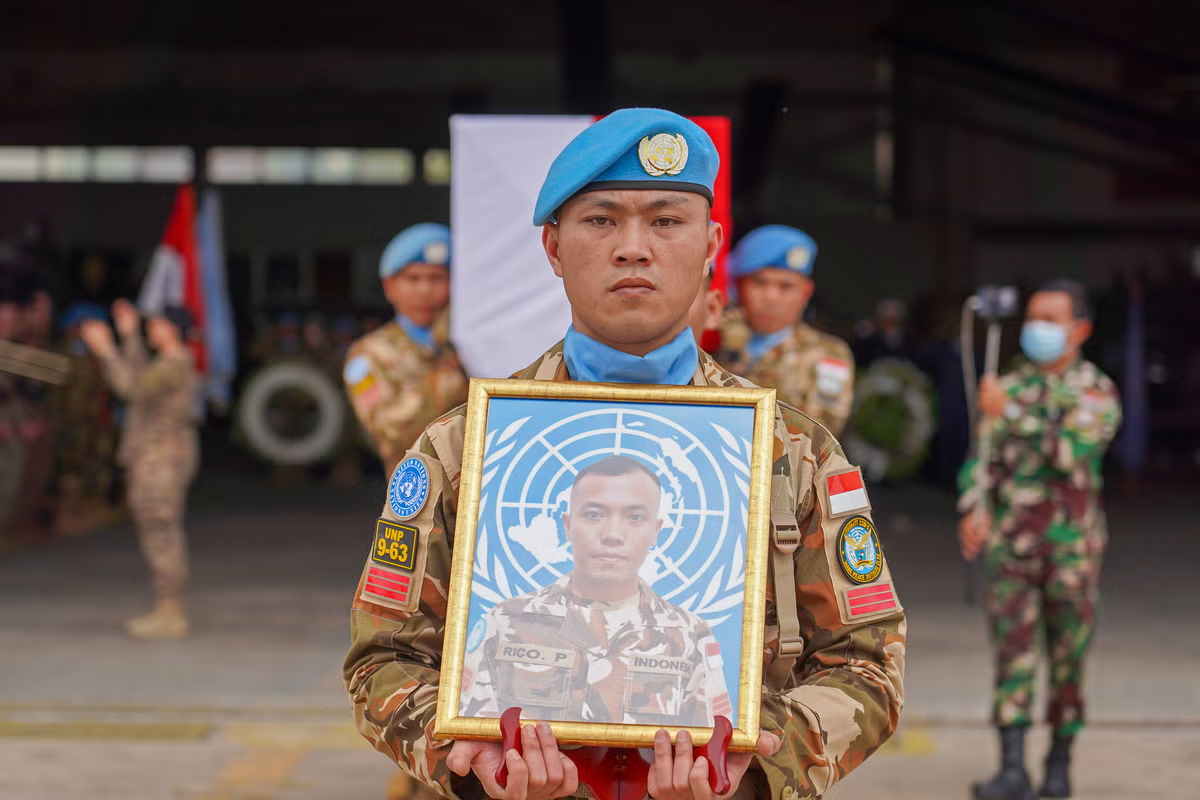
Underneath a blazing sun, peacekeepers in sportswear and bright blue hats gathered for a jog and gym session inside the Shama base. Afterwards, they held a minute’s silence for colleagues recently killed in the line of fire.
It has been a brutal year for the United Nations Interim Force in Lebanon (Unifil). Since hostilities between Israel and Hezbollah reignited in early March following US strikes on Iran, seven peacekeepers have been killed. Four were Indonesians, two of whom were killed when an Israeli tank fired at their position and another two by an improvised explosive device (IED), thought to have been placed by Hezbollah.
Two French ‘blue helmets’ were also killed in April by small arms fire in a likely Hezbollah ambush. The latest fatality was a Serbian peacekeeper, killed in June by a shell explosion of unknown origin.
The perilous conditions mean that peacekeepers no longer patrol far from their bases, nor do they conduct weapon searches as they used to. Their role is now limited to keeping a record of the conflict and protecting themselves.
“The mandate that we have persists,” Unifil spokesperson Kandice Ardiel tells The Independent, “but obviously the situation around us has changed drastically”.
Before 2 March, Unifil had “fairly wide-ranging patrols within each contingent’s area of operations to look for unauthorised weapons and to monitor the situation,” she told The Independent.
“We’re not able to do that anymore […] It’s just too dangerous to have peacekeepers out there when there’s active combat, when there’s projectiles being launched back and forth,” she said.
Unifil was first deployed in 1978 following the IDF’s invasion of Lebanon during its vicious sectarian civil war. Since Hezbollah and Israel’s month-long conflict in 2006, its mission has been to uphold Resolution 1701; ensuring the IDF’s withdrawal from southern Lebanon and supporting Beirut’s authority over the region.
Israel has long opposed Unifil’s presence in the region, claiming it failed to stop Hezbollah’s military buildup or create a deterrent. The US ambassador to the UN, Dorothy Shea, said earlier this year that the “time has come for Unifil’s mission to end”.
In August 2025, the UN Security Council voted to extend the mandate up until December 31 this year, after which time it will expire and Unifil will have completely withdrawn by the end of 2027.
The consequences are unpredictable and the decision has been criticised by western allies. The UK’s UN representative at the vote, James Kariuki, said the Council was not able to make an “evidence-based assessment” of the impact of Unifil’s withdrawal.
The IDF and Hezbollah have exchanged fire on a near-daily basis since a ceasefire agreed in April, with recent signs the conflict is not only persisting but intensifying.
On Wednesday, Israeli PM Benjamin Netanyahu said his country’s forces would remain in the area as long as Hezbollah remained a threat. A deal brokered by the US links Israel’s withdrawal from Lebanon to the militant group’s disarmament, something Hezbollah rejects.
The war has had a devastating impact on Lebanon. More than 4,300 people have been killed, while at least 1.2 million people million have been displaced.
“At this point, frankly, the escalation between the Israel Defense Forces and Hezbollah appears to be intentional”, Ardiel said.
But she denies any suggestion that Unifil will be pushed from their bases by Israel.
“The Security Council has given us the mandate, and peacekeepers will remain in position, will remain on the ground, as long as the Security Council tells us to do so.”
However, she does concede that they have been “lightening the footprint in certain positions” due to challenges in resupplying more isolated positions.
The necessity of such precautions are reflected in the deaths of the two French peacekeepers in April. They were attempting to clear a route blocked by an IED in order to resupply an isolated Unifil position when they were ambushed by Hezbollah militants, according to President Emmanuel Macron. Hezbollah denied the allegations.
Ardiel explains that “with road blockages, we’re sometimes not able to reach positions to resupply them with food, fuel and water,” but says reducing the number of peacekeepers in those positions does not impact their presence, as they are not able to leave the positions for patrols anyway.
The IDF’s destruction of the Qasmieh bridge – the last southwestern bridge across the Litani river linking southern Lebanon to the recent of the country – “most definitely” brings such resupply and logistics concerns, she says.
For Fawaz Gerges, professor of International Relations at the London School of Economics, these attempts to stifle peacekeeper operations represent a long-term attempt to “create a mini-Gaza in southern Lebanon.”
“It’s not just about ending the Unifil mission. What Israel is trying to do is to basically raze the villages, towns, hamlets, and all ingredients of life,” he said.
In late March, Israeli Defense Minister Israel Katz made similar comments, saying that he and Netanyahu had ordered the IDF to accelerate the demolition of Lebanese homes in frontline villages along the border, “in line with the model we applied in Gaza’s Rafah and Beit Hanoun.”