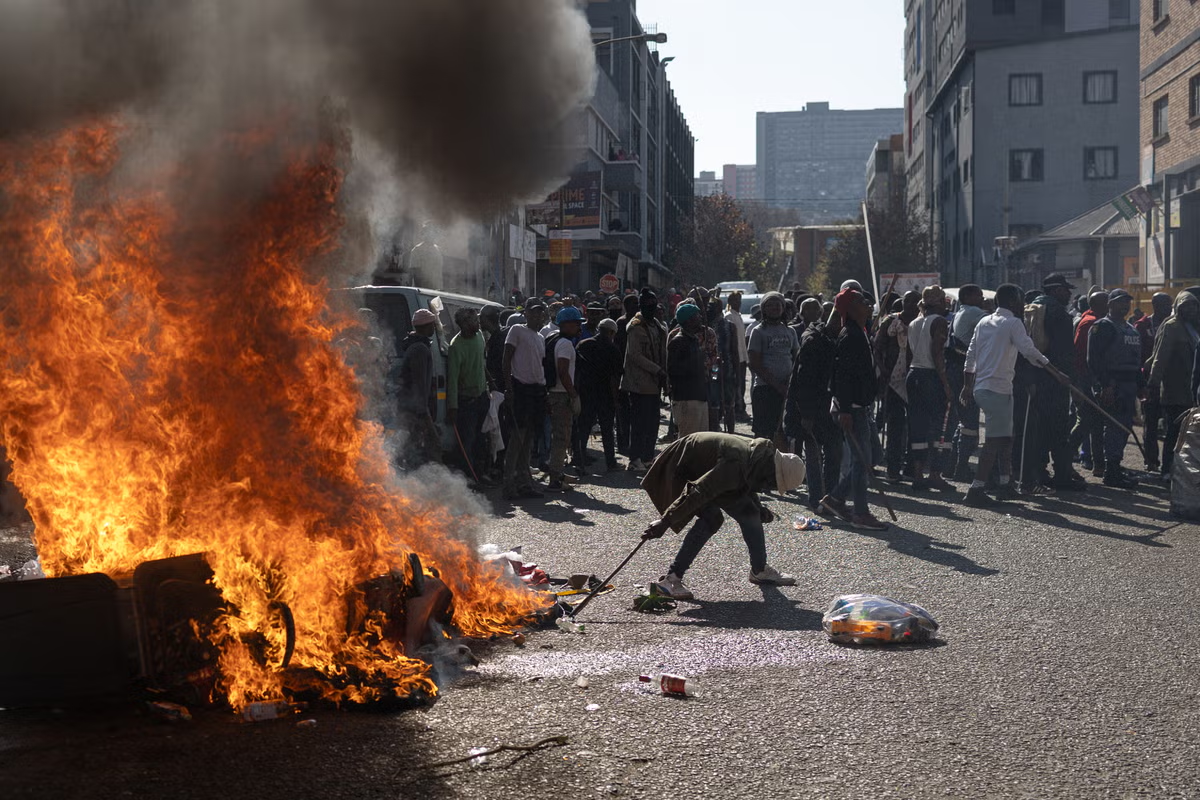
Walking to collect her groceries in Johannesburg, Doris Mthebe watches a large group of men, women and children waving sticks and screaming: “Get them out”.
The Ivory Park suburb is just a short drive away from Alexandra Stadium, where 30 years ago Nelson Mandela outlined his vision for a tolerant, diverse South Africa in a landmark speech ahead of local elections.
“We cannot blame other people for our troubles. We are not victims to the influx of foreign people into South Africa,” he told a rally in response to a burst of xenophobic violence, just a year after he was swept to power.
Mandela’s dream is once again threatened by a wave of violent, xenophobic protests demanding the immediate expulsion of all undocumented migrants from South Africa’s borders. The latest demonstrations are more sustained, coordinated, and politically impactful than any that have come before.
Doris recounts her memory of a protest on 15 June in Thembisa, one of many across the country that experts say is part of a political campaign to exploit valid economic concerns for political gain ahead of municipal elections later this year.
“People were running away from the group, holding the sticks, shouting and screaming,” she tellsThe Independent.
“They were running to [supermarket] Pick n Pay, running because they were scared that maybe there will be shooting. There were a lot of people, men, women, children as well, at the age of 14 or 15, shouting and screaming: ‘They must go, they must go, they must go’.”
The latest round of protests on Tuesday, organised by a coalition of more than 20 groups, marked an unofficial deadline of 30 June by which point demonstrators demanded all undocumented migrants leave the country. More than 900 people were arrested.
The horror of South Africa’s racist apartheid system which segregated whites from non-whites, who were denied basic rights, ended in 1994.
Countries such as Zambia, Tanzania and Zimbabwe provided crucial safe havens, resources, and bases for exiled freedom fighters. Nigeria spent billions supporting the African National Congress (ANC), Mandela’s party. And yet on Wednesday, the Nigerian government said it would seek compensation from South Africa for its citizens who have left the country due to the protests.
It seems a far cry from Mandela’s plea in 1996 for a “legacy of unity and solidarity” in Africa. “No individual must take the law into their own hands,” he told the rally.
But South Africa’s recent protests have been defined by disturbing bouts of violence targeting foreigners. In Yeoville, a suburb where many African migrants live, protesters threw bricks at several homes. In Germiston, which is around 15 kilometres (nine miles) from Johannesburg, demonstrators rampaged around homes forcefully evicting residents they suspected were foreign nationals and demanding police check their details.
Looting has also run rampant during the protests, according to Doris and local media reports, as many exploit the chaos to carry out low-level crime.
Businesses were also forced to close across the country in anticipation of Tuesday’s protests.
Earlier this week, Human Rights Watch said the demonstrations are “causing a humanitarian crisis, with many people displaced and without food” as migrants are forced to flee areas where they had settled.
Police in South Africa say that 25,000 undocumented migrants, mostly from South Africa, have been repatriated so far.
Nigeria flew out 269 citizens on the eve of the protest, with citizens of Ghana, Malawi, Mozambique and Zimbabwe also having been repatriated by plane or bus in recent days.
Out of 120 marches held across the country, police said 108 were peaceful while 12 saw police intervention. But the latest round of protests, South Africa’s political experts say, are different to previous flare-ups of anti-migrant sentiment in the country – such as in 2008, when at least 62 people were killed in a wave of anti-migrant attacks.
The 2026 movement is coordinated and backed by large sums of money. There is a much greater scale of political organisation on social media, where misinformation is rife.
“This time it’s different, the coordination of these protest marches nationally across all the big cities, and the money behind this movement,” says Professor Jo Vearey of the African Centre for Migration & Society, University of the Witwatersrand.
“This isn’t sort of a grassroots mobilisation, this is something that is a very clearly organised and manipulated space.”
The success of the movement in reaching the mainstream was evidenced in a meeting called by president Cyril Ramaphosa with the organisers on the eve of Tuesday’s demonstrations, in a last-minute bid to defuse tensions.
Herman Wasserman, a professor of journalism and expert in political media at Stellenbosch University, says the movement is “inauthentic”.
“It presents itself as a grassroots movement, but it’s an inauthentic ploy online using bots, using influencer armies, all these sort of strategies of hate and disinformation that have now been deployed to really divide.”
For Wasserman, “protests” is a soft word to describe the latest trend. “They are really xenophobic outbursts and violent outbursts”, which often come back during an election year as political parties use the issue to “gain popular traction”.