The grand finale of the competition, held in Lagos on Monday and Tuesday, brought together tertiary institutions from across the country to showcase engineering innovations designed to address pressing national challenges through technology, entrepreneurship and locally developed solutions. 

Team Mavericks of Modibbo Adama University clinched the top prize with its “Sarafa Community Security Alert,” a community-based rapid alert system that uses low-cost devices to connect households and instantly notify neighbours and emergency responders during security emergencies.
In addition to the N50 million prize, the Faculty of Engineering of the institution will benefit from the construction of a Centre of Excellence Building to be sponsored by the NCDMB.
The competition, organised by the NCDMB in partnership with ENACTUS Nigeria as technical partner, also received funding support from Renaissance Africa Energy Company and First Exploration & Petroleum Development Company (First E&P).
Team Aurora of the University of Ibadan emerged first runner-up with its “Aurora Birth Health Tech Suite,” an innovation designed to reduce neonatal deaths resulting from birth asphyxia in low-resource healthcare facilities. The team received N30 million, while its institution will receive engineering equipment valued at N75 million.
Team Fortizo of the University of Jos secured third place with “FarmAnchor,” a solar-powered, artificial intelligence-enabled device that helps smallholder farmers detect crop pests, diseases and soil deficiencies. The team received N20 million and engineering equipment worth N50 million.
The fourth-place prize went to Team Flameless of the University of Nigeria, Nsukka, for its innovation that converts flare gas from marginal oil operators into electricity for nearby communities. The team received N10 million.
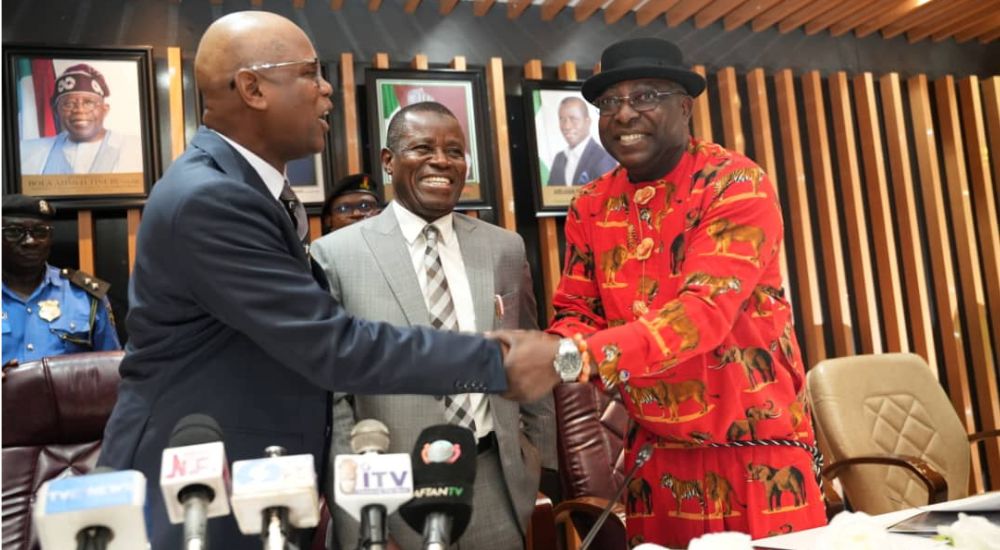
Speaking on behalf of the Executive Secretary of the NCDMB, Engr. Felix Omatsola Ogbe, the Board’s Director of Planning, Research and Statistics, Mr. Omomehin Ajimijaye, described the Olympiad as more than a competition, saying it represented a celebration of innovation and the capacity of Nigerian youths to develop practical solutions to national challenges.
He said the Board remained committed to promoting human capital development, entrepreneurship and innovation as part of its mandate to deepen Nigerian Content across the oil and gas industry and the wider economy.
“Our mandate is to build human and institutional capacity that enables Nigerians to compete successfully not only within the oil and gas industry but across the broader economy. Youth development is a strategic investment in Nigeria’s future,” he said.
Ajimijaye disclosed that another panel of judges was already assessing entries for the NCDMB Technology Innovation Challenge in Yenagoa, Bayelsa State, while the Board had recently launched its Young Researchers Programme, with about 500 undergraduate students already enrolled.
According to him, the initiatives are designed to nurture researchers, innovators and future industry leaders capable of developing indigenous technologies that will strengthen Nigeria’s industrial competitiveness.
Also speaking, ENACTUS Nigeria Country Director, Michael Ajayi, said preparations for the maiden Engineering Olympiad began more than two years ago.
He revealed that the competition attracted 375 project submissions from 984 students representing 80 tertiary institutions, including universities, polytechnics and research institutes across the six geopolitical zones.
Ajayi said the entries underwent a rigorous assessment involving 202 judges, 177 professionals and more than 852 evaluation hours before the top 30 innovations emerged.
Each of the 30 teams received a N3 million development grant, amounting to N90 million, to build prototypes of their innovations over an eight-week period before advancing to regional competitions and the national finals.
He added that finalists also participated in a two-week business development boot camp aimed at equipping them with entrepreneurial and commercialisation skills.
Representing First Exploration & Petroleum Development Company Limited, the General Manager, Engineering and Capital Projects, Engr. John Alani, said the company supported the initiative because it provides structured opportunities for talented young engineers to transform innovative ideas into practical solutions.
He noted that an industry survey indicating that only five per cent of engineering graduates are industry-ready underscores the need for programmes that bridge the gap between academic training and industry expectations.
Similarly, the Vice President, Relationships and Sustainable Development at Renaissance Africa Energy Company, Mr. Igo Weli, said the Olympiad aligns with the company’s commitment to innovation and pledged to engage other sponsors on increasing the innovation grants awarded to participating teams.
The immediate past President of the Nigerian Society of Engineers (NSE), Engr. Margaret Oguntala, who represented the NSE President, commended the NCDMB and its partners for establishing what she described as a national platform for engineering innovation and entrepreneurship.
She said the competition demonstrates that Nigeria possesses abundant engineering talent capable of addressing national development challenges when provided with the right support.
Among the other finalists were teams from the University of Port Harcourt, University of Benin, Imo State University, University of Lagos, University of Abuja, Nigerian Army University Biu, Aliko Dangote University of Science and Technology, Kano, and Ahmadu Bello University, Zaria, which showcased innovations spanning smart security systems, assistive technologies, renewable energy, agriculture, healthcare and artificial intelligence.
The event was attended by senior officials of the NCDMB, representatives of government agencies, academia, professional bodies and industry stakeholders, underscoring the Board’s commitment to fostering innovation, entrepreneurship and indigenous capacity development as key drivers of Nigeria’s industrial growth.