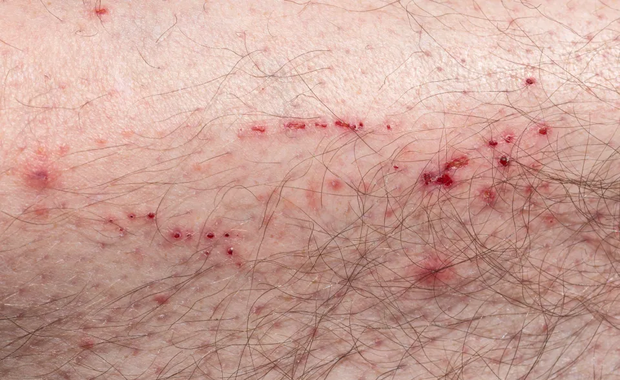
(scabies causes a scaly rash. Photo Credit: Sun Nigeria)
A hospital has been forced to take drastic measures following an outbreak of a rare and highly contagious form of scabies.
Officials closed a hospital ward in Wales in an effort to stop the spread across beds.
Crusted scabies, previously known as Norwegian scabies, is a severe form of scabies spread through direct contact with an infected person or contaminated surfaces such as bedding.
It presents as a scaly rash and thickened crusts of skin containing thousands of mites.
According to a report, Hywel Dda health board said Steffan Ward at Glangwili Hospital, Carmarthen, Wales, would be closed while the outbreak is managed in line with established infection prevention and control procedures.
The health board said all patients and staff identified as contacts have now been informed and offered treatment, including those without symptoms, adding that extra infection prevention and control measures have been put in place on the ward.
This includes enhanced monitoring, treatment of identified contacts, and ongoing support from specialist teams.
According to the health board, there has been a rise in scabies cases across Carmarthenshire, Pembrokeshire, and Ceredigion, which has contributed to the hospital outbreak.
It said the situation will be kept under review, and the ward will reopen in line with infection prevention and control guidance once it is safe to do so.
Scabies is an itchy rash caused by mites and needs prompt treatment to prevent its spread. Crusted scabies can result from reduced immunity, though this is not always the case.
Scabies often affects the elbows, knees, feet, and hands, appearing on the skin between the fingers and on the wrists.
According to health authorities, scabies is not usually a serious condition. A pharmacist can recommend a cream or lotion applied over the whole body, including the scalp and face.
While it is highly infectious, it can take up to eight weeks for the rash to appear, and its symptoms often overlap with other skin conditions such as eczema, psoriasis, and food allergies.