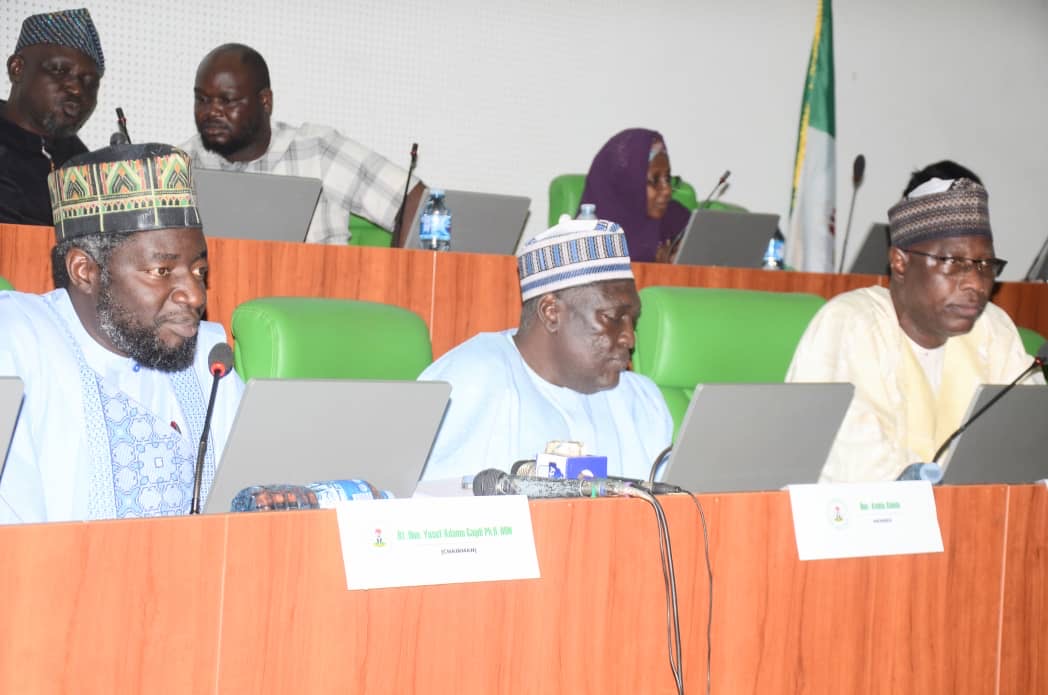
The panel asked Mr Ribadu to appear before it on Thursday at 12:00 noon to explain the measures taken after his office confirmed that the PFIPC was not recognised by the federal government.
The House of Representatives Ad-Hoc Committee investigating the activities of the unestablished Presidential Foreign Investment Promotion Council (PFIPC) has invited the National Security Adviser, Nuhu Ribadu, to explain the action his office took regarding the fake agency.
The committee has also requested that the Minister of Foreign Affairs, Bianca Odumegwu-Ojukwu, appear before it in person. The summons follows the submission made to the committee by the Permanent Secretary (PS) of the ministry, Dunoma Ahmed, on Tuesday. The panel is chaired by Yusuf Gagdi (APC, Plateau).
It is examining how the PFIPC allegedly operated as a federal government agency despite having no legal basis for its existence. It is probing claims that the organisation presented itself as a presidential institution, corresponded with government agencies and attempted to engage foreign investors while using the Presidency’s name. The panel was also mandated to find out how the phantom agency obtained an allocation in the 2026 budget.
Mr Ahmed told the lawmakers that the ministry never recognised or had any official dealings with the PFIPC, insisting that both the council and its alleged Director-General, Adeniyi Adeyemi, were unknown to the federal government.
Giving the ministry’s account, the PS said Mr Adeyemi approached it on three occasions — “26 June 2025, 5 August 2025 and 5 June 2026” — seeking its collaboration and endorsement for a proposed World Investment Summit in Nigeria.
According to him, Mr Adeyemi identified himself in the correspondence as the “Director-General of both the Presidential Economic Advisory Council (PEAC) and the Presidential Foreign Investment Promotion Council.”
The PS said the ministry rejected all three requests after carrying out due diligence, citing inconsistencies in the documents submitted and doubts over the authenticity of both the council and its purported leadership.
He explained that the ministry subsequently wrote to the Office of the National Security Adviser (ONSA) on 16 October 2025 seeking clarification on whether Mr Adeyemi was indeed the Director-General of the PFIPC.
According to Mr Ahmed, ONSA replied on 26 November 2025 after making enquiries with the Office of the Secretary to the Government of the Federation and the Office of the Chief of Staff to the President, confirming that Mr Adeyemi was unknown to any office of the federal government.
He further told lawmakers that the ministry never participated in any diplomatic engagement involving the PFIPC and did not facilitate any foreign investor, international partner or delegation on behalf of the council.
He added that no Memorandum of Understanding, treaty or investment agreement was signed through the PFIPC, while Nigerian missions abroad were never directed to engage with the organisation because the ministry never recognised it as a legitimate government institution.
Apart from the correspondence already submitted to the committee, Mr Ahmed said the ministry had no official records relating to the PFIPC and had never collaborated with either the council or its alleged Director-General in any official capacity.
Reacting to the revelations, Committee Chairman Mr Gagdi expressed concern that the Office of the National Security Adviser had confirmed as far back as November 2025 that the PFIPC was not a recognised government institution, yet questions remained over the actions taken afterwards.
He said it was the committee’s responsibility to determine whether the country’s security agencies took appropriate steps after establishing that the council had no legal existence.
Consequently, the committee summoned Mr Ribadu to appear before it on Thursday at 12:00 noon to explain the measures taken after his office confirmed that the PFIPC was not recognised by the federal government.
The committee also directed Mrs Odumegwu-Ojukwu to personally appear before the panel to provide further clarification on issues arising from the ministry’s submissions.
Explaining the summons, Mr Gagdi said the committee wanted ONSA to account for the actions it took after the Ministry of Foreign Affairs raised concerns over the authenticity of the organisation.
He said once the Office of the National Security Adviser established that the PFIPC did not exist as a government institution, it ought to have taken appropriate action, adding that the committee would determine whether the necessary steps were taken to prevent the organisation from continuing its activities.Earlier testimonies
The testimony adds to a growing list of government institutions that have distanced themselves from the controversial council.
On Monday, the Central Bank of Nigeria (CBN) told the committee that two foreign currency accounts opened in connection with the PFIPC had remained inactive since they were created. Representatives of the bank said the accounts had never received any deposits or recorded any transactions, stressing that the bank merely processed the account opening in line with regulatory requirements and had no role in establishing or recognising the organisation.
Similarly, the Head of the Civil Service of the Federation (HCSF), Didi Walson-Jack, denied any knowledge of the so-called council, saying it was never established through the procedures required for creating federal government agencies.
Mrs Walson-Jack told lawmakers that no request was ever received from the Presidency, the Office of the Secretary to the Government of the Federation or any other authorised institution for the creation of the PFIPC. She said her office neither approved the establishment of the council nor issued any organisational structure, staffing schedule or appointment recognising Mr Adeyemi as its Director-General.