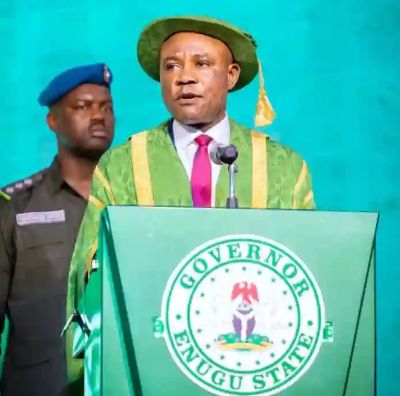
Governor Peter Mbah of Enugu State has called for a fundamental overhaul of Nigeria’s education system, urging schools to focus on producing problem-solvers and innovators rather than graduates armed only with certificates.
Governor Mbah said this on Thursday when he delivered the 55th Convocation Lecture of the University of Nigeria, Nsukka (UNN).
He said education must become the driving force for restoring human dignity through experiential learning, innovation, and inclusive prosperity.
Delivering the lecture, titled: “Restoring the Dignity of Man: Enugu’s Quantum Leap in Human Development and Inclusive Prosperity Through Experiential Learning,” he described UNN’s motto as a timeless mission whose relevance has become even greater in the era of artificial intelligence, biotechnology, and knowledge economy.
He argued that true development should be measured by citizens’ ability to transform knowledge into productivity and shared prosperity rather than by physical infrastructure alone.
He said: “True dignity exists when people possess not merely the freedom to aspire, but the capability to transform aspiration into achievement, potential into productivity, and possibility into shared prosperity.”
Mbah said Enugu’s education reforms were inspired by the Igbo apprenticeship system, which, according to him, embodies learning by doing, mentorship, trust, discipline, and entrepreneurship.
He said: “Our purpose is not to romanticise the past, but to apply its deepest principle to the future.
“This is why we embraced experiential learning—not as a foreign educational idea, but as a modern expression of our knowledge tradition and a twenty-first-century development imperative.”
The governor explained that through experiential learning, the state seeks to democratise opportunities by ensuring that access to quality education, technology, healthcare, infrastructure, mentorship, capital, and connectivity are no longer determined by birthplace, income, or social status.
He disclosed that the Centre for Experiential Learning and Innovation (CELI), Enugu is driving reforms in curriculum development, teacher training, research, digital literacy, technical education, and industry partnerships to bridge what he described as the “activation gap” between knowledge and opportunity.
Mbah said his administration’s vision of growing Enugu’s economy from about $4.4 billion to $30 billion is anchored on human capital development rather than conventional infrastructure projects alone.
He noted that about one-third of the state’s annual budget has consistently been allocated to education, leading to the construction of 268 Smart Green Schools across the state’s 260 political wards, equipped with smart classrooms, laboratories, digital libraries, innovation studios, clinics, smart farms, solar power, and internet connectivity.
According to him, over 23,000 teachers have undergone digital literacy training, while the state has approved the recruitment of 4,698 teachers to strengthen the Smart Green School initiative.
The governor added that students in the state’s Technical and Vocational Education and Training (TVET) colleges were already receiving practical industry training in ICT, mechatronics, aquaponics, precision welding, fashion and design through partnerships with industries, including the Enugu Haier Factory.
He also announced plans to establish three specialised universities dedicated to Artificial Intelligence and Technology, Education and Technology, and Agriculture, Agro-industrialisation and Technology, while new degree programmes in Automation, Artificial Intelligence and Mechatronics have already been introduced at the Enugu State University of Technology (ESUT) and Institute of Management Technology (IMT).
To demonstrate the impact of experiential learning, Mbah narrated the story of Arinze Edeoga, a pupil of a Smart Green School in rural Owo community, who recently taught digital literacy to pupils in Enugu metropolis.
He said: “A village child became a teacher of urban peers.
“In Arinze, you see restored confidence, democratided opportunity and a child once defined by geography becoming a creator of knowledge rather than merely a consumer of it.
“You see the dignity of man.”
Mbah, however, said education reforms alone would not guarantee prosperity unless supported by investments in healthcare, electricity, roads, aviation, tourism, and technology, stressing that Enugu’s development strategy integrates all sectors into a single human development architecture.
He cited projects such as the 300-bed Enugu International Hospital, transport terminals, Enugu Air, expansion of primary healthcare centre, Enugu Command tourism infrastructure, and the proposed 660-megawatt power plant as interconnected investments designed to unlock productivity, attract investment and improve citizens’ quality of life.
He concluded by urging governments, universities, communities, and the private sector to reject what he described as the “poverty of imagination”, insisting that the future belongs to societies willing to invest boldly in human capability.
Mbah said: “Let us measure leadership by the capabilities it develops in others, education by the lives learners become able to shape, and development by the dignity and opportunity it extends to every citizen.”
In their various remarks, the Vice Chancellor of UNN, Prof. Simon Ortuanya, and Chairman of the event and former Minister of Power, Prof. Chinedu Nebo, commended Mbah’s milestones in human capital development.
They noted that he had, in three years, made a resounding impact in development across all sectors.
The event was attended by notable dignitaries, including the Deputy Governor of Enugu State, Ifeanyi Ossai; Deputy Speaker, Enugu State House of Assembly, Hon. Ezenta Ezeani; Minister of Innovation, Science, and Technology, Dr. Kingsley Udeh; Catholic Bishop of Nsukka Diocese, Most Rev. Godfrey Igwebuike Onah; and Senator Ikeje Asogwa.