The Iranian state media on Wednesday reported that a foreign-flagged cargo ship got stuck in the Strait of Hormuz after ignoring the Iranian administration’s instructions and claimed that the vessel was using a “US-suggested route” instead of the route laid out by Tehran’s Revolutionary Guard.
State television highlights severity of the grounding
According to IRIB’s report, which is affiliated with the Revolutionary Guard (IRGC), the incident took place after the cargo ship “deviated from the designated shipping route” and highlighted that it’s “an incident even worse than sinking”.
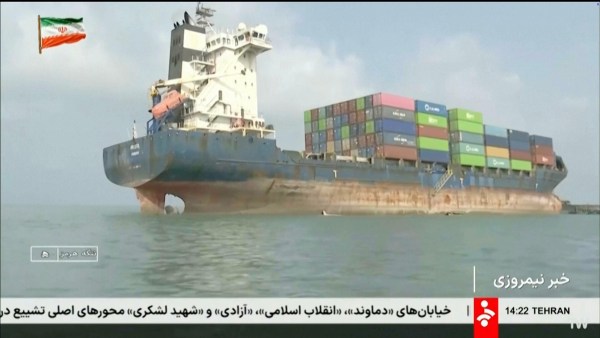 This frame grab of footage aired by Iranian state television shows a vessel that ran aground in the Strait of Hormuz. (AP)
“A foreign container ship, because of choosing a route other than the one designated under the Iranian order, has run aground in the Strait of Hormuz,” AP reported, citing a state TV news anchor.
Strategic implications for global energy logistics
The IRGC has continued to reiterate its warnings to the vessels transiting the Strait of Hormuz that they must follow the track designated by the Iranian navy in the strategic waterway, and by that, asserting the claim that the Islamic Republic controls the strait, which is responsible for 20 percent of global oil and gas supply, AP reported.
Independent verification of the stranded vessel
However, in contrast to Iranian claims, the ship tracking data from TankerTrackers, a company that tracks oil shipments at sea, showed the foreign-flagged cargo ship stuck in Hormuz was a container ship, Arista, and the data was based on the vessel’s location, shape and other details, AP reported.
Registration discrepancies and false flag operations
Arista was reportedly flying a false flag on the vessel linked to the East African island nation of Comoros, which, according to the AP report, was last year known as the Panama-flagged Gauja.
Story continues below this ad
Treasury sanctions and enforcement interventions
The US Treasury Department had included the tanker in its sanctioned list and described it as a network that had been “generating tens of billions of dollars in profit” for Tehran’s ruling administration.
The Tanker Tracker data also showed that Arista has been under sanctions “since last summer” in the US Office of Foreign Assets Control (OFAC).