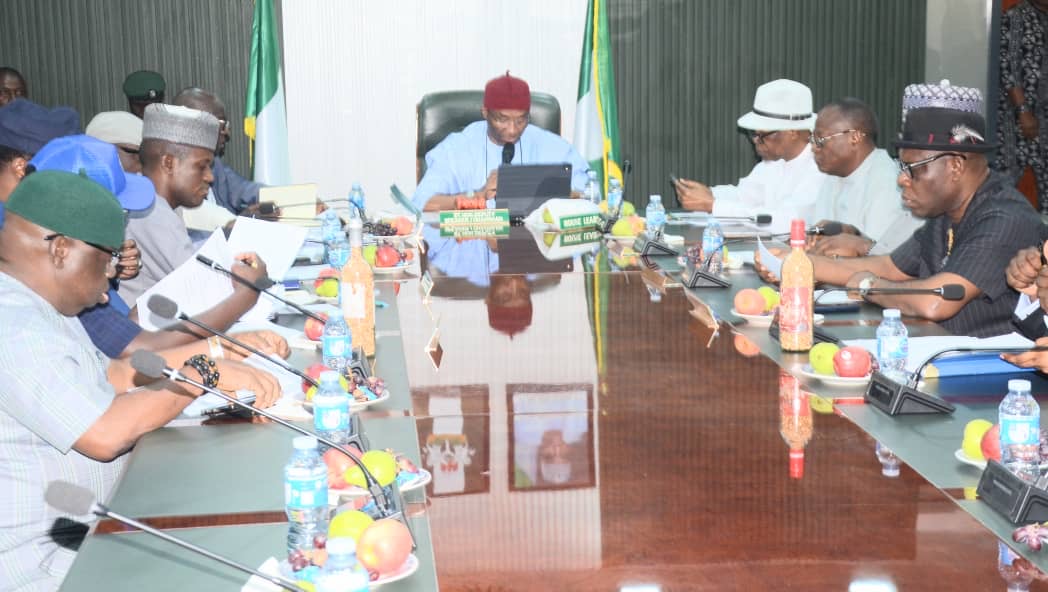
The House Constitution Review Committee says it may adopt the Senate-passed version with minor amendments to accelerate the constitutional amendment process.
The House of Representatives Committee on Constitution Review has indicated it may adopt the version of the state police bill already passed by the Senate to fast-track the constitutional amendment process.
The Chairman of the committee and Deputy Speaker of the House, Benjamin Kalu, disclosed this on Monday at the commencement of the committee’s consideration of President Bola Tinubu’s executive bill seeking to establish state police, signalling closer collaboration between both chambers of the National Assembly on one of the administration’s flagship constitutional reform proposals.
The committee’s deliberation comes less than a week after President Tinubu formally transmitted the Executive Bill to the House.
In response, the House last Tuesday rescinded its earlier approval of a constitutional amendment bill on state police, paving the way for consideration of the President’s proposal.
The lawmakers also passed the Executive Bill for second reading after adopting a motion moved by the Chairman of the House Committee on Rules and Business, Francis Waive, who argued that the new proposal necessitated revisiting the earlier legislation.
Addressing members at Monday’s meeting, Mr Kalu said the Senate-passed version of the bill would serve as the committee’s working document, with only minor adjustments where necessary.
He explained that members would carefully review the Senate’s amendments and adopt them where appropriate.
“The purpose of today’s meeting is to consider the Executive Bill clause by clause and make appropriate recommendations to the House. We must note that the Senate has already considered and adopted the bill with certain amendments, and copies of that version have been circulated to members. This document will serve as our working draft throughout this exercise,” he said.
According to the deputy speaker, the Executive Bill is largely consistent with previous drafts already considered by the National Assembly, making it unlikely that the House would introduce significant changes.
“On the clause-by-clause consideration, the Executive Bill is substantially similar to what we have previously worked on, with only minor adjustments. Therefore, we do not anticipate any major departure from the work already undertaken,” he added.
He noted that the proposed legislation introduces Section 318 on interpretation, transitional provisions to guide implementation of the state police framework, and other consequential amendments.
Mr Kalu also disclosed that the Senate inserted about eight additional clauses containing minor adjustments, which the House committee would examine before making recommendations to the House.
“You will see the introduction of Section 318 dealing with interpretation, as well as transitional and saving provisions to facilitate the implementation and operationalisation of the State Police framework, together with other consequential amendments. The Senate also introduced about eight minor clauses with slight adjustments that are not too significant.
“So, as we proceed with this amendment process, we shall take into consideration the work already done by the Senate and adopt it where applicable,” he said.
Mr Kalu recalled that before lawmakers proceeded on recess, the House had passed its own Constitution Alteration Bill on state police on 11 June.
However, after President Tinubu transmitted an Executive Bill to the National Assembly, the House rescinded its earlier decision on 14 July and instead allowed consideration of the presidential proposal.
“You may recall that on 11 June, before the recess, the House considered and passed the Police Constitution Alteration Bill. However, following the introduction of an Executive Bill by the President, that decision was reversed by the House on 14 July to enable consideration of the Executive Bill coming from the Commander-in-Chief of the Armed Forces,” he said.
The deputy speaker argued that the President, as commander-in-chief of the armed forces, was well placed to initiate comprehensive reforms to address the country’s security challenges.
He further stated that the Executive Bill had already passed first and second readings in the House, while stakeholder engagements held during the National Assembly Open Week effectively fulfilled the public hearing requirement for the legislation.
“The bill has been referred to this committee, and the committee is not just the deputy speaker and the deputy chairman. The committee is you and me. Our responsibility is to carefully scrutinise this legislation and ensure that it reflects the aspirations and expectations of the Nigerian people,” he said.
Mr Kalu described the proposed state police legislation as one of President Tinubu’s major constitutional reform initiatives, noting that the President had advocated a multi-level policing structure since his time as governor of Lagos State.
“I must emphasise that the State Police Bill remains one of the signature constitutional reform initiatives of His Excellency, President Bola Ahmed Tinubu. As governor of Lagos State, he was among the earliest advocates of multi-layered policing as a strategic solution to Nigeria’s security challenges. Today, as President, he is championing the same cause, demonstrating consistency between his convictions and his actions,” he said.
He stressed that although the Executive, Legislature and Judiciary operate independently, all three arms share responsibility for achieving national objectives, particularly improving security.
“As we have always argued, although we are three arms of government, we are one government. There is a national objective, and all we do is align ourselves with it, especially when that objective is in the best interest of Nigerians. Today, there is a national consensus that security must remain at the forefront of governance, and both the Executive and the Legislature are committed to achieving that objective,” he said.
Mr Kalu said the committee convened on a Monday, outside the House’s normal legislative schedule, because of the urgency attached to the proposed constitutional amendment.
“We are here today not because it is convenient for us. Our parliamentary week ordinarily begins on Tuesday, but duty calls, and time is of the essence. We are joining hands with the Executive to ensure that this collaborative effort results in the successful passage of this priority constitutional amendment,” he said.
He also expressed confidence that the House and Senate would conclude work on the legislation in harmony before transmitting it to President Tinubu for assent.
“Historically, the House and the Senate are working in tandem to ensure this significant constitutional amendment is achieved. I am confident that once it returns to the Executive, it will receive expeditious assent,” the deputy speaker stated.
The Executive Bill seeks to amend the Constitution to establish a multi-tier policing system, allowing states to establish and operate their own police services alongside the Nigeria Police Force, as part of broader efforts to address growing insecurity across the country.