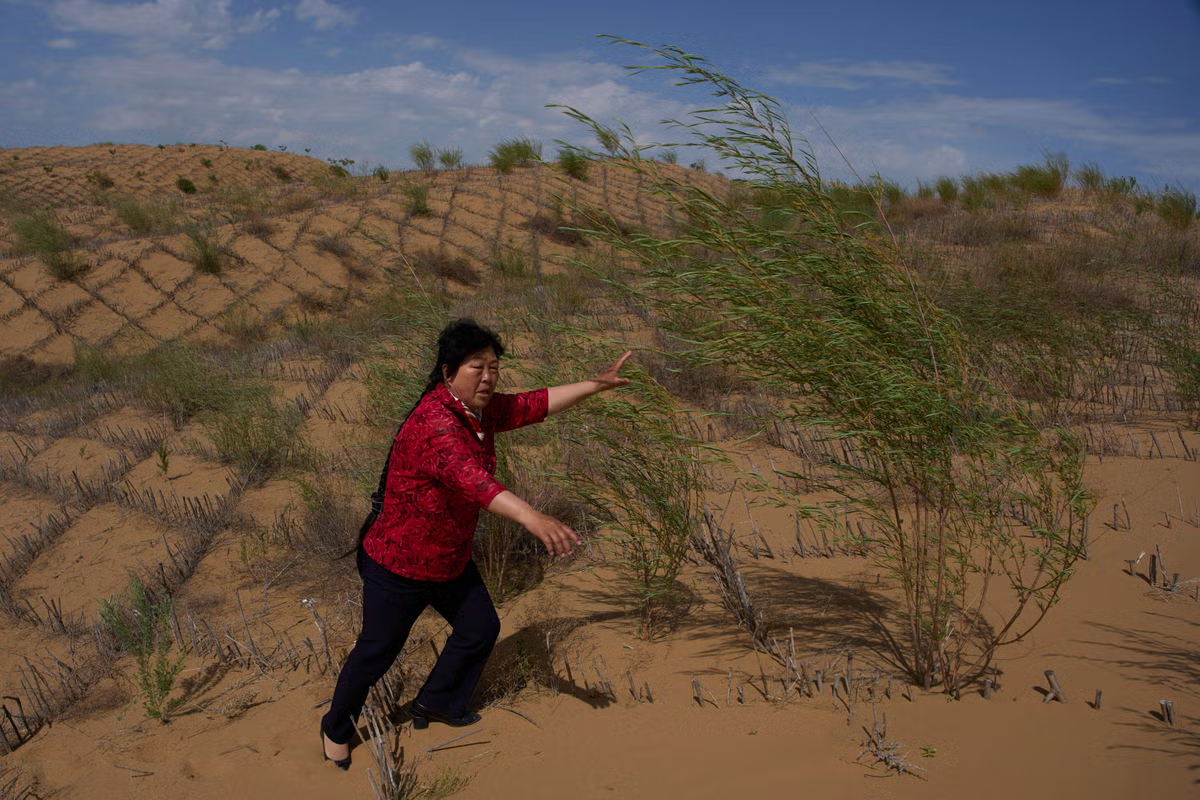
For half a century, a monumental human endeavour has unfolded across China’s northern deserts, as millions of workers meticulously insert forearm-length sticks into shifting sands.
Arranged first in rows, then intersecting lines, these gradually form a grid, within which saplings are planted and sustained by an irrigation system.
This technique, known as “straw checkerboards,” offers a simple yet highly effective method to stabilise sand dunes against the relentless wind, simultaneously aiding the establishment of new plant life.
The vast lattice patterns created across the landscape have become the enduring symbol of China’s decades-long battle against the encroaching desert, a campaign officially known as the Three-North Protective Forest Program, or more colloquially, the Green Great Wall.
While generations of this painstaking work have yielded demonstrable progress, scientists caution that preserving these gains will necessitate many more decades of sustained effort. Historically, factors such as drought, overgrazing, and intensive farming practices stripped away vegetation, damaged soil, and rendered vast areas vulnerable to wind and sandstorms – a process known as desertification. According to data published by state media, the extent of desertified land in northern China peaked in 2000, but has since been reduced by over 1,000 square kilometres (400 square miles) annually.
The Chinese government said the initiative launched in 1978 has played a crucial role in transforming vast regions covering nearly half of China from “the desertification advancing and people retreating” to “greenery advancing and the desertification retreating.” Forests planted by the program now cover a cumulative 500,000 square kilometers (200,000 square miles).
“The broad significance of the Three-North Program is not only the scale of restoration, but the long-term political commitment behind it,” said Barron Joseph Orr, chief scientist for the U.N. Convention to Combat Desertification. In a response to The Associated Press, he wrote that reversing desertification is possible when it becomes part of long-term development strategies.
Elsewhere, efforts to combat desertification have included a project launched in Africa in 2007 to plant trees across a number of countries to hold back the Sahara Desert.
The project aimed to create of a 5000-mile wall of trees, passing through 11 countries: Chad, Mali, Niger, Burkina Faso, Mauritania, Nigeria, Sudan, Ethiopia, Eritrea, Djibouti and Senegal.
The United Nations described the project, led by the African Union, as “a green wall to promote peace and restore nature in Africa’s Sahel region” and was expected to provide10 million job opportunities by 2030.
However, the project had stalled after a number of setbacks.
“The Sahel countries have not allocated any spending in their budgets for this project,” Issa Garba, an environmental activist from Niger, told Independent Arabia in 2023.
“They are only waiting on funding from abroad, whether from the European Union, the African Union, or others.”
“This project will persist despite its faltering and setbacks. However, completing it within the 2030 deadline remains an unattainable goal”.
The progress is the result of the efforts of frontline sand-control workers, along with top-level planning and substantial state investment, said Zhu Jiaojun, a scientist at the Institute of Applied Ecology, Chinese Academy of Sciences, who has long been dedicated to the construction and management of the program. He added that increased rainfall in recent years in some areas has made vegetation restoration easier.
“The achievement of desertification combat is due to people’s hard work and a bit of luck with climate,” he said.
According to long-term monitoring data by Zhu’s team, China’s desertified land has shrunk by around 10% overall since 2000, and areas of severely or extremely desertified land have decreased by more than 40%. Forest cover in the program area has risen from around 5% in 1978 to 14% in 2022.
In a recent government-organized media tour to a corner of Kubuqi Desert, about 800 kilometers (500 miles) to the west of Beijing, 60-year-old Yin Yuzhen recounted her early days of being a sand-control worker as “very lonely.” Working alongside her husband near her hometown in the neighboring Mu Us desert, she said that it felt delightful to encounter any other creature.
“Even the passing of a bird across the sky made me happy,” she said.
Four decades ago, she recalled, the sand often blew so thick that it made it hard to see a short distance.
“But now we can see the sun. We can see the green in the distance. We can see the road,” said Yin.
She and her husband now work from dawn to noon every day, attending to trees and fixing or replacing checkerboards. They are joined by their children and sometimes local volunteers.
Zhu, the scientist, estimated that over 300 million rural laborers have been involved in the program, mostly on a paid, part-time basis.
Orr said restored ecosystems in drylands can become increasingly self-sustaining over time, but they still require careful management and long-term monitoring, with success depending on factors such as water availability and soil health.
The environmental advocacy group Green Camel Bell in Gansu province works to explain desertification and its risks to farmers and herders, plant trees with them in dryland areas, and help restore and sustain vegetation.