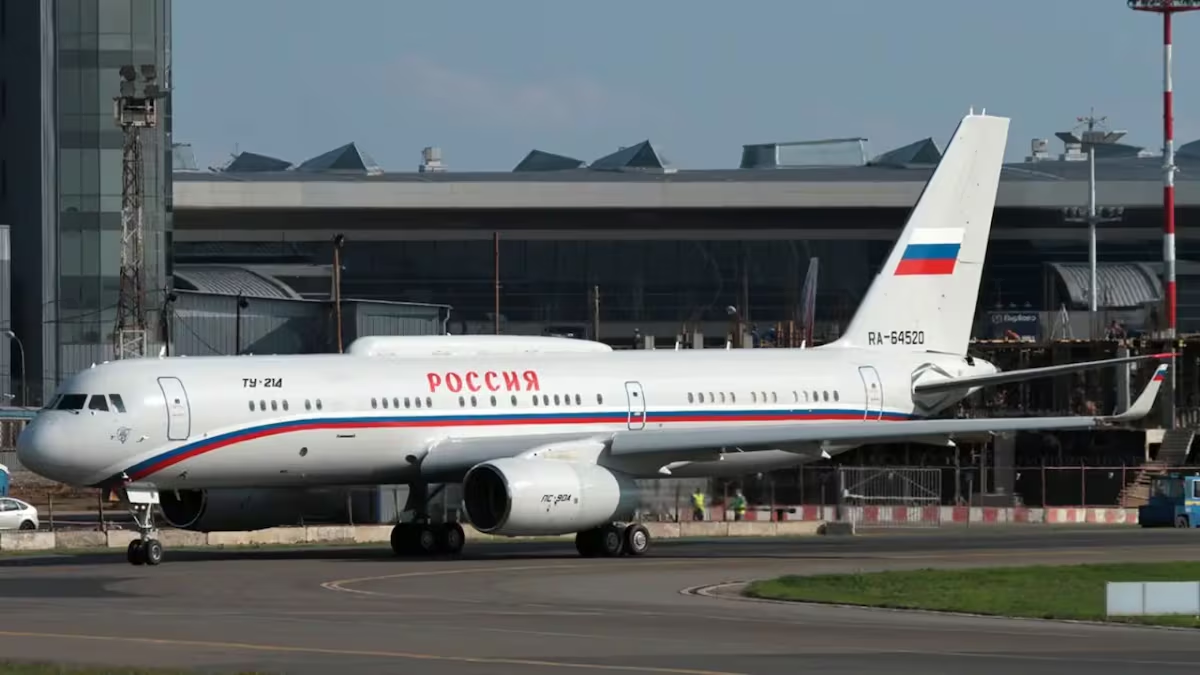
The Tu-214PU, often likened to the aircraft the United States uses for high-level command functions during emergencies, was flown into Tehran as fighting between Iran, the US and Israel continues.
Also Read: Iran condemns US strikes, calls it violation of UN charter
The US has maintained military operations against Iranian targets even after President Donald Trump announced a ceasefire in June, with tensions flaring again following attacks on shipping in the Strait of Hormuz. The truce proved short-lived, with hostilities resuming last week after strikes on vessels in the strategic waterway.
Analysts view the deployment as further evidence of the close strategic ties between Russia and Iran. The appearance of a Russian command aircraft on Iranian soil is being interpreted as a signal that military cooperation between the two countries continues despite the volatile regional backdrop.
Aircraft specifications
The Tu-214PU is a specially adapted command-post variant of the Tupolev Tu-214 passenger airliner and is sometimes referred to informally as a “doomsday plane.” Developed for Russia’s presidential and strategic air fleet, it carries advanced communications and command equipment that allows senior officials to continue running state affairs while airborne.
The “PU” designation comes from the Russian term for a flying control or command post, distinguishing it from a standard passenger jet. Although based on the Tu-214 airframe, its interior and avionics have been extensively modified for secure command-and-control operations.
US-Iran War Live Updates: Crude prices rise over 4% on renewed tension in West Asia
The aircraft is designed to function as a mobile command centre for Russia’s top leadership, equipped with dedicated radio and communications systems to support presidential travel and government operations on the move. Reported specifications put its cruising speed at around 850 kmph and its range at roughly 6,500 kilometres in at least one configuration, making it a narrow-body counterpart to other VIP command aircraft. A more advanced military variant, the Tu-214PU-SBUS, reportedly carries enhanced communications capabilities.
Fresh strikes across the region
The aircraft’s arrival coincides with continued fighting across West Asia. Iran’s Islamic Revolutionary Guard Corps (IRGC) said on Monday, July 13, that it had struck fuel tanks and Patriot air defence batteries at Ali Al-Salem Air Base, along with a radar installation at Ahmed Al-Jaber Air Base in Kuwait, a close US regional ally.
The IRGC said the strikes formed part of the third phase of what it called its “eye-for-an-eye” campaign against Washington, describing them as retaliation for earlier US military action and warning that further operations would follow, according to a report by Al Jazeera.
Also Read: Iran expands attacks on Gulf states after US strikes, says Strait of Hormuz closed
Earlier the same day, the IRGC said it had also struck helicopter maintenance facilities, a hangar housing a P-8 aircraft, and a US drone command-and-control centre at Sheikh Isa Air Base in Bahrain, describing the attacks as the second phase of its retaliatory campaign.
Iran’s attacks followed renewed US strikes inside the country early on Monday. US Central Command (CENTCOM) said the latest operation was launched in response to attacks on ships transiting the Strait of Hormuz and was intended to further degrade Iran’s ability to threaten civilian and commercial shipping.
CENTCOM said on X that additional strikes against Iran began at 5 pm ET on Monday under orders from the Commander-in-Chief.
By sending the command aircraft, Russia appears to be signalling to Washington and other regional actors that it remains closely aligned with Tehran and is prepared to support high-level coordination through intelligence sharing, diplomatic backing, military consultations, or contingency planning.