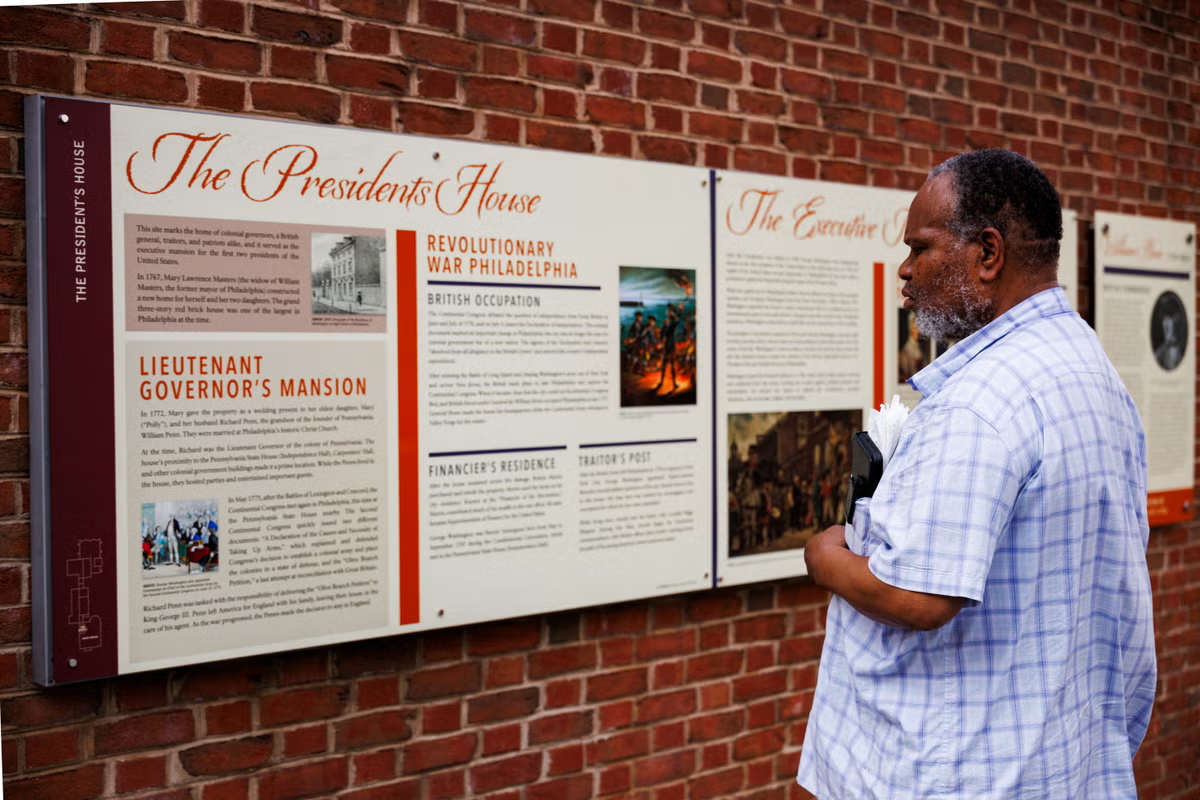
The Trump administration has removed a slavery exhibit at the home of former president George Washington in Philadelphia, replacing it with another version that historians have complained whitewashes the subject.
Now known as the President’s House, the property was home to the Founding Father and his wife Martha from 1790 to 1797 and was also occupied by his successor John Adams for another three years before the construction of the White House in Washington, D.C.
The Washingtons lived there with nine African slaves who had been sent up from the first president’s plantation home in Mount Vernon, Virginia, to serve him in Pennsylvania, a story told via a series of information boards on show at the site in Independence National Historical Park since 2010.
The administration previously had the display taken down in January, only for the City of Philadelphia to sue the Department of the Interior and the National Parks Service to demand its reinstatement, which was duly brought about by court order in February.
District Judge Cynthia Rufe invoked George Orwell in her ruling as she accused the government of seeking to “disassemble historical truths.”
However, a three-judge panel of the U.S. 3rd Circuit of Appeals went on to reverse her decision and said on July 3 that a replacement installation could be erected instead.
Philadelphia’s Democratic Mayor Cherelle L. Parker reacted angrily to that coming to pass Wednesday, writing on X: “Overnight, under the cover of darkness, the federal government removed panels at the President’s House that told a thorough history of Philadelphia.
“It was allowed to do this by the decision of the federal court, but that it did so at night shows it understands this action is shameful, that it violates community trust. Which it is, and which it does.”
Parker vowed to “continue the fight,” observed that “you cannot erase American history” and pointed out that the story of Washington’s slaves posed an important question: “How do we share power for the betterment of all people?”
A government website presenting the new panels revealed that they still carry information about Washington’s slaves, the perspectives of the first presidents and the Constitution on the issue and background on the abolitionist movement that finally brought it to an end.
However, other details are missing and they take a less overtly critical tone, the originals having referred unambiguously to “The Dirty Business of Slavery,” for instance.
The Interior Department said the new panels “are full of historical context and highlight the momentous events that took place in the President’s House and the other sites at Independence National Historical Park.
“They acknowledge the evils of slavery, including its injustices and hypocrisies, and, by telling the stories of the nine slaves that Washington kept in the President’s House, remind us of their essential humanity.”
The Independent has reached out to the department for further comment.
Michael Coard, an attorney and founder of the Avenging the Ancestors Coalition, has pledged that his local historical preservation society would continue to oppose the changes in court, accusing the Trump administration of seeking to rewrite the past.
“What if there’s a president next time who doesn’t like the Liberty Bell because the Liberty Bell was used by abolitionists to support the end of slavery?” Coard asked.
“What if there’s a president who doesn’t like the Statue of Liberty because too many immigrants come in? Do we remove the Statue of Liberty?”
Ed Stierli, a director with the National Parks Conservation Association, has similarly complained that the new boards contain only “cherry-picked historical quotes and are no substitute for the original exhibit.”
The controversy first erupted after President Donald Trump signed an executive order in March 2025 entitled “Restoring Truth and Sanity to American History.”
The order claimed a “corrosive ideology” had been allowed to “undermine the remarkable achievements of the United States by casting its founding principles and historical milestones in a negative light.”
“Under this historical revision, our nation’s unparalleled legacy of advancing liberty, individual rights and human happiness is reconstructed as inherently racist, sexist, oppressive or otherwise irredeemably flawed,” it stated.
The order went on to direct Interior Secretary Doug Burgum to “take action, as appropriate and consistent with applicable law, to ensure that all public monuments, memorials, statues, markers, or similar properties within the Department of the Interior’s jurisdiction do not contain descriptions, depictions, or other content that inappropriately disparage Americans past or living (including persons living in colonial times).”
As soon as the directive appeared, concerns were raised about the prospect of its being used to sanitize the darker aspects of American history.
Like the Smithsonian Institution, Washington’s old home has since found itself on the frontline of the culture wars.