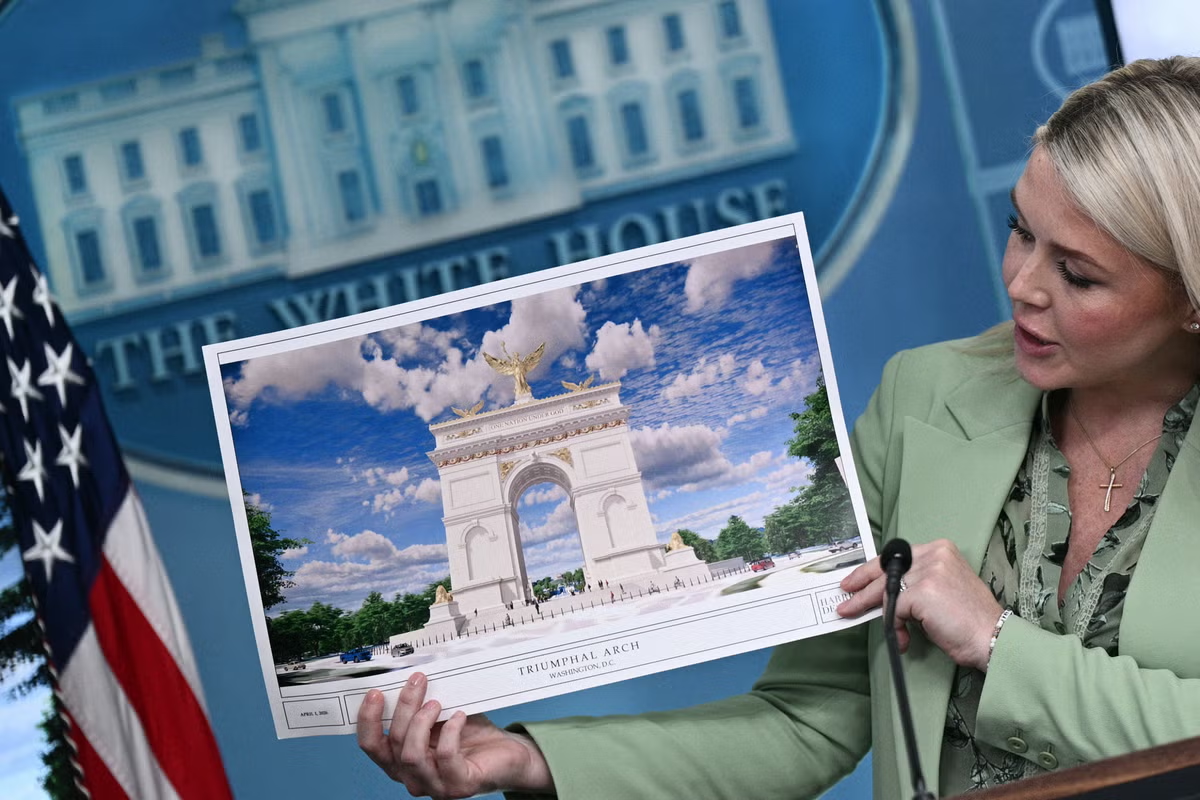
President Donald Trump’s team is trying to push his giant Triumphal Arch through the approval process by arguing for a new interpretation of a long-standing Washington, D.C., law that limits the heights of buildings.
The Height of Buildings Act, passed in 1910, generally prohibits buildings taller than 130 feet in the nation’s capital. But Trump’s team has argued the law does not apply to federal buildings as they push for a federal commission to approve his plans for the 250-foot arch.
Trump’s Interior Department wrote a memo to the National Capital Planning Commission arguing that Congress “did not intend for the law to apply to federal buildings.”
The commission – which is led by a Trump appointee – is expected to consider that argument Thursday afternoon during an open meeting.
But the National Capital Planning Commission has historically ruled that the law applies to federal buildings, and its position has been consistent since 1938, according to a staff memo published ahead of Thursday’s meeting. The memo also recommends commissioners “request the applicant revise the project design to comply with the Height of Buildings Act.”
The Interior Department’s memo cited an 1899 law that exempted federal buildings from height limits. While the Height of Buildings Act repealed all conflicting laws, Trump’s team has argued that the 1899 law’s exception “does not conflict with the [Height of Buildings Act] because the latter does not apply to federal buildings.”
“Rather, the [Height of Buildings Act] is just a local zoning ordinance and does not apply to the United States—a point confirmed by subsequent D.C. zoning ordinances and federal law, which establish different regulatory schemes for local D.C. construction and federal construction in D.C.,” Trump’s team wrote.
If the commission adopts this new theory, it could impact how they approach future projects, The New York Times reports.
“If this new theory were to be adopted, according to NCPC’s own staff memo, it would be inconsistent with the decisions made by NCPC. since its creation,” Tom Mayes, the chief legal officer and general counsel for the National Trust for Historic Preservation, told the newspaper.
When reached for comment, White House spokesperson Davis Ingle said Trump’s Triumphal Arch “is going to be one of the most iconic landmarks not only in Washington, D.C., but throughout the world.”
“It will enhance the visitor experience at Arlington National Cemetery for veterans, the families of the fallen, and all Americans alike, serving as a visual reminder of the noble sacrifices borne by so many American heroes throughout our 250-year history so we can enjoy our freedoms today. President Trump will continue to honor our veterans and give the greatest Nation on earth — America — the glory it deserves,” Ingle told The Independent
While the Height of Buildings Act generally limits structures to 130 feet, there are some nuances. For instance, some buildings on Pennsylvania Avenue can reach up to 160 feet, while structures in residential areas can’t surpass 90 feet.
Many major landmarks come in under 130 feet, including the Lincoln Memorial (99 feet) and the White House, which is 70 feet tall on its south side and 60 feet tall on its north side. But some iconic Washington structures are still hundreds of feet tall, including the Washington Monument (555 feet) and the U.S. Capitol building (288 feet).