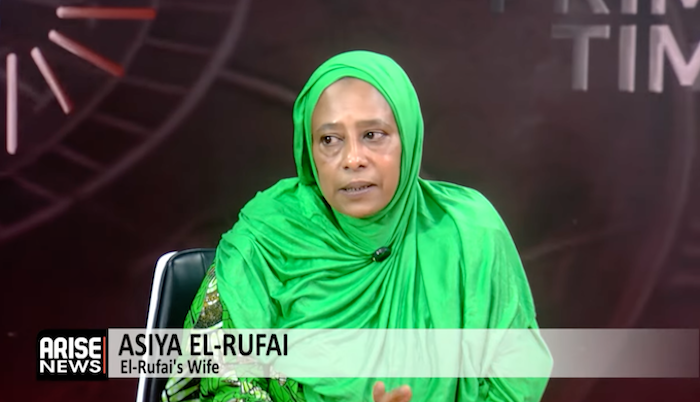
Asiya El-Rufai, a lawyer, discussed the implications of the arrest of her husband’s personal physician, Bello Abubakar, during a recent interview on ARISE NEWS.
Asiya El-Rufai, wife of the former Kaduna State Governor, has warned that the alleged “weaponisation” of healthcare in connection with her husband’s prosecution risks intimidating medical professionals and exacerbating Nigeria’s “brain drain” crisis.
Mrs El-Rufai, a lawyer, made the remarks during an interview on ARISE NEWS while reacting to the arrest of her husband’s personal physician, Bello Abubakar. She argued that the implications of the arrest extend beyond her husband’s ongoing trial, creating a dangerous precedent that could discourage doctors from exercising independent medical judgment.
According to Mrs El-Rufai, physicians should be free to provide care without fear of harassment or intimidation. She warned that such actions could accelerate the exodus of Nigerian health workers seeking better working conditions abroad.
She further stated that although her husband suffers from glaucoma and has received treatment at various clinics, authorities allegedly refused to allow him to consult Mr Abubakar, who has managed his healthcare for decades, dating back to his tenure as Director-General of the former Bureau of Public Enterprises (BPE).
Mrs El-Rufai also rejected allegations that her husband’s recent hospital visit was a pretext for political meetings. She maintained that the visit was strictly for medical consultation and adhered to a court order granting him unfettered access to healthcare.
“The court directive was very clear: he should have unfettered access to healthcare. The ICPC is interpreting the order too narrowly,” she asserted.
She explained that the family scheduled the appointment for 5 p.m. specifically to minimise contact with other patients. Regarding claims that the visit facilitated political meetings, Mrs El-Rufai noted that her husband had no access to a telephone while in custody. She added that any interactions at the hospital were incidental, involving members of the public who recognised her husband as a public figure; these exchanges were open and unplanned.
Mr El-Rufai is currently facing multiple criminal prosecutions. In a case brought by the ICPC, he has pleaded not guilty to allegations bordering on abuse of office, fraud, money laundering, and procurement-related offences.
The anti-corruption agency alleges that, while serving as Kaduna governor, Mr El-Rufai approved a contract for the procurement, survey planning, final design, and installation of a CCTV surveillance system in the Kaduna metropolis at a revised cost of ₦8.68 billion. The ICPC claims the contract was awarded to Singularity Network Security Limited despite the company’s lack of required experience, and that proceeds were subsequently laundered. Mr El-Rufai has denied these allegations.
He is also facing a separate federal prosecution regarding the alleged unlawful interception of telephone communications. PREMIUM TIMES reported on Wednesday that Mr El-Rufai, through his media aide, Muyiwa Adekeye, accused the ICPC of misrepresenting facts regarding the court order and his medical treatment.
Mrs El-Rufai’s comments highlight the ongoing crisis regarding Nigeria’s shortage of healthcare workers. The country has faced a sustained migration of doctors, nurses, and medical professionals to the United Kingdom, Canada, the United States, and Australia in search of improved pay and working conditions. Stakeholders have repeatedly warned that this exodus strains the domestic healthcare system, increases workloads for remaining staff, and limits access to quality care for the public.