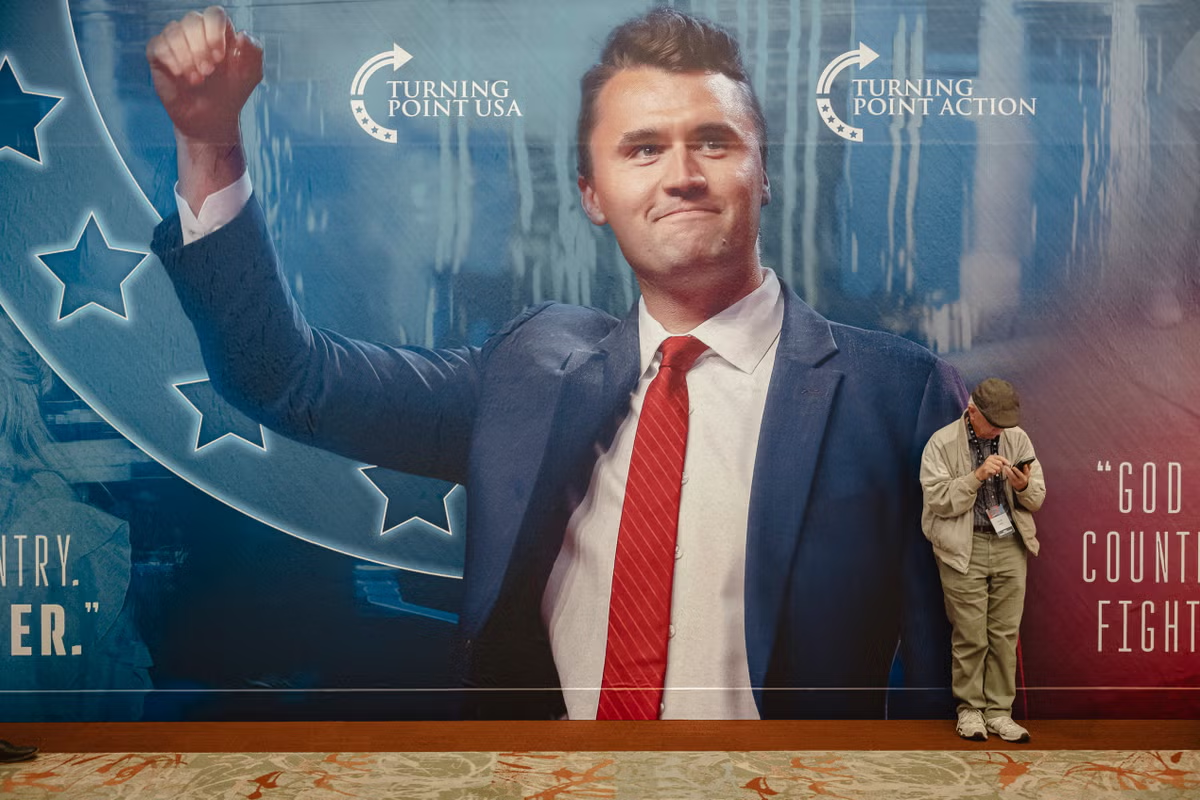
Jurors are expected to hear explosive new evidence Thursday in the case against the man accused of assassinating conservative activist Charlie Kirk, as Utah prosecutors prepare to play edited recordings of police interviews with his roommate and romantic partner.
The recordings from Lance Twiggs come after a judge rejected the defense’s efforts to keep them out of public view, although several portions were ordered removed over concerns that they could prejudice the case.
Tyler Robinson, 23, is charged with aggravated murder and six other counts in Kirk’s Sept. 10, 2025, killing at Utah Valley University. He has not entered a plea, and prosecutors are seeking the death penalty.
Defense attorneys argued prosecutors would portray Twiggs’ statements as confessions, potentially tainting future jurors if the recordings were widely broadcast.
“We are very concerned that the publication of what the state will call confessions at trial violates Mr. Robinson’s due process rights,” defense attorney Richard Novak told the court.
Judge Tony Graf ordered prosecutors to remove portions of the recordings but said he will review the interviews in full when deciding whether there is enough evidence to send Robinson to trial.
Twiggs, who has not been charged, was interviewed by investigators two days after the shooting and again in April after receiving immunity, meaning his statements cannot be used against him in a future criminal case.
The recordings are expected to be a key part of the preliminary hearing, which marks the first major public airing of the prosecution’s evidence.
Prosecutors allege Robinson confessed before and after the shooting in messages to Twiggs. Court filings say Robinson left a note stating: “I had the opportunity to take out Charlie Kirk and I’m going to take it.”
They also allege Robinson later texted Twiggs that he targeted Kirk because he had “enough of his hatred,” adding: “Some hate can’t be negotiated out.”
Prosecutors argue the messages show Robinson targeted Kirk because of his conservative political views. The defense disputes that characterization and has sought to limit evidence of an alleged political motive, arguing it could influence the death penalty phase if Robinson is convicted.
Investigators allege Robinson climbed onto a rooftop overlooking Kirk’s appearance at Utah Valley University and fired a single shot through the activist’s neck as he answered questions before a crowd of thousands. Kirk, a prominent ally of President Donald Trump credited with energizing young conservative voters, died after being taken to a hospital.
Police later recovered what investigators say was the murder weapon—a bolt-action rifle with one spent casing—wrapped in a towel in a wooded area near the scene.
Earlier this week, Robinson’s attorneys challenged DNA evidence linking him to the rifle and towel, arguing FBI testing could not conclusively identify him as the source of the DNA.
Defense attorney Michael Burt questioned the reliability of the testing, arguing the analyst “can’t match Mr. Robinson to the questioned samples.”
Prosecutors countered with testimony from forensic science expert Lawrence Quarino, who said the DNA testing methods used by law enforcement are “extremely reliable.”
“DNA testing is the gold standard in forensic science,” Quarino testified.
The hearing has also reignited debate over transparency in the high-profile case.
Attorneys representing Kirk’s family and several media organizations argued the recordings should be played publicly rather than behind closed doors.
“To not be transparent, to not be open and let the world see what happened will create doubt and distrust in the judicial system,” attorney Jeffrey Neiman, representing Kirk’s family, told the court.
Graf has indicated he is unlikely to rule immediately on whether Robinson will stand trial, saying he plans to carefully review all of the evidence presented during the weeklong hearing before making his decision.